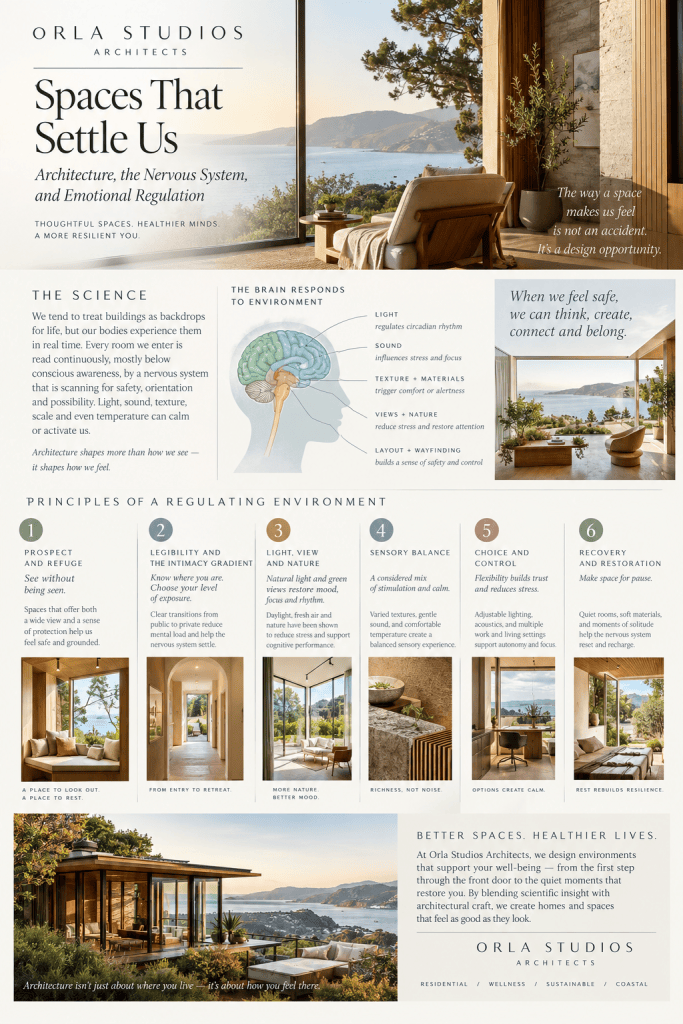
We tend to treat buildings as backdrops for life, but the body doesn’t experience them that way. Every room we enter is read continuously, mostly below conscious awareness, by a nervous system that is scanning for safety, orientation, and possibility. A low, dim corridor with no visible exit feels different in the chest than a high, daylit room with a view out. Architects and scholars have long intuited this, and neuroscience is now beginning to describe the mechanisms.
This article draws on architectural theorists and on the scientists they increasingly work with. It also marks where the evidence is strong and where it is still speculative.
The Body as the Measure of Architecture
The most important shift in recent architectural thought is the move away from treating buildings as visual objects and toward treating them as bodily experiences. The Finnish architect and theorist Juhani Pallasmaa argues in The Eyes of the Skin (1996) that modern architecture has been dominated by vision at the expense of the other senses. He proposes that we perceive architecture with the whole body: touch, sound, smell, temperature, and the muscular sense of moving through space. In his view, a building that engages only the eye leaves us feeling detached, while one that engages the full sensory body makes us feel grounded and “at home.”
Peter Zumthor makes a similar case in Atmospheres (2006). He describes the emotional impact of a space as arising from material presence, sound, temperature, and the “tension between interior and exterior,” and he lists these among the things he attends to when designing. Zumthor is writing as a practitioner rather than a scientist, but his observations about how people respond to rooms anticipate much of what researchers now test.
Harry Francis Mallgrave, an architectural historian, gives this intuition a scientific frame in The Architect’s Brain (2010) and Architecture and Embodiment (2013). Drawing on embodied cognition and neuroscience, he argues that perception is inseparable from action and bodily state. The environment doesn’t merely inform the mind; it participates in shaping emotion and thought. The collection Mind in Architecture (2015), edited by Sarah Robinson and Pallasmaa, gathers architects and neuroscientists around the same idea.
What “Regulation” Means in Spatial Terms
Emotional regulation is partly cognitive, but it rests on physiological regulation: heart rate, breathing, muscle tension, and the balance between sympathetic arousal (mobilization) and parasympathetic calm (rest and recovery). Environments can push this balance in either direction. A noisy, glaring, unpredictable space tends to keep us alert and taxed. A space that offers legibility, comfort, and sensory ease lets the system down-shift.
A caution is warranted here. Popular writing often leans on Stephen Porges’s polyvagal theory to explain how rooms “signal safety.” That theory is influential in clinical circles but disputed among physiologists, so it is better treated as a useful metaphor than as settled mechanism. The more robust evidence comes from environmental psychology and neuroscience, discussed below.
Principles of a Regulating Environment
1. Prospect and refuge: seeing without being seen
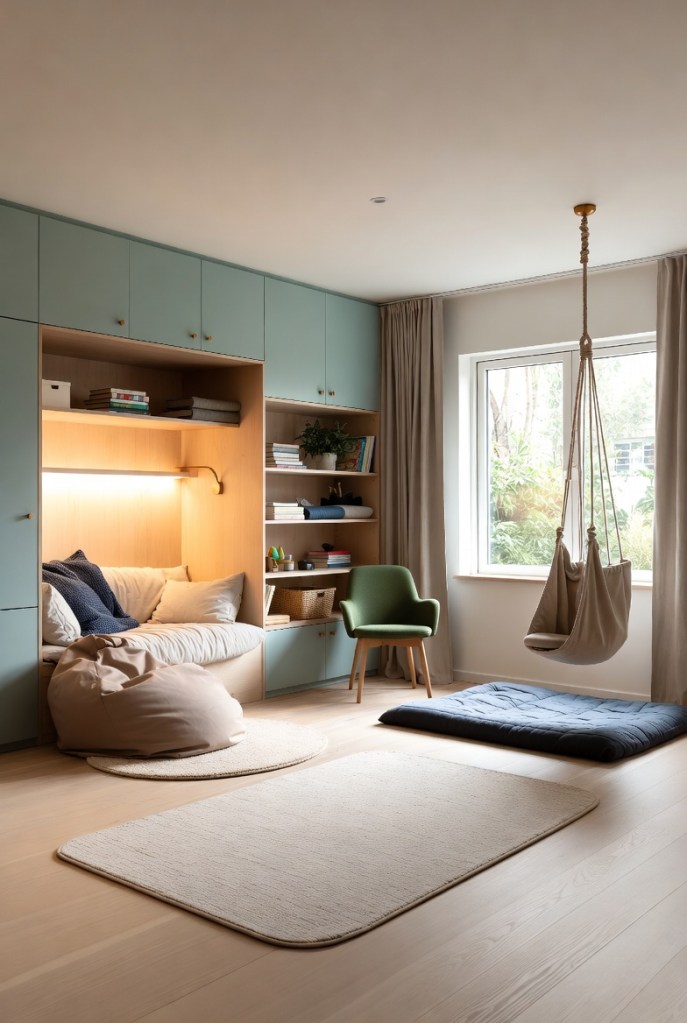
The geographer Jay Appleton proposed in The Experience of Landscape (1975) that people prefer places that offer both prospect (a wide view) and refuge (a protected position). This feels like an evolutionary hypothesis, and it has been widely adopted in architecture. Christopher Alexander’s A Pattern Language (1977) encodes the same instinct in patterns such as “Window Place” and “Alcoves,” which describe built-in spots where a person can sit sheltered yet look out. A reading nook in a bay window, a deep porch, or a booth along a wall all give the body a place to rest its vigilance.
2. Legibility and the intimacy gradient
Alexander’s “Intimacy Gradient” pattern holds that a building should move from public to private in graded steps, so that people always know where they are and can choose their level of exposure. Nervous systems tire in spaces where thresholds are ambiguous or where one is abruptly exposed. Clear sequences of entry, transition, and retreat reduce the low-level work of orientation. Steen Eiler Rasmussen’s classic Experiencing Architecture (1959) makes a related point about how rhythm, scale, and proportion make a space readable to the moving body.
3. Light, view, and nature
Alexander’s “Light on Two Sides of Every Room” captures an intuition that has since been supported empirically: daylight and varied illumination affect mood and circadian rhythm. The best-known evidence for nature views comes from Roger Ulrich’s 1984 study in Science, which found that surgical patients with a window view of trees recovered somewhat faster and used less pain medication than those facing a brick wall. Stephen Kellert’s Biophilic Design (2008) builds on E. O. Wilson’s biophilia hypothesis to argue that daylight, plants, natural materials, and organic patterns support wellbeing. The Kaplans’ attention restoration theory adds that natural settings help recover depleted attention. These findings are credible, though effect sizes vary and many studies are small.
4. Proportion, ceiling height, and form
Some experimental findings are intriguing, but should be held loosely. Meyers-Levy and Zhu (2007) found that ceiling height influenced the style of thinking people used, with high ceilings favoring abstract, relational thought and low ceilings favoring detail-focused thought. Vartanian and colleagues (2013, PNAS) found that people tended to rate curvilinear interiors as more beautiful and showed different brain responses than to angular ones. Reviews such as Coburn, Vartanian, and Chatterjee (2017) caution that the field is young and that context matters enormously. A low ceiling is cozy in an alcove and oppressive in a lecture hall.
5. Sound and silence
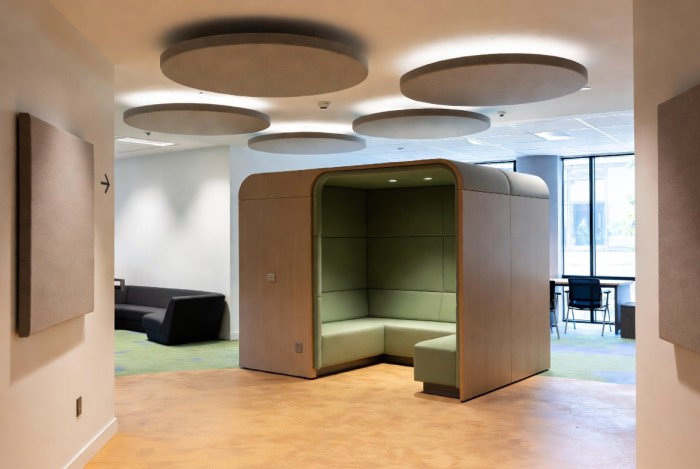
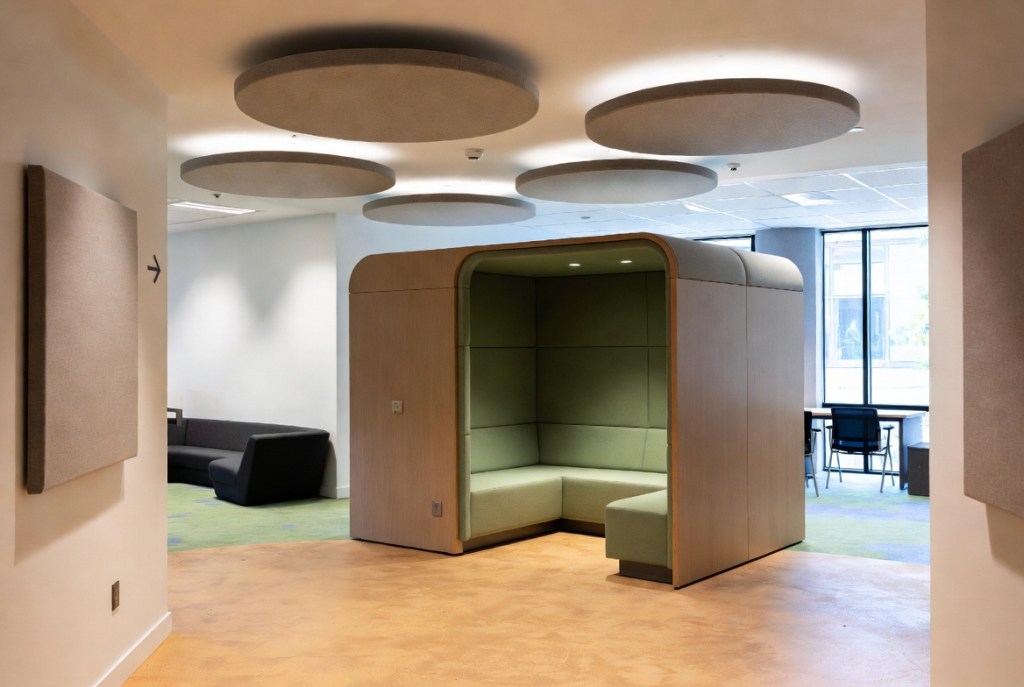
Pallasmaa notes that hearing structures our sense of spatial depth and intimacy, and that silence is itself an architectural material. Barry Blesser and Linda-Ruth Salter’s Spaces Speak, Are You Listening? (2007) develops the idea of “aural architecture.” Chronic noise is a well-documented stressor, and hard, reverberant surfaces make environments harder to process, especially for people with sensory sensitivities. Acoustic softness (textiles, wood, absorptive ceilings) is one of the cheapest and most effective regulating interventions.
6. Materials and touch
Warm, tactile materials such as wood, stone, and lime plaster invite contact and carry the traces of time and making. Pallasmaa contrasts these with flat, glossy, synthetic surfaces that offer the hand nothing. Gaston Bachelard’s philosophical classic The Poetics of Space (1958) explores how corners, nests, and thresholds carry deep emotional associations of shelter, which designers can honor through enclosure and material warmth.
7. Personal space and control
Edward T. Hall’s The Hidden Dimension (1966) introduced proxemics, showing that people carry culturally shaped zones of personal space and become stressed when these are violated. A regulating space gives occupants control: the ability to adjust light, open a window, close a door, move a chair, or withdraw. Perceived control is itself a powerful buffer against stress.
Neurodiversity and Designing for Sensory Difference
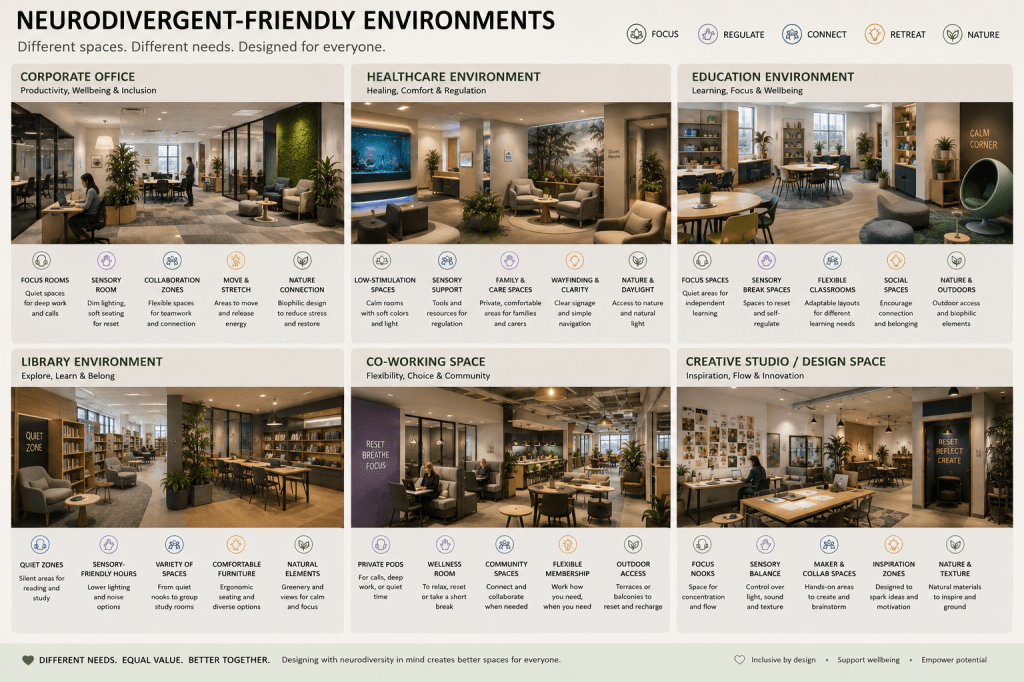
Regulation needs differ. Autistic people, people with ADHD, and those with trauma histories or sensory processing differences may find ordinary environments overwhelming. Magda Mostafa’s Autism ASPECTSS design index translates this into concrete criteria: acoustics, spatial sequencing, escape spaces, compartmentalization, transitions, sensory zoning, and safety. Her work shows that designing for the most sensitive users often improves the space for everyone, and it reinforces the value of offering choice among calmer and more stimulating zones.
Historical Precedents
The idea that buildings can heal is not new. Alvar Aalto’s Paimio Sanatorium (1929–33) was designed around the patient’s experience: daylit rooms, sun terraces, calming colors, quiet fixtures, and even specially angled washbasins to dampen the sound of running water. The Academy of Neuroscience for Architecture, founded in 2003 in association with the Salk Institute, formalized the collaboration between designers and neuroscientists. Esther Sternberg’s Healing Spaces (2009) surveys the science linking environments, stress, and health from a physician-researcher’s perspective.
Practical Takeaways
For architects and for anyone shaping their own home, the literature converges on a handful of principles. Provide places of refuge with a view outward. Make circulation legible and offer graded transitions between public and private. Bring in daylight, natural views, and natural materials. Manage acoustics deliberately. Offer variety, so people can choose between bright and dim, open and enclosed, social and solitary. And give occupants control over their immediate environment. None of this requires large budgets. A well-placed chair, a rug that softens sound, or a window seat can matter more than a grand gesture.
Limits and Honest Caveats
It would be a mistake to claim architecture “causes” emotional regulation in any simple way. Individual differences, culture, and personal history shape how we respond to a place. Many findings come from small or lab-based studies, and some popular claims outrun the data. Architecture is best understood as a supportive condition rather than a treatment: it can lower the baseline load on the nervous system and make regulation easier, while therapy, relationships, sleep, and community do much of the actual work.
Conclusion
The thread running from Alexander and Pallasmaa to Mallgrave and contemporary neuroscience is that buildings are not neutral. They are continuously in conversation with our bodies. Designing with the nervous system in mind means attending to the whole sensory person: how a room sounds, how light moves across a wall, where one can sit with one’s back protected, how easy it is to find the way out. A space that respects these things lets people exhale.
Selected References
Alexander, C., Ishikawa, S., & Silverstein, M. (1977). A Pattern Language. Oxford University Press.
Appleton, J. (1975). The Experience of Landscape. Wiley.
Bachelard, G. (1958/1994). The Poetics of Space. Beacon Press.
Blesser, B., & Salter, L.-R. (2007). Spaces Speak, Are You Listening? MIT Press.
Coburn, A., Vartanian, O., & Chatterjee, A. (2017). Buildings, beauty, and the brain. Journal of Cognitive Neuroscience, 29(9).
Hall, E. T. (1966). The Hidden Dimension. Doubleday.
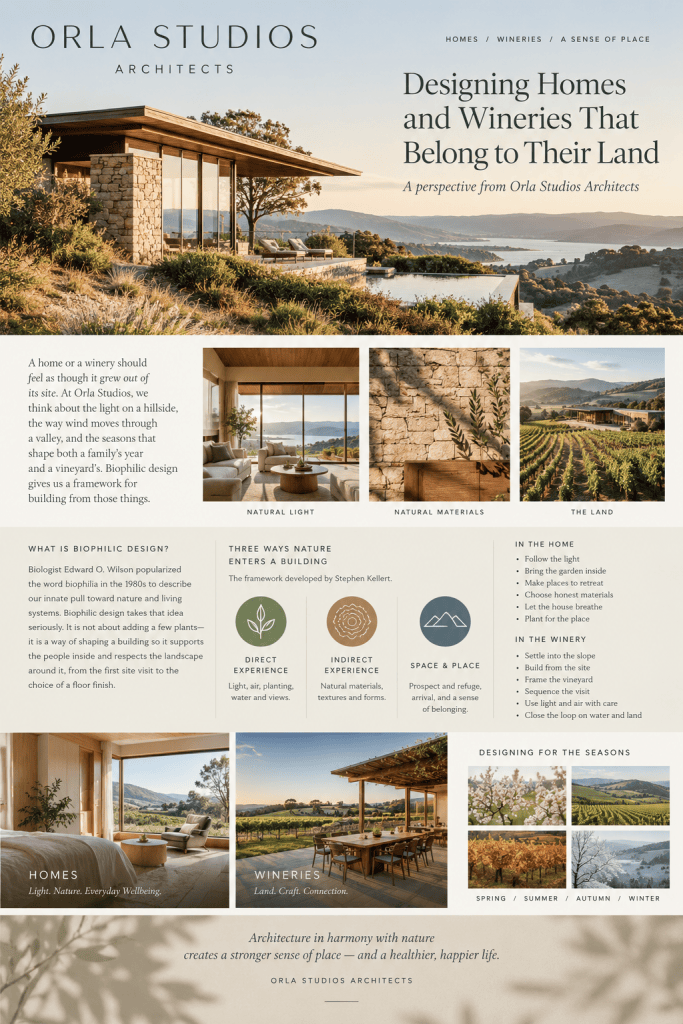
A home or a winery should feel as though it grew out of its site. At Orla Studios, we think about the light on a hillside, the way wind moves through a valley, and the seasons that shape both a family’s year and a vineyard’s. Biophilic design gives us a framework for building from those things, and a surprising amount of research and architectural thought stands behind it.
What biophilic design means
The word biophilia, “love of life,” was first used by psychoanalyst Erich Fromm in the 1960s. Biologist Edward O. Wilson popularized it in the 1980s as the biophilia hypothesis: the idea that humans have an innate tendency to seek connection with nature and other living systems. Wilson argued that because we evolved in natural settings, our minds and bodies still respond to them.
Biophilic design applies that idea to buildings. It is not about adding a few potted plants. It is a way of shaping rooms, materials, views and landscapes so they answer a need people have always had. For us, that starts on the first site visit and continues down to the choice of a floor finish.
The ideas behind the practice
Biophilic architecture draws on several overlapping theories from psychology, environmental science, design and philosophy. No single one explains everything, but together they shape how we make decisions.
The biophilia hypothesis and Kellert’s nine values. In 1993, Wilson and social ecologist Stephen Kellert edited The Biophilia Hypothesis, which brought together scholars from many fields. Kellert went on to describe nine values through which people relate to nature, among them aesthetic, symbolic, utilitarian and ecological-scientific. Later, with Judith Heerwagen and Martin Mador, he turned the theory into a design method in Biophilic Design (2008), and in Nature by Design (2018) he refined it into three categories: direct experience of nature, indirect experience of nature, and experience of space and place.
Stress Reduction Theory. Environmental psychologist Roger Ulrich proposed that natural scenes help us recover from stress because we evolved to find certain landscapes safe and restorative. His best-known study, published in 1984, followed patients recovering from surgery. Those whose windows looked onto trees tended to have shorter hospital stays and need less pain medication than those facing a brick wall. The study was small, but it launched decades of research into healing environments.
Attention Restoration Theory. Rachel and Stephen Kaplan argued that modern life demands constant, effortful concentration, and that nature restores our focus through what they called soft fascination: gentle stimulation, such as moving leaves, water or clouds, that holds attention without draining it. They identified qualities that make a setting restorative, including a sense of being away, a feeling of extent or richness, and compatibility with what we want to do there. A reading room facing a garden, or a winery terrace over vine rows, is soft fascination put into a plan.
Prospect and Refuge Theory. Geographer Jay Appleton proposed in 1975 that we prefer places where we can see without being seen: wide views paired with a sheltered position behind us. He tied this to the survival advantage of watching for opportunity and danger from a protected spot. Related ideas, such as the savanna hypothesis, suggest we may favor open landscapes with scattered trees, though that claim is debated. Window seats, deep porches, cellar thresholds and hillside terraces all draw on this thinking.
Fractals and natural patterns. Physicist Richard Taylor has studied the fractal patterns found in trees, clouds, coastlines and foliage, in which similar shapes repeat at different scales. His work suggests that people often find moderately complex fractal patterns calming, which he links to the way our visual system evolved. Architectural theorist Nikos Salingaros has made a related argument for ornament, structure and detail that offer visual richness at many scales, from a building’s massing down to the grain of a timber beam.
Pattern language. Architect Christopher Alexander’s A Pattern Language (1977) catalogued recurring design solutions, many rooted in human comfort and nature: window places, sheltering roofs, gardens, and paths that unfold slowly. Though not labeled biophilic at the time, his patterns strongly influence today’s biophilic thinking.
Organic architecture. Long before the term biophilia reached architecture, Frank Lloyd Wright described organic architecture, the idea that a building should belong to its site and grow from it. His Fallingwater, built over a waterfall, is the classic example. Alvar Aalto and Antoni Gaudí likewise worked with natural forms and materials. The language differs from the scientific literature, but the aim is shared.
Genius loci and critical regionalism. Architectural theorist Christian Norberg-Schulz revived the Roman idea of genius loci, the spirit of a place, arguing that architecture should respond to a site’s character. Kenneth Frampton’s critical regionalism similarly urges buildings to draw on local climate, materials, topography and tradition rather than imposing a universal style. For a winery, this runs parallel to the idea of terroir: the building, like the wine, should be recognizably of its place.
Phenomenology and the senses. Finnish architect Juhani Pallasmaa, in The Eyes of the Skin (1996), criticized architecture that serves the eye alone and called for buildings that engage touch, sound, smell, temperature and the movement of the body. Biophilic design shares this concern: the cool of a stone cellar, the smell of oak, the sound of water in a courtyard and the shift of light through a day all matter as much as appearance.
Design with nature, biomimicry and regenerative design. Landscape architect Ian McHarg’s Design with Nature (1969) argued for planning that begins with a site’s ecology. Janine Benyus’s Biomimicry (1997) asked designers to learn from how organisms solve problems, such as passive cooling inspired by termite mounds. More recent regenerative design goes further, aiming for buildings that improve their surroundings rather than merely reducing harm. Frameworks like the Living Building Challenge include a dedicated biophilic requirement.
Patterns of biophilic design. In 2014, the consultancy Terrapin Bright Green published 14 Patterns of Biophilic Design, a practical translation of the research into three groups: nature in the space (plants, water, light, airflow), natural analogues (natural materials, patterns and forms), and nature of the space (prospect, refuge, mystery and risk or peril). It has become a common reference for architects and clients.
Three ways nature enters a building
Drawing on these theories, we organize our work around Kellert’s three categories.
Direct experience of nature means real contact with the natural world: daylight, fresh air, planting, water and views. In a home, that might be a courtyard garden, a kitchen that opens onto an herb bed, or windows that open to catch a breeze. In a winery, it is a terrace looking straight down the vine rows.
Indirect experience of nature uses materials and forms that echo the natural world. Local stone, timber, lime plaster and clay bring texture and warmth, and shapes inspired by ridgelines, leaves or vine rows can inform a roofline or a plan.
Experience of space and place is the subtlest. It includes prospect and refuge, the sense of arrival, the path that reveals a view slowly, and the feeling that a building belongs to its region and culture.
In the home
A house is where biophilic design is felt most often, because we live inside it every day.
Following the light. We study the sun’s path across the site so that morning light finds the kitchen, soft light reaches workspaces, and evening glow settles where the family gathers.
Bringing the garden into the plan. Rooms that wrap a courtyard or open onto a terrace make greenery part of the daily route through the house, offering the soft fascination the Kaplans described.
Making places to retreat. A window seat, a deep porch or a reading nook gives a view outward while feeling protected behind, in the spirit of prospect and refuge.
Choosing honest materials. Timber, stone and natural fibres age well and engage the senses, as Pallasmaa urged. They give a home a calm, lived-in quality that synthetic finishes rarely match.
Layering detail at every scale. Natural grain, varied textures and considered joinery provide the kind of visual richness that fractal research suggests we find restful.
Letting the house breathe. Cross-ventilation, shading and thermal mass keep rooms comfortable and reduce the need for mechanical cooling.
Planting for the place. Native and drought-tolerant species need little water, support pollinators and change with the seasons.
In the winery
A winery already depends on soil, sun, weather and time. Biophilic design lets the building share that logic, so a visit feels like part of the landscape instead of a stop beside it.
Settling into the slope. Cellars set into or sheltered by the hillside use the earth’s steady temperatures and keep the building low against the vines, much as organic architecture would advise.
Building from the site. Rammed earth, local stone and regional timber express genius loci and critical regionalism, tying the architecture to the vineyard’s geology while giving barrel halls natural thermal mass.
Framing the vineyard. Tasting rooms and terraces are placed to frame rows, ridgelines and sky, with shaded seating that draws guests outdoors and invites a slower pace.
Sequencing the visit. Guests might move from open fields through a threshold, down into the cool, dim cellar and back up into daylight. This uses the pattern of mystery and revelation, and echoes the journey of the wine itself.
Engaging every sense. The smell of oak and fermenting fruit, the sound of footsteps on stone, the temperature drop on descending to the cellar: these multisensory moments are central to a memorable visit.
Using light and air with care. Clerestories and shaded openings bring in soft light where it helps, while passive ventilation and stack effect cool production areas.
Closing the loop on water and land. Rainwater harvesting, reed-bed treatment of process water and planting between buildings reduce demand and support local ecology, in the spirit of regenerative design.
Designing for the seasons
Homes and wineries both live through a yearly cycle, and we design so that every season has something to offer. Spring brings blossom and bud break seen from kitchen windows. Summer calls for deep eaves, shaded courtyards and thick walls that hold the heat at bay. Harvest asks for working areas that are efficient and bright, with sheltered places for gathering. Winter lets low sun reach deep into rooms, with warm materials and views of bare branches and rain.
Why it matters, and what we don’t claim
Research has linked views of greenery, daylight and natural materials with lower stress, better mood and improved attention. The practical benefits are easier to point to: good daylighting reduces electric lighting, shading and natural ventilation cut cooling loads, and planted landscapes help manage stormwater. Biophilic design often overlaps with sustainable design, though the two are not the same, since a building can be energy efficient and still feel sterile.
It is also worth being candid about the limits. Much of the evidence comes from small or observational studies, some theories (the savanna hypothesis among them) remain debated, and preferences vary with culture, age and personal history. We treat these ideas as a well-informed starting point rather than a formula, and we avoid promising measurable gains in wellbeing or productivity.
Starting with the land
Every project we take on begins with the site: its slope, soil, climate, views and history. From there, we design a house or winery that makes the most of what is already there. If you are planning a home or a winery and want it to feel connected to its setting, we would be glad to hear about your land and your plans.
Designing the Home Around the Habits That Help Us Thrive
What if one of the most important wellness technologies in our lives is not a device, supplement, or fitness program—but the home itself?
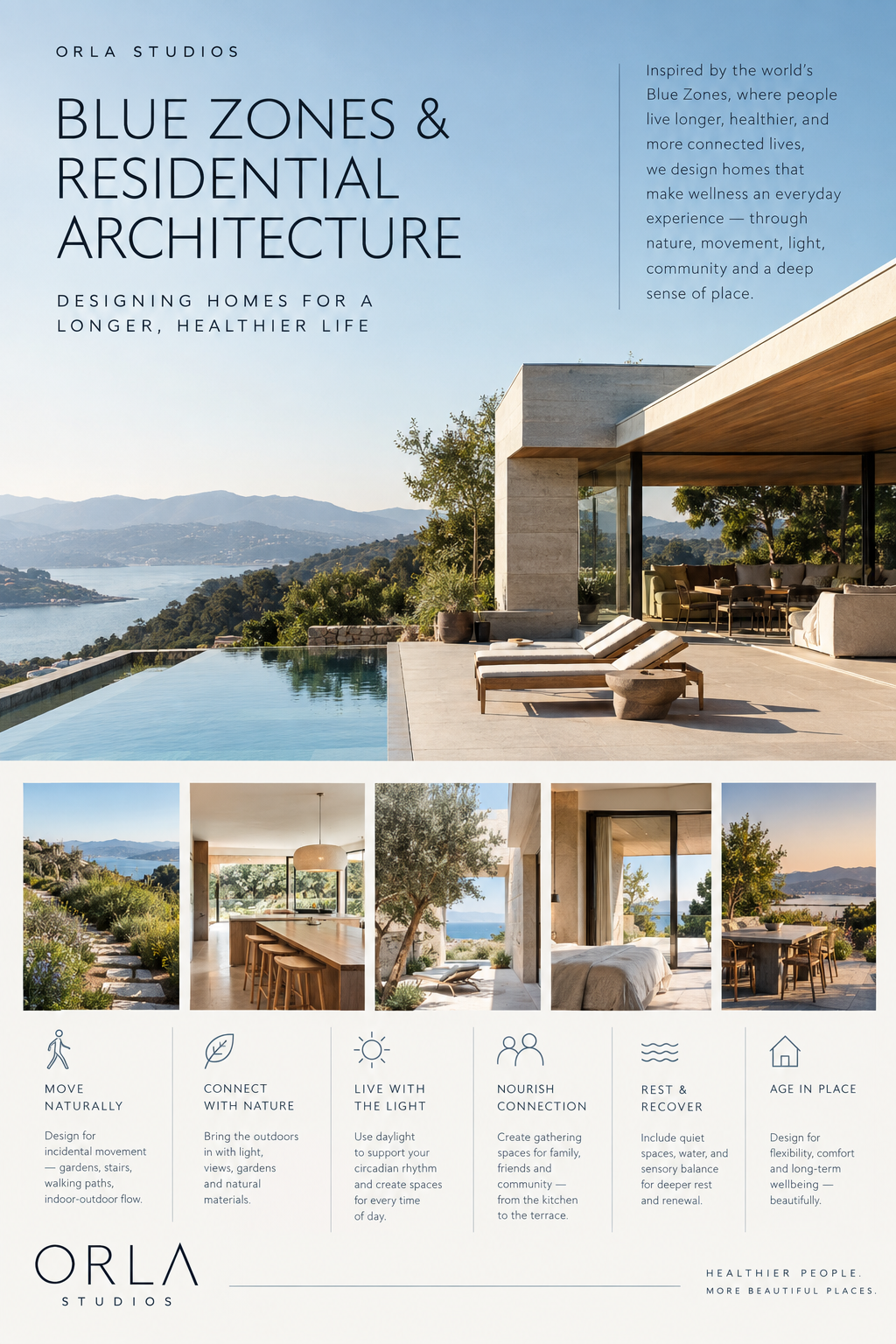
Across several regions of the world known for unusually high rates of longevity, researchers have identified patterns in the way people live, move, eat, socialize, rest, and connect with their surroundings. These places, often referred to as Blue Zones, have inspired a broader conversation about longevity and the environments that support a healthy, meaningful life.
For architects, the most interesting question is not simply where people live longer. It is:
How can residential architecture make the healthiest parts of daily life feel natural, beautiful, and effortless?
At Orla Studios, we believe wellness architecture begins with this idea: a home should support the way people actually want to live—not simply provide space for life to happen.
The Architecture of Everyday Movement
Blue Zones research has highlighted a distinctive form of physical activity: rather than relying exclusively on structured exercise, people often move naturally throughout the day.
They walk. They garden. They cook. They climb stairs. They work outdoors. They move between neighbors and family members.
Residential architecture can encourage this kind of incidental movement.
A home can be organized so that everyday destinations are connected by a sequence of spaces rather than a single efficient corridor. A garden might be reached by a short walk through a courtyard. The kitchen can open directly onto an outdoor dining terrace. A bedroom can connect to a morning garden or balcony. Stairs can become a beautiful architectural feature rather than something hidden away.
The objective is not to make a house feel like a gym.
It is to make movement part of living.
Designing for Movement
Connected indoor and outdoor spaces
Gardens and courtyards that invite exploration
Beautiful, visible stairways
Multiple routes through the home
Outdoor kitchens and dining areas
Walkable connections between house, garden, pool, and landscape
Comfortable places to pause along circulation paths
In a luxury residence, these strategies can be particularly powerful because they transform movement into an experience.
A morning walk through a landscaped courtyard can become part of the architecture of the day.
Nature as a Daily Ritual
Many Blue Zone communities have a close relationship with the natural environment.
This relationship does not necessarily require spectacular views or remote landscapes. It can be as simple as sunlight entering the kitchen in the morning, herbs growing outside the back door, or a shaded place to sit beneath a tree.
Architecture can strengthen these relationships.
Rather than treating landscape as decoration surrounding the house, the landscape can become part of the living environment itself.
Large openings can frame gardens like living artwork. Covered terraces can extend the usable season. Courtyards can bring vegetation into the center of a plan. Operable doors and windows can allow residents to experience changing temperatures, sounds, scents, and daylight.
For homes in California, this connection can be especially meaningful.
The architecture can respond to the landscape rather than compete with it—opening toward redwoods, hillsides, vineyards, gardens, or the Pacific while providing moments of enclosure and refuge.
Light, Circadian Rhythm & the Architecture of Time
Wellness is not only about what a house contains. It is also about how the house changes throughout the day.
Natural light is one of the most important environmental signals affecting our daily rhythms. A thoughtfully designed residence can use daylight as an architectural material, creating a subtle progression from bright morning light to warmer, quieter evening environments.
Morning spaces might receive direct eastern light.
Living spaces can be oriented toward changing daylight throughout the afternoon.
Bedrooms can be designed to become darker and quieter at night.
Artificial lighting can then complement—not compete with—the natural rhythm of the day.
This creates a home that feels different at 7 a.m. than it does at 7 p.m.
That changing sensory experience can make the passage of time perceptible and reinforce daily rituals of waking, working, gathering, relaxing, and sleeping.
The Kitchen as the Heart of Wellness
Food is another important component of longevity-oriented lifestyles.
But healthy eating is not simply about selecting the right ingredients. It is also about how food is prepared, shared, and experienced.
Residential architecture can make cooking and eating social activities rather than isolated tasks.
A kitchen designed around conversation can allow the person preparing dinner to remain connected with family and guests. A garden directly outside the kitchen can make growing herbs, vegetables, and fruit more accessible. Dining areas can overlook gardens or terraces rather than being separated from them.
Even storage can influence behavior.
Fresh foods can be made visible and accessible. Cooking tools can be organized around the way the kitchen is actually used. Pantry and refrigerator layouts can support preparation rather than conceal it.
The result is a kitchen designed not merely as a room for cooking, but as a social and sensory center of the home.
Designing for Connection
One of the most compelling lessons associated with Blue Zones is the importance of social connection.
Architecture has always influenced social behavior.
A house with a series of isolated rooms creates a different social experience from one organized around shared spaces, visual connections, courtyards, terraces, and gathering places.
The answer is not to eliminate privacy.
Instead, successful residential architecture can provide a gradient between solitude and connection.
A person might move from a private bedroom to a quiet sitting area, then into a shared living space, and finally outdoors to a larger gathering terrace.
This creates choice.
You can be alone without being isolated.
You can participate without being in the center of the activity.
And you can move naturally between different levels of social engagement.
Spaces That Encourage Connection
Kitchens designed around conversation
Dining rooms connected to gardens or terraces
Outdoor gathering spaces
Fireplaces and intimate sitting areas
Courtyards that become social centers
Guest spaces that provide both independence and connection
Flexible rooms that can adapt to different generations and activities
A beautiful house does not simply accommodate relationships.
It can help relationships happen.
The Importance of Belonging
Longevity is not only a biological question.
It is also deeply connected to meaning, identity, belonging, and purpose.
Residential architecture can reinforce these qualities by giving people places to practice the rituals that make their lives meaningful.
A workshop for making things.
A library for reading.
A garden for cultivating plants.
A dining table large enough for extended family.
A quiet room for meditation or reflection.
A porch where neighbors can stop and talk.
A guest suite that allows multiple generations to remain connected.
These spaces may not appear on a conventional list of “wellness amenities,” yet they can be among the most important spaces in a home.
Wellness architecture is not about adding more features. It is about creating environments that support a richer life.
Designing for Aging in Place
The Blue Zones conversation also raises an important architectural question:
Can a beautiful home continue to serve its residents as their lives change?
Longevity means more than living longer. It means having a home capable of evolving with us.
Universal design strategies can be incorporated discreetly into luxury residential architecture from the beginning.
Zero-step entries, generous circulation, carefully designed bathrooms, well-positioned lighting, adaptable rooms, comfortable stair proportions, and provisions for future mobility needs can be integrated without making a home feel institutional.
The best accessibility is often the accessibility you barely notice.
A generous doorway can feel elegant.
A curbless shower can feel luxurious.
A well-designed stair can be both sculptural and comfortable.
A home prepared for changing needs can remain beautiful throughout decades of life.
Recovery, Quiet & the Need to Do Less
Modern wellness culture sometimes focuses heavily on activity.
But restoration is equally important.
A healthy home should provide places where nothing is required of you.
A shaded garden bench.
A window seat.
A quiet bedroom.
A reading room.
A warm bath.
A covered terrace listening to rain.
These spaces create opportunities for recovery from the sensory and cognitive demands of contemporary life.
At Orla Studios, we think of this as designing a sensory gradient—moving between active and quiet environments, social and private spaces, bright and subdued light, openness and enclosure.
The home becomes a landscape of different experiences.
Water, Bathing & Restorative Rituals
Water has long been associated with restoration, ritual, and relaxation.
In contemporary residential architecture, pools, spas, outdoor showers, soaking tubs, and cold-plunge environments can be integrated into the architecture and landscape rather than treated as separate amenities.
A pool can become the visual center of a courtyard.
An outdoor shower can connect bathing with a garden.
A soaking tub can become part of a private retreat.
A Sauna and cold plunge can be a morning or evening ritual.
A wellness space can open toward natural light and vegetation.
The important distinction is between a collection of wellness features and a home designed around wellness rituals.
The latter is much more powerful.
A Home Designed Around Human Behavior
Perhaps the most useful lesson from Blue Zones for architects is that longevity is not created by a single architectural intervention.
There is no “Blue Zone house.”
Instead, there are patterns.
Movement.
Nature.
Social connection.
Healthy food.
Rest.
Purpose.
Community.
Daily rituals.
Architecture can support these behaviors by making them easier, more pleasurable, and more integrated into everyday life.
A stair placed where it naturally becomes part of circulation.
A garden visible from the kitchen.
A terrace positioned for evening conversation.
A bedroom oriented toward morning light.
A quiet room separated from the busiest areas of the house.
A kitchen that invites people to gather.
A courtyard that becomes a natural meeting place.
Individually, these decisions may seem small.
Together, they can fundamentally change how a home is experienced.
Beyond the Wellness Amenity
The future of wellness architecture may have less to do with adding specialized rooms and more to do with reconsidering the architecture of ordinary life.
Instead of asking:
Where should we put the gym?
We can ask:
How can the house encourage movement?
Instead of:
Where should we put the meditation room?
We can ask:
Where can someone naturally find quiet?
Instead of:
How do we create a wellness retreat?
We can ask:
How can the entire home become restorative?
This shift—from wellness as an amenity to wellness as an underlying architectural strategy—is where residential design becomes especially interesting.
The Orla Studios Approach
At Orla Studios, we see wellness architecture as an opportunity to create homes that are not only beautiful, but deeply responsive to the people who inhabit them.
Our approach considers the relationship between light, landscape, movement, materiality, acoustics, privacy, social connection, indoor-outdoor living, and the changing rhythms of daily life.
For a coastal California residence, that might mean opening a home toward the landscape while creating sheltered places for retreat.
For a hillside property, it might mean turning circulation into a journey through gardens and terraces.
For a multigenerational home, it might mean creating both connection and independence.
For a contemporary residence, it might mean using daylight, natural materials, planting, water, and carefully sequenced spaces to create a sense of calm.
The goal is not to imitate a village in Okinawa or a Mediterranean island.
It is to understand the deeper principles behind environments where people have traditionally lived active, connected, purposeful lives—and translate those principles into a distinctly contemporary home.
Designing for a Longer Life—and a Better One
The most compelling idea behind Blue Zones may ultimately be very simple:
A long life is made up of ordinary days.
Architecture has the extraordinary ability to shape those days.
The walk from the bedroom to the garden.
The morning light across the kitchen.
The conversation around the dining table.
The vegetables growing outside.
The afternoon spent reading beneath a tree.
The evening swim.
The quiet moment before sleep.
These are not separate wellness programs.
They are life.
And perhaps the most meaningful form of wellness architecture is simply the art of designing a home that helps us experience more of it.
At Orla Studios, we believe the healthiest homes are not those that ask us to change our lives—but those that quietly make living well feel natural.
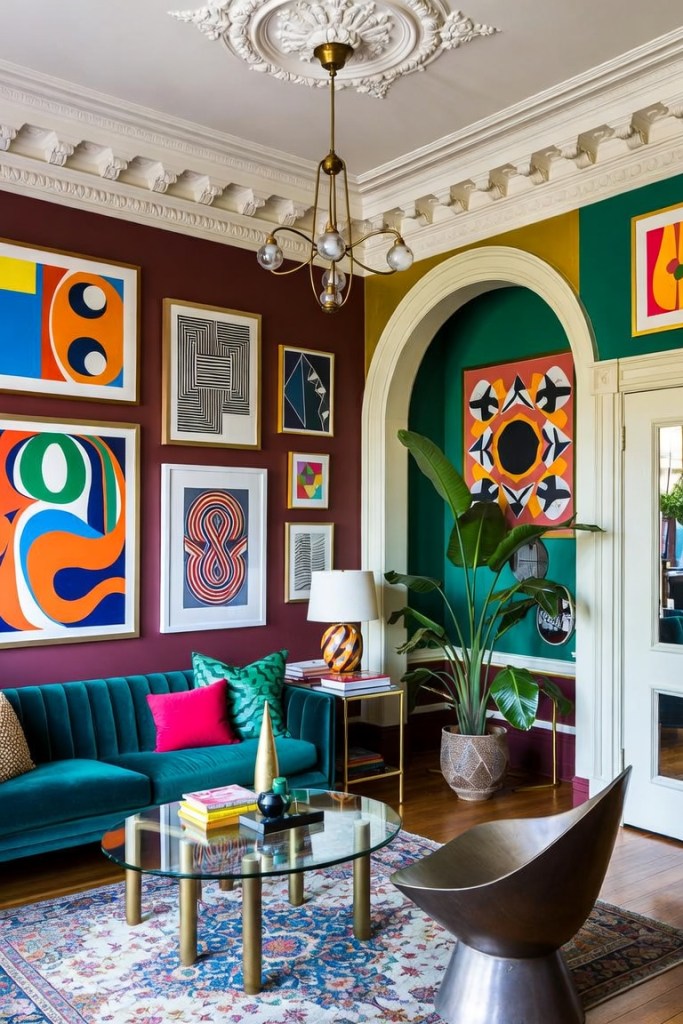
Maximalist interiors work differently. They are rooms with a pulse: layered, colorful, and full of the things their owners care about. Maximalism has become one of newest movements in home design because it treats a home as a portrait of the people who live there.
What maximalist design is
Maximalism is a philosophy of abundance. It embraces rich color, mixed patterns, dense collections, and the belief that a room should feel full of life rather than emptied of it. Where minimalism asks “what can I remove?”, maximalism asks “what else do I love?”
That question is what separates a maximalist room from a cluttered one. The best maximalist spaces are curated with care. Colors echo across the room, favorite pieces get their moment, and the whole thing hangs together with rhythm and intention. It is a lot, but it’s a lot on purpose.
A tradition worth celebrating
Maximalism has deep roots. Baroque and Rococo interiors covered walls and ceilings in gilding, paint, and ornament. Victorian parlors were filled with curios, textiles, and treasures from around the world. Mughal palaces glowed with inlaid stone and jewel-toned color. For much of history, a richly layered home was simply what a beautiful home looked like.
The twentieth century brought the modernist mantra “less is more,” and minimalism ruled for decades. But designers kept the maximalist spirit alive. In 1966, architect Robert Venturi answered modernism with a cheerful “less is a bore.” In 1980, Ettore Sottsass and the Memphis Group in Milan began producing furniture in bold colors, playful shapes, and wild laminates that made rooms feel like celebrations. That energy never really went away, and today it is back in full color.
Why it’s flourishing now
Homes now do a great deal. They are offices, gyms, cinemas, and gathering places, and many people want spaces that lift their mood in return. Designers have picked up on this with ideas like “dopamine decor,” which is the simple notion that surrounding yourself with colors and objects you love makes you feel good. A vivid green wall, a gallery wall of mismatched frames, or a velvet sofa in deep magenta can change how a room feels every time you walk in.
There is also a real appetite for individuality. In a world of matching showrooms and identical rental apartments, a maximalist home says someone specific lives here. It is a way to make a space unmistakably your own.
Personality, story, and sustainability
The most rewarding maximalist homes are built slowly, and that makes them naturally sustainable. A grandmother’s vase, a flea-market armchair, a rug from a trip, and a vintage lamp rescued from a thrift store all find a place because maximalism values character and history over uniform newness. Nothing has to match, so almost anything can belong. Each piece carries a story, and together they make a home that feels lived in and loved, and that is hard to replicate by ordering a room in one afternoon.
Room by room: bringing maximalism home
Living rooms are the natural stage. Try a bold sofa, layered rugs, a gallery wall, and a mix of lamp light at different heights for warmth.
Bedrooms can be cocoons of color: a saturated wall, patterned bedding layered with textures, and art hung right up to the ceiling.
Kitchens and dining rooms welcome open shelves of colorful dishes, patterned tile, and statement lighting, since they’re already places for abundance.
Bathrooms and small spaces are perfect for experimenting. A dramatic wallpaper or a jewel-toned paint color in a powder room is a low-risk way to start.
Principles for doing it well
Choose a thread. A recurring color, motif, or material lets very different pieces feel related.
Vary the scale. Mix bold statement pieces with small, intricate details so the eye has places to land and places to explore.
Layer texture. Velvet, linen, wood, brass, and ceramic add depth that flat color can’t.
Start with what you love. Build outward from a favorite painting, rug, or heirloom instead of a trend.
Give it time. The most beautiful maximalist rooms feel collected over years, and that’s part of the pleasure.
Leave a little breathing room. A calm surface or two makes the richness around it feel deliberate.
The takeaway
Maximalism invites you to stop worrying about whether your home looks “correct” and start asking whether it feels like you. It rewards curiosity, generosity, and a willingness to let color, pattern, and personal treasures share the same room. Minimalism suits people who find peace in emptiness, but many of us find joy in abundance. Whether you begin with one bold wallpaper or a full room of layered color, a maximalist home offers a place that feels warm, alive, and yours.
Rooms With a Pulse: The Joy of Maximalist Interior Design
Some rooms are easy to admire and hard to love. They are tidy, tasteful, and quiet, and they could belong to anyone. Maximalist interiors work the other way. They are rooms with a pulse: layered, colorful, and full of the things their owners care about. Maximalism has become one of the most exciting movements in home design because it treats a home as a portrait of the people who live there.
What maximalist design is
Maximalism is a philosophy of abundance. It embraces rich color, mixed patterns, dense collections, and the belief that a room should feel full of life rather than emptied of it. Where minimalism asks “what can I remove?”, maximalism asks “what else do I love?”
That question is what separates a maximalist room from a cluttered one. The best maximalist spaces are curated with care. Colors echo across the room, favorite pieces get their moment, and the whole thing hangs together with rhythm and intention. It is a lot, but it’s a lot on purpose.
A tradition worth celebrating
Maximalism has deep roots. Baroque and Rococo interiors covered walls and ceilings in gilding, paint, and ornament. Victorian parlors were filled with curios, textiles, and treasures from around the world. Mughal palaces glowed with inlaid stone and jewel-toned color. For much of history, a richly layered home was simply what a beautiful home looked like.
The twentieth century brought the modernist mantra “less is more,” and minimalism ruled for decades. But designers kept the maximalist spirit alive. In 1966, architect Robert Venturi answered modernism with a cheerful “less is a bore.” In 1980, Ettore Sottsass and the Memphis Group in Milan began producing furniture in bold colors, playful shapes, and wild laminates that made rooms feel like celebrations. That energy never really went away, and today it is back in full color.
Why it’s flourishing now
Homes now do a great deal. They are offices, gyms, cinemas, and gathering places, and many people want spaces that lift their mood in return. Designers have picked up on this with ideas like “dopamine decor,” which is the simple notion that surrounding yourself with colors and objects you love makes you feel good. A vivid green wall, a gallery wall of mismatched frames, or a velvet sofa in deep magenta can change how a room feels every time you walk in.
There is also a real appetite for individuality. In a world of matching showrooms and identical rental apartments, a maximalist home says someone specific lives here. It is a way to make a space unmistakably your own.
Personality, story, and sustainability
The most rewarding maximalist homes are built slowly, and that makes them naturally sustainable. A grandmother’s vase, a flea-market armchair, a rug from a trip, and a vintage lamp rescued from a thrift store all find a place because maximalism values character and history over uniform newness. Nothing has to match, so almost anything can belong. Each piece carries a story, and together they make a home that feels lived in and loved, and that is hard to replicate by ordering a room in one afternoon.
Room by room: bringing maximalism home
Living rooms are the natural stage. Try a bold sofa, layered rugs, a gallery wall, and a mix of lamp light at different heights for warmth.
Bedrooms can be cocoons of color: a saturated wall, patterned bedding layered with textures, and art hung right up to the ceiling.
Kitchens and dining rooms welcome open shelves of colorful dishes, patterned tile, and statement lighting, since they’re already places for abundance.
Bathrooms and small spaces are perfect for experimenting. A dramatic wallpaper or a jewel-toned paint color in a powder room is a low-risk way to start.
Principles for doing it well
Choose a thread. A recurring color, motif, or material lets very different pieces feel related.
Vary the scale. Mix bold statement pieces with small, intricate details so the eye has places to land and places to explore.
Layer texture. Velvet, linen, wood, brass, and ceramic add depth that flat color can’t.
Start with what you love. Build outward from a favorite painting, rug, or heirloom instead of a trend.
Give it time. The most beautiful maximalist rooms feel collected over years, and that’s part of the pleasure.
Leave a little breathing room. A calm surface or two makes the richness around it feel deliberate.
Maximalism invites you to stop worrying about whether your home looks “correct” and start asking whether it feels like you. It rewards curiosity, generosity, and a willingness to let color, pattern, and personal treasures share the same room. Minimalism suits people who find peace in emptiness, but many of us find joy in abundance. Whether you begin with one bold wallpaper or a full room of layered color, a maximalist home offers a place that feels warm, alive, and yours.
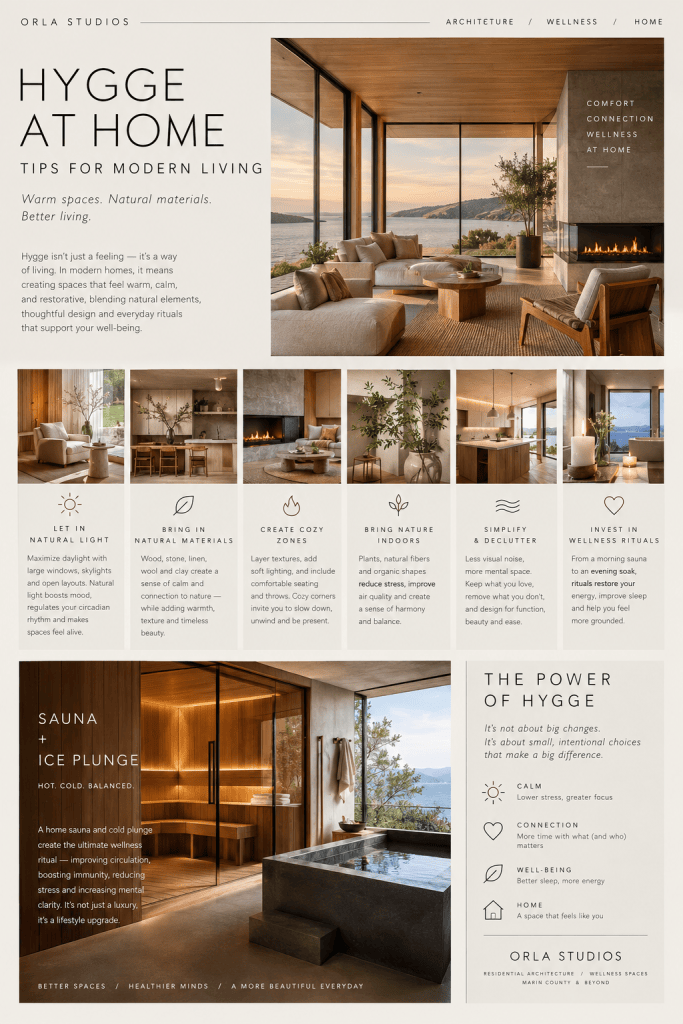
Hygge (pronounced roughly “hoo-ga”) is a Danish concept that resists a tidy English translation. It’s often described as a feeling of cozy contentment — candlelight, warm blankets, slow mornings, and the simple pleasure of being present in a comfortable space. It emerged from a climate of long, dark winters, where the home became a refuge from the cold.
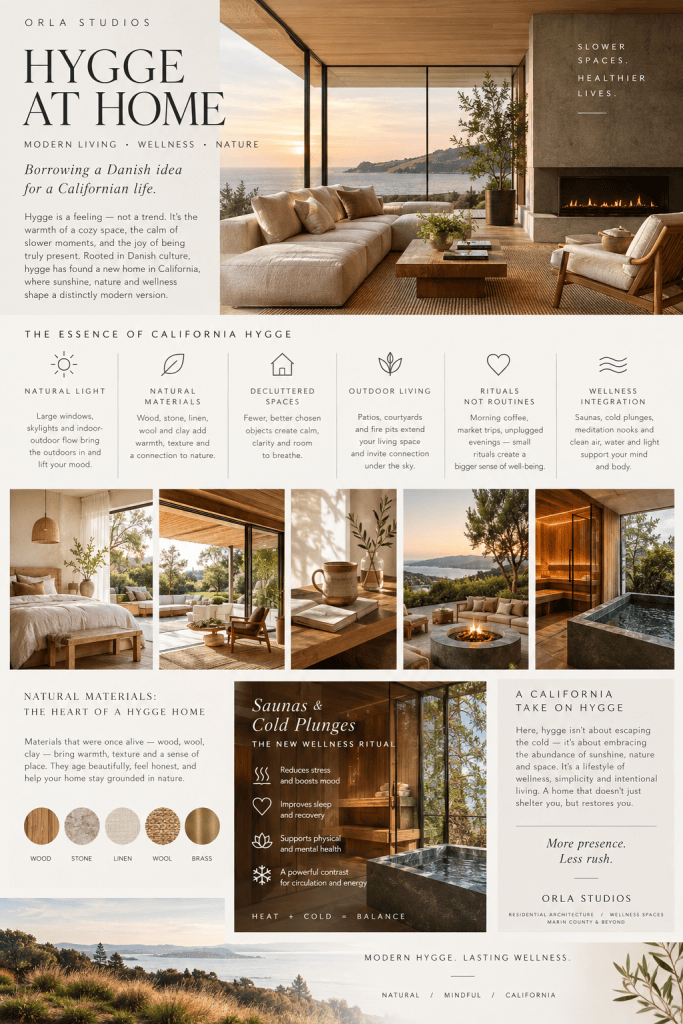
California couldn’t be more different in climate — sunshine, mild winters, and an outdoor-oriented lifestyle define much of the state. Yet hygge has found an enthusiastic audience here, reshaped into something distinctly Californian: a design philosophy centered on wellness, simplicity, and intentional living, rather than shelter from harsh weather.
Why Hygge Resonates in a Wellness-Obsessed State
California has long been at the forefront of the wellness movement — yoga studios on every corner, farm-to-table dining, meditation apps, and a cultural emphasis on work-life balance (however imperfectly achieved). Hygge fits naturally into this ethos because it isn’t about acquiring more; it’s about creating an atmosphere that supports rest, connection, and mental clarity.
For many Californians juggling long commutes, demanding tech and entertainment industries, and a fast pace of life, the home has become a deliberate counterbalance — a place engineered for slowing down.
What Hygge Looks Like in a California Home
1. Natural Light and Indoor-Outdoor Flow
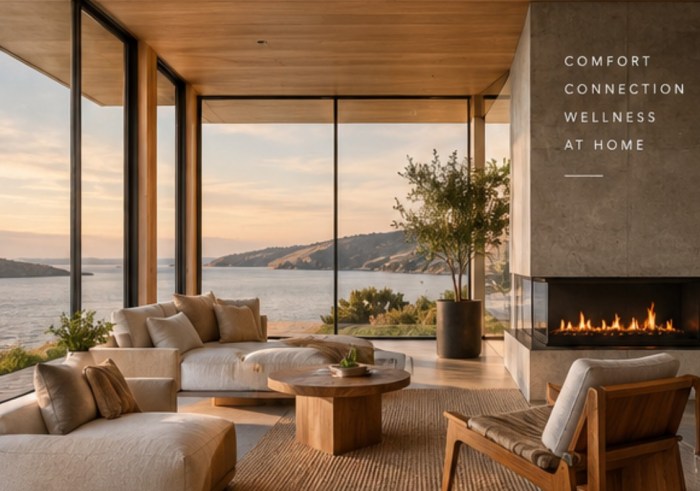
California’s abundant sunshine is a built-in advantage. Large windows, sliding glass doors, and open floor plans blur the line between indoor and outdoor spaces. Where Danish hygge might rely on candlelight to combat darkness, California hygge leans into natural light, skylights, and views of gardens, patios, or hillsides.
2. Warm, Textured Materials
Even in warmer climates, texture matters. Chunky knit throws, sheepskin rugs, linen bedding, and reclaimed wood furniture add tactile warmth without requiring heavy insulation. These materials create a sense of comfort that doesn’t depend on temperature.
3. Neutral, Calming Palettes
Soft whites, warm beiges, sage greens, and terracotta tones dominate California-hygge interiors. These colors echo the state’s coastal and desert landscapes while promoting a sense of calm — a nod to biophilic design principles that link nature-inspired environments to reduced stress.
4. Decluttered, Intentional Spaces
Minimalism and hygge overlap significantly. A California hygge home isn’t sparse or cold — it’s curated. Fewer, better-chosen objects: a well-loved ceramic mug, a stack of books, a single thriving houseplant. The goal is a space that feels calm rather than cluttered.
5. Outdoor Living as an Extension of Home
Patios, courtyards, and backyard fire pits play the role that a cozy living room might play in Denmark. Outdoor lounge areas, string lights, and comfortable seating extend the hygge feeling beyond four walls, taking advantage of California’s mild evenings.
6. Rituals Over Rigid Routines
Hygge isn’t just aesthetic — it’s behavioral. Morning coffee on the porch, a weekend farmers’ market trip, unplugged evenings with family or friends. These small rituals matter as much as the furniture, reinforcing presence and connection.
Natural Materials: Grounding the Home in Nature
Material choice is one of the quietest but most powerful ways hygge shows up in a California home. Rather than polished, synthetic surfaces, natural-material homes lean on elements that age well and connect the senses to the outdoors:
Wood — white oak floors, cedar ceiling beams, and reclaimed timber furniture bring warmth and visual texture. Wood is often left unfinished or lightly treated so its grain stays visible.
Stone and clay — limestone countertops, plaster walls, and terracotta tile echo the region’s coastal and desert landscapes while adding a tactile, earthy feel.
Natural fibers — linen curtains, wool rugs, jute baskets, and organic cotton bedding replace synthetic textiles, softening a space without adding visual clutter.
Living elements — houseplants, dried florals, and small indoor gardens reinforce the biophilic link between nature and calm.
The philosophy here is that materials should feel honest — a home built from things that were once alive (wood, wool, clay) tends to feel warmer and more grounding than one built from plastic, laminate, or glossy finishes, even if the latter looks sleek.
Saunas and Cold Plunges: The New Wellness Ritual
If hygge is about creating rituals of comfort and presence, saunas and cold plunges have become one of the most visible ways California homeowners are building wellness directly into their houses. What started as a niche fitness trend has moved firmly into residential design.
Home Saunas
Traditional Finnish-style saunas use dry heat (typically 150–195°F) generated by a wood-burning or electric stove, often layered with cedar or hemlock benching for its aroma and moisture resistance.
Infrared saunas have grown popular in smaller California homes because they require less space, lower electrical draw, and gentler heat, using infrared panels to warm the body directly rather than the surrounding air.
Many homeowners are converting garages, backyard sheds, or unused corners of a patio into freestanding sauna spaces, often paired with outdoor showers.
Aesthetically, home saunas tend to follow the same natural-material palette as the rest of a hygge-inspired house: unfinished wood, soft lighting, and minimal, uncluttered interiors.
Cold Plunge Pools
Cold plunges are typically chilled to somewhere between 39–55°F and are used for short immersions (often a few minutes) following exercise or a sauna session.
Options range from simple large tubs and repurposed stock tanks to purpose-built plunge pools with chillers and filtration systems.
The contrast ritual — alternating between sauna heat and cold plunge — has become a popular backyard wellness routine, drawing on Nordic and Scandinavian bathing traditions that pair naturally with the hygge aesthetic.
Why This Fits the Hygge-Wellness Model
Saunas and cold plunges are, in a sense, a physical version of hygge’s core idea: creating a dedicated ritual and space that forces a pause from daily life. They combine:
Structured slowness — a sauna session can’t be rushed, and a cold plunge demands full presence in the moment.
Sensory comfort — natural wood, warm light, and the physical sensation of heat or cold ground people in their bodies.
Social or solitary use — like a cozy living room, a sauna can be a shared gathering space or a quiet solo retreat.
Designers are increasingly building these features into new home plans rather than treating them as afterthoughts, positioning outdoor wellness rooms alongside patios, gardens, and pools as core parts of a home’s “restoration zone.”
The Wellness Connection
Wellness and hygge intersect most clearly in their shared rejection of hustle culture. Both philosophies suggest that health isn’t only about diet and exercise — it’s also about environment. A home that feels safe, warm, and unhurried can lower stress, improve sleep, and support emotional wellbeing.
Architects and interior designers across California have taken note. Wellness-focused developments increasingly include:
Circadian lighting systems that mimic natural daylight cycles
Air and water filtration systems for cleaner indoor environments
Meditation nooks or quiet rooms separate from high-traffic areas
Biophilic elements like living walls, natural wood, and stone
These features align with hygge’s core value: a home shouldn’t just look good — it should feel good to be in.
A Uniquely Californian Interpretation
What makes California hygge distinct isn’t a rejection of the original Danish concept but a regional translation of it. Where Danish hygge often centers around fighting off winter darkness with warmth and light, Californian hygge celebrates abundance — of sunshine, space, and access to nature — while still prioritizing comfort, slowness, and human connection.
In a state known for innovation and speed, hygge offers something quietly countercultural: permission to pause. Whether it’s a modern bungalow in Los Angeles with sun-drenched reading nooks, a Bay Area home with a fog-watching porch, or a desert retreat in Palm Springs designed around stargazing evenings, the throughline is the same — home as a place of restoration, not just residence.
Muted, warm neutrals — sand, oatmeal, soft grey, occasional deep charcoal, almost no saturated color Raw, tactile materials — oiled oak, travertine, linen, wool, unlacquered brass Low, horizontal furniture — chairs and sofas that sit close to the ground, emphasizing calm sightlines Diffuse natural light — often through sheer curtains or large single-pane windows, rarely harsh Restraint — very few objects per surface, nothing decorative without a function
Hygge in California isn’t a trend confined to Pinterest boards; it reflects a broader cultural shift toward valuing wellbeing over status, and presence over productivity. As more homeowners and designers embrace this philosophy, modern California homes are becoming spaces that do more than shelter their inhabitants — they nurture them.
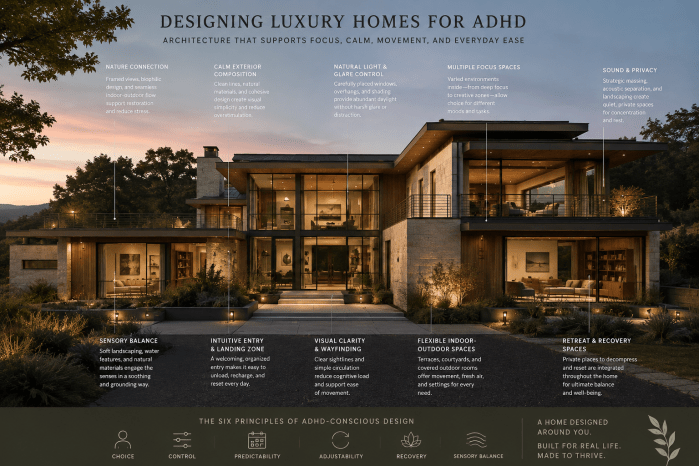
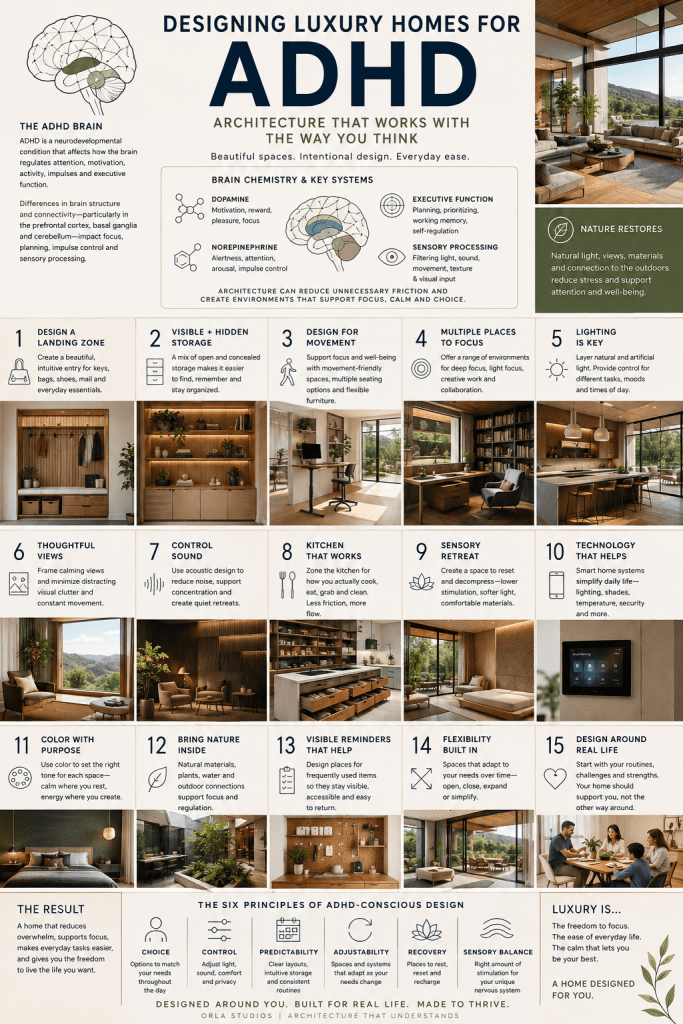
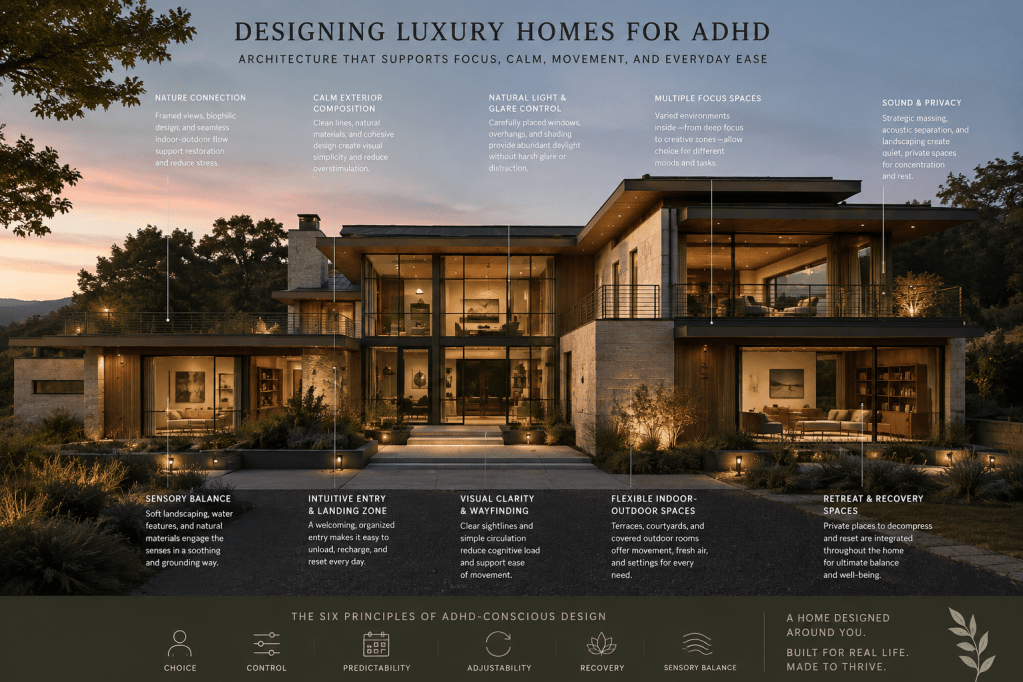
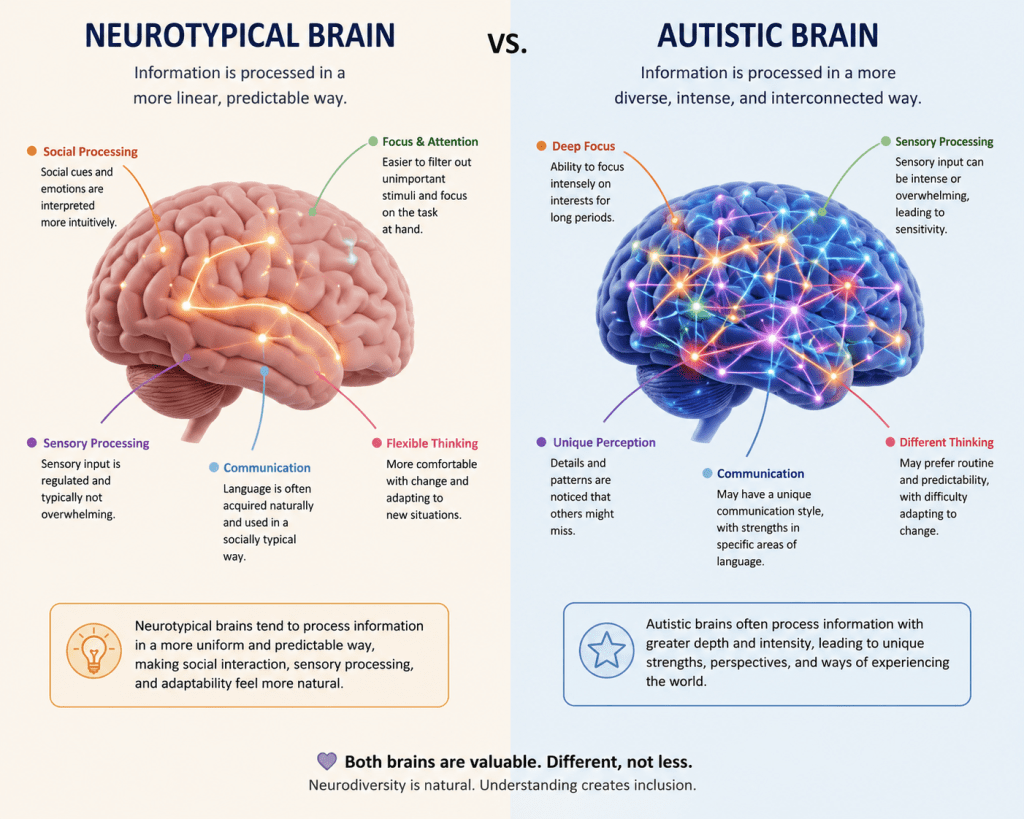
Before designing a home for someone with ADHD, it helps to understand that ADHD is not simply a matter of being distracted, disorganized, or unable to sit still.
ADHD is a neurodevelopmental condition that affects the way the brain regulates attention, motivation, activity, impulses, working memory, and executive functions.
And importantly, ADHD is not one single brain type. It is a highly variable neurological profile. Two people with ADHD can have completely different strengths, challenges, sensory preferences, and ways of interacting with their environment.
What Happens in the ADHD Brain?
Research using brain imaging and other neurological methods has identified differences associated with ADHD in several brain systems, including networks involved in executive function, attention, reward processing, motivation, emotional regulation, and movement.
Some studies have found differences in the development, structure, and connectivity of regions such as the prefrontal cortex, basal ganglia, cerebellum, and related brain networks. These areas are involved in planning, prioritizing, inhibiting impulses, maintaining attention, switching between tasks, and regulating behavior.
Neurotransmitters Matter Too
The differences are subtle and highly variable. ADHD is a different neurodevelopmental pattern.
Two neurotransmitter systems that receive particular attention in ADHD research are dopamine and norepinephrine.
These chemical messengers play important roles in attention, motivation, reward, alertness, and the ability to regulate behavior.
This helps explain one of the most misunderstood characteristics of ADHD:
Attention is not necessarily absent. It can be difficult to regulate.
A person with ADHD may struggle to focus on an uninteresting administrative task for 20 minutes, yet become intensely absorbed in a highly engaging architectural project, creative activity, conversation, hobby, or problem.
This is sometimes described as interest-based attention rather than simply a lack of attention.
The environment can therefore have a surprisingly important influence.
Executive Function and the Built Environment
Many of the everyday difficulties associated with ADHD involve executive functions—the mental processes that help us organize and regulate behavior.
These can include:
Starting a task
Prioritizing
Sequencing steps
Remembering intentions
Managing time
Switching between activities
Controlling impulses
Regulating attention
Managing competing sensory information
Completing tasks
Thoughtful architecture can reduce unnecessary cognitive demands.
This is where residential design becomes particularly interesting.
A house can either create hundreds of tiny decisions every day—or quietly eliminate many of them.
Where do the keys go?
Where does the mail go?
Where do shoes belong?
Where should unfinished projects live?
Where can someone work without interruption?
Where can they move while thinking?
Where can they retreat when the house becomes overwhelming?
Where are frequently used objects stored?
The more intuitive these relationships are, the less mental effort is required simply to navigate everyday life.
The ADHD Brain and Reward
Dopamine is often described in popular media as the “pleasure chemical,” but its role is considerably more complicated.
Dopamine is involved in motivation, learning, reward prediction, movement, and the process of determining what deserves our attention.
For some people with ADHD, tasks that are repetitive, delayed in reward, or insufficiently stimulating can be particularly difficult to initiate.
This is one reason novelty, challenge, urgency, interest, and immediate feedback can have such a powerful effect on attention.
Architecture can respond by creating environments that offer choice and variety without chaos.
A home might provide:
A quiet library for deep concentration.
A bright kitchen for active engagement.
A studio for creative work.
A terrace for walking and taking calls.
A cozy retreat for decompression.
The occupant can choose the environment that matches the task.
Why Sensory Input Matters
The brain is constantly filtering information.
Light. Sound. Movement. Texture. Temperature. Visual objects. People moving through a room. Appliances running in the background.
For some people with ADHD, competing sensory information can make it harder to maintain focus or regulate attention.
This does not mean every person with ADHD is hypersensitive to sensory input. ADHD is highly individual, and some people actually seek additional stimulation.
That is why control is more important than uniformity.
Instead of designing every room to be quiet and visually minimal, an architect can create a range of environments:
Low stimulation → moderate stimulation → high stimulation
The occupant can then move between them according to what they need.
From Neuroscience to Architecture
This is where understanding ADHD becomes valuable for residential architecture.
The objective isn’t to make a home look “ADHD-friendly.”
It is to translate an understanding of attention, executive function, sensory processing, motivation, and individual behavior into architectural decisions.
That can mean:
Reducing unnecessary friction.
Making important things visible.
Creating intuitive storage.
Providing multiple places to work.
Allowing movement.
Controlling sound and light.
Creating opportunities for retreat.
Providing environmental choice.
Making technology work quietly in the background.
Designing spaces around real behavior rather than idealized behavior.
In other words, the architecture becomes a form of environmental support.
And that is where designing a home for someone with ADHD becomes much more than an exercise in aesthetics.
It becomes an opportunity to create a home that works with the way their brain naturally operates.
An Architectural Framework for Autism, Asperger’s, AuDHD, ADHD, and Dyslexia
Different Minds. Extraordinary Homes.
20 percent of the US population are neurodivergent: 50 million people.
Designing Homes for Neurodivergent Occupants: Creating Beautiful Spaces That Support the Way People Think, Feel, and Experience the World
Redefining wellness in architecture:
When most people think about an ideal dream home, they imagine soaring ceilings, dramatic staircases, designer finishes, expansive glass walls, and impressive entertaining spaces.
What if wellness in architecture means walking into your home and immediately feeling calm, comfortable, focused, and completely at ease?
For neurodivergent individuals, a home can have an enormous impact on daily life. Light can be overwhelming. Noise can be exhausting. Visual clutter can make it difficult to concentrate. An unpredictable layout can increase anxiety, while a thoughtfully designed environment can improve focus, emotional regulation, creativity, and overall well-being.
Neurodivergence describes natural variations in the way people think, process information, learn, communicate, and experience their environment. This includes people with autism, ADHD, dyslexia, and those with overlapping neurotypes such as AuDHD.
As architects, designers, and homeowners become more aware of neurodiversity, we’re beginning to understand that one-size-fits-all design doesn’t work. Instead, homes should be tailored to the people who live in them.
The good news is that many of the same principles that create exceptional architecture also create neuroinclusive architecture.
The difference is that neuroinclusive design places the human nervous system at the center of the design process.
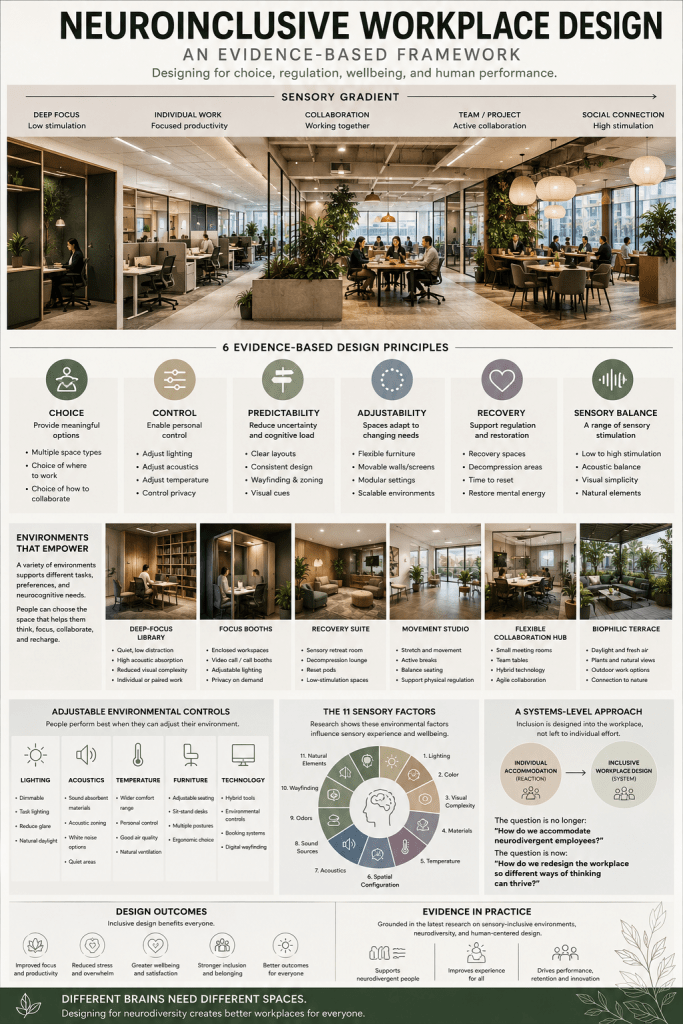
Modern research identifies six key principles that should guide every neuroinclusive environment:
Choice
Control
Predictability
Adjustability
Recovery
Sensory balance
Together, these principles create homes that are not only beautiful but also supportive, restorative, and deeply personal.
The Most Important Factors That Influence Neuroinclusive Residential Design
1. Choosing the Right Site
Great design begins long before the first floor plan is drawn.
The site should feel like a sanctuary. While this description below is an ideal scenario, there are many things that can be done during schematic design to make your home neuro inclusive in any location.
The location of a home may have a greater impact on a neurodivergent person’s daily experience than any interior finish or architectural detail.
Before designing an ideal home, architects should carefully evaluate:
Traffic noise
Flight paths
Nearby schools
Commercial activity
Neighboring properties
Light pollution
Visual distractions
Privacy
For many autistic individuals, environmental noise is one of the most significant sources of stress.
A beautiful home overlooking a busy street may be visually appealing, but if emergency sirens, traffic, and constant movement create sensory overload, thoughtful mitigation is an action item to be considered.
If possible, consider:
Larger lots
Greater setbacks
Landscape buffers
Courtyard homes
Natural screening
Private gardens
2. Creating a Predictable Floor Plan
Many homes are designed around dramatic, open-concept spaces.
While these layouts are impressive, they don’t always support neurodivergent occupants.
People often feel more comfortable when spaces have clear purposes and predictable organization.
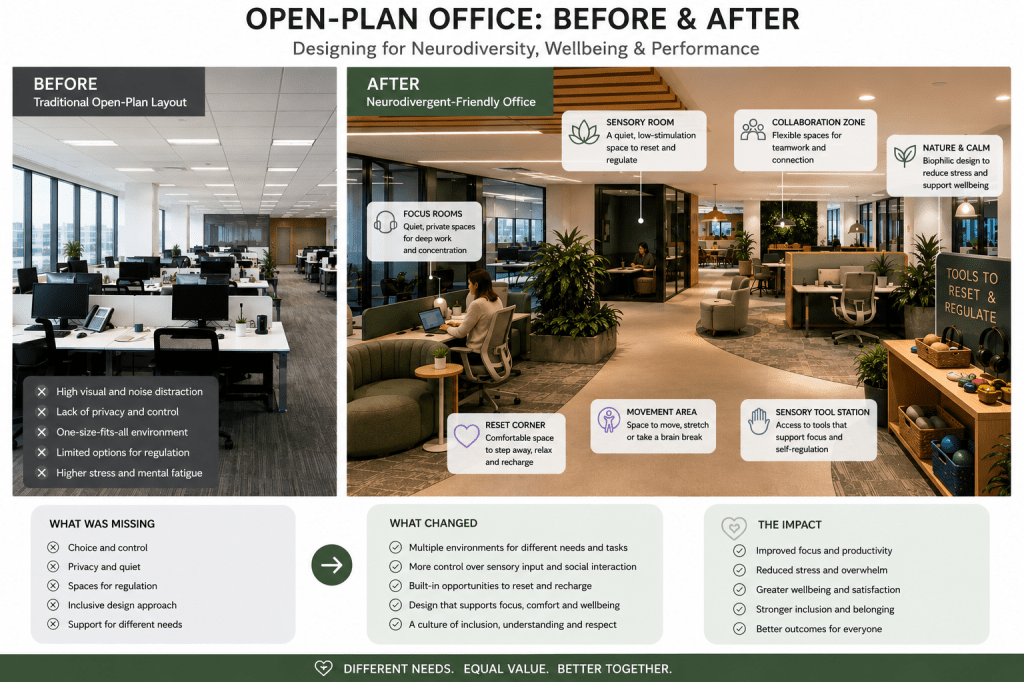
Instead of designing one large, undefined environment, consider dividing the home into zones.
Quiet spaces
These might include:
Bedrooms
Reading rooms
Libraries
Meditation spaces
Active spaces
These might include:
Kitchens
Family rooms
Home offices
Social spaces
These might include:
Dining rooms
Entertainment spaces
Media rooms
Game rooms
Think of the home as a sensory journey.
A resident should be able to move gradually from stimulation to calm rather than being in a single environment that tries to do everything.
3. Designing for Sound
Imagine hearing every conversation, every appliance, every footstep, every air-conditioning unit, and every car outside your window.
For many neurodivergent individuals, this isn’t hypothetical.
It’s everyday life.
Acoustics are often overlooked in residential design, yet they may be one of the most important factors affecting comfort.
Consider incorporating:
Triple-glazed windows in very noisy external environments
Sound-insulated walls
Solid-core doors
Acoustic ceiling treatments
Soft furnishings
Carpets and rugs
Cork flooring
Fabric wall panels
Mechanical systems also deserve special attention.
Luxury should sound quiet.
Architects should consider:
Low-noise HVAC systems
Isolated mechanical rooms
Silent ventilation systems
Vibration-reducing equipment
A peaceful home allows the nervous system to relax.
4. Using Light to Support Well-Being
Light influences far more than visibility.
It affects:
Mood
Sleep
Concentration
Energy levels
Emotional regulation
Natural light is incredibly valuable, but too much direct sunlight can create glare and visual discomfort.
As an alternative to maximizing glass, architects can alternatively focus on controlling light.
Helpful strategies include:
North-facing windows
Diffused daylight
Clerestory windows
Covered terraces
Light shelves
Adjustable window coverings
Artificial lighting should be equally flexible.
Every room should include:
Ambient lighting
Task lighting
Accent lighting
Most importantly, occupants should be able to adjust lighting themselves.
Control is empowering.
5. Simplifying Color and Visual Complexity
Luxury interiors often incorporate multiple materials, bold colors, dramatic patterns, and strong visual contrasts.
For some neurodivergent individuals, however, visual complexity can be exhausting.
A calmer palette often creates a more comfortable environment.
Consider using:
Warm whites
Earth tones
Muted greens
Soft blues
Natural wood finishes
Avoid overwhelming spaces with:
High-contrast color combinations
Repetitive patterns
Excessive ornamentation
Highly reflective surfaces
This doesn’t mean interiors must be minimalist.
It simply means every design decision should be intentional.
6. Choosing Materials That Feel Good
We don’t just see architecture.
We touch it.
We hear it.
We experience it.
Materials influence sensory comfort in powerful ways.
Natural materials often provide warmth and familiarity.
Excellent choices include:
Wood
Stone
Wool
Linen
Clay plaster
Leather
Cork
Try to avoid combining too many competing textures within a single space.
The goal is sensory harmony rather than sensory competition.
7. Rethinking Larger Spaces
Traditional architecture often celebrates large volumes.
Double-height entry halls and expansive great rooms certainly create visual impact, but they can also increase noise and create feelings of disconnection.
Scale matters.
Smaller, more intimate spaces often provide a greater sense of security.
This doesn’t mean homes should feel small.
Instead, architects should create a balance between openness and enclosure.
One strategy is to create a sequence of spaces that expand and contract naturally throughout the home.
This approach creates variety without sacrificing comfort.
8. Making Navigation Effortless
A well-designed home
Clear circulation reduces cognitive fatigue and anxiety.
Architectural tools that improve the experience of moving throught the home include:
Courtyards
Changes in materials
Architectural landmarks
Consistent lighting
Visual connections between rooms
The best circulation systems are almost invisible because they feel so natural.
9. Creating Dedicated Recovery Spaces
Everyone needs a place to retreat.
For neurodivergent individuals, recovery spaces are essential rather than optional.
These spaces provide an opportunity to decompress, regulate emotions, and reduce sensory input.
A recovery space might be:
A library
A meditation room
A quiet bedroom
A spa suite
A sensory room
An indoor garden
These rooms should include:
Adjustable lighting
Comfortable furniture
Soft textures
Acoustic protection
Minimal visual stimulation
Think of them as emotional recharge stations.
10. Bringing Nature Into the Home
Humans are biologically connected to nature.
This connection is particularly important in neuroinclusive design.
Research consistently shows that natural environments support emotional regulation and reduce stress.
Ways to incorporate biophilic design include:
Courtyards
Gardens
Water features
Green walls
Outdoor living spaces
Natural ventilation
Indoor planting
Whenever possible, every major room should have a visual connection to nature.
Even a small garden can have a profound impact.
General Guidelines for Designing for Specific Neurodivergent Experiences
Designing for Autism
People on the autism spectrum often experience heightened sensory sensitivity.
Key priorities include:
Predictability
Reduced sensory input
Emotional regulation
Safety
Design recommendations
Prioritize acoustic comfort.
Minimize visual clutter.
Create clear spatial organization.
Include dedicated retreat spaces.
Use soft, adjustable lighting.
Design gradual transitions between rooms.
Incorporate calming natural materials.
The goal is to create a home that feels safe, understandable, and manageable.
Designing for People Who Identify With Asperger’s
Although Asperger’s syndrome is now included within the autism spectrum, many adults continue to identify with the term.
Many people who identify as having Asperger’s value:
Independence
Intellectual stimulation
Deep focus
Personal interests
Design recommendations
Create specialized home offices.
Include library or study spaces.
Design dedicated hobby rooms.
Allow for extensive personalization.
Separate work and social spaces.
Support focused, uninterrupted activity.
The home should celebrate individuality.
Designing for ADHD
People with ADHD often benefit from environments that support organization, movement, and executive functioning.
Challenges may include:
Distraction
Time management
Organization
Task initiation
Design recommendations
Create highly organized storage systems.
Use visual cues.
Design flexible workspaces.
Encourage movement throughout the home.
Keep frequently used items visible.
Avoid unnecessary clutter.
The environment should support focus without becoming restrictive.
Designing for AuDHD
AuDHD combines characteristics associated with both autism and ADHD.
This can create seemingly contradictory needs.
Someone might simultaneously crave:
Stimulation and quiet
Routine and novelty
Solitude and connection
Because of these competing needs, flexibility becomes the most important design principle.
Design recommendations
Create multiple sensory environments.
Design several retreat spaces.
Use modular flexible furniture.
Incorporate adjustable lighting.
Allow rooms to serve different functions.
Give occupants as many choices as possible.
The solution isn’t to find the perfect environment.
The solution is to create several environments and allow the individual to choose the one that best supports them in that moment.
Designing for Dyslexia
Dyslexia affects reading and information processing, but architecture can still play an important role in reducing cognitive load.
Many people with dyslexia benefit from environments that are highly organized and visually intuitive.
Design recommendations
Simple circulation.
Organize storage consistently.
Use color strategically.
reduce clutter
incorporate large black boards aesthetically placed for lists, large white letters are easier to read on black backgrounds
The goal is to reduce mental effort and make everyday tasks feel more intuitive.
The Neuroinclusive ideal Home Checklist
A successful neuroinclusive home should include:
Adjustable lighting
Excellent acoustics
Flexible furniture
Clear circulation
Quiet mechanical systems
Sensory zoning
Dedicated recovery spaces
Biophilic design
Intuitive circulation
Personalized controls
Smart-home integration
Adaptable workspaces
Organized storage
Natural materials
Choice at every level
Top 10 list for neuroinclusive design:
The future of home architecture is about building homes that are personalized to the homeowner.
The most successful homes of the future will be defined by how well they support the people who live in them.
Neuroinclusive architecture reminds us that every brain experiences the world differently.
When architects design for choice, comfort, predictability, and sensory well-being, they create homes that do more than look beautiful.
They create homes that help people thrive.
And perhaps that’s the greatest luxury of all. Contemporary neuroarchitecture is redefining luxury by recognizing that the most valuable feature in a home may be the ability to support the occupant’s neurological needs.
Designing for neurodivergent occupants requires architects to move beyond universal accessibility and consider how individuals experience sensory input, attention, spatial perception, memory, communication, emotional regulation, and environmental predictability. A home that is visually stunning but acoustically overwhelming, spatially confusing, or impossible to regulate cannot be considered truly luxurious for a neurodivergent resident.
The six foundational principles for neuroinclusive design:
Choice
Control
Predictability
Adjustability
Recovery
Sensory balance
These principles are increasingly recognized as the foundation of sensory-inclusive environments and neurodivergent-centered architecture. Research also consistently identifies lighting, acoustics, materials, spatial configuration, wayfinding, natural elements, and environmental control as the most significant architectural variables affecting neurodivergent well-being. These findings are supported by emerging neuroarchitecture literature and autism-specific design frameworks.
The New Definition of Luxury
Traditional luxury homes prioritize:
Monumental spaces
Open floor plans
Double-height ceilings
Large expanses of glass
Statement materials
Visual complexity
For many neurodivergent occupants, these characteristics can create:
Sensory overload
Acoustic reverberation
Visual distraction
Loss of spatial orientation
Increased anxiety
Reduced executive functioning
In a neuroinclusive home, luxury shifts from spectacle to experience.
Luxury becomes:
Environmental mastery
Sensory regulation
Personalized control
Privacy
Predictability
Emotional safety
Cognitive ease
1. Thoughts for Site Selection and Context
The design process begins before the house itself is designed.
Site Noise
Evaluate:
Traffic
Aircraft routes
Neighboring properties
Commercial activity
Emergency vehicle frequency
Recreational facilities
School zones
Recommended guidelines
For autistic and sensory-sensitive occupants:
Select quiet neighborhoods
Increase setbacks
Use landscape buffers
Introduce earth berms
Orient bedrooms away from roads
Research consistently identifies sound as one of the strongest environmental triggers affecting autistic individuals.
Visual Context
Evaluate:
Adjacent buildings
Light pollution
Busy streets
Commercial signage
High-density development
Recommended guidelines
Avoid:
Chaotic urban views
Constant movement outside windows
Visual clutter
Instead, prioritize:
Gardens
Water features
Forest views
Courtyards
Controlled sightlines
2. Spatial Planning and Floor Plan Organization
Spatial organization is one of the most important design considerations for neurodivergent occupants.
Research repeatedly identifies predictability, intelligibility, and clear spatial sequencing as essential design requirements.
Zoning
Luxury neuroinclusive homes should be organized into distinct zones:
Low-stimulation zone
Bedrooms
Libraries
Meditation rooms
Retreat spaces
Moderate-stimulation zone
Kitchens
Family rooms
Home offices
High-stimulation zone
Gyms
Entertainment rooms
Game rooms
Social spaces
The home should function as a sensory gradient rather than a collection of disconnected rooms.
Public and Private Separation
Separate:
Entertaining spaces
Family spaces
Individual retreat spaces
Avoid forcing occupants to pass through social spaces to reach private rooms.
Acoustic design is arguably the most important consideration for autistic occupants.
The ASPECTSS framework identifies acoustics as the primary criterion for autism-responsive design.
Design strategies
Building envelope
Specify:
Triple-glazed windows
Acoustic insulation
Isolated wall assemblies
Solid-core doors
Interior finishes
Use:
Acoustic plaster
Fabric wall systems
Cork
Carpeting
Acoustic ceiling panels
Avoid:
Stone-on-stone surfaces
Excessive concrete
Large reverberant volumes
Mechanical systems
Mechanical systems should be nearly silent.
Specify:
Low-velocity HVAC systems
Remote mechanical equipment
Vibration isolation
Silent bathroom fans
Unexpected mechanical noise is a common trigger for sensory distress.
4. Lighting Design
Light influences:
Circadian rhythms
Emotional regulation
Visual comfort
Attention
Executive function
Natural Light
Use:
Diffused daylight
North-facing glazing
Clerestory windows
Covered terraces
Light shelves
Avoid:
Direct solar glare
Excessive contrast
Uncontrolled sunlight
Artificial Lighting
Specify:
Flicker-free LEDs
Full-spectrum lighting
Layered lighting systems
Dimmable controls
Provide multiple lighting options:
Ambient lighting
Task lighting
Accent lighting
Every room should allow occupants to control light intensity independently.
Research specifically recommends avoiding fluorescent lighting because of both visual flicker and auditory humming.
5. Color
Color directly affects emotional regulation and sensory processing.
Recommended palettes
Use:
Earth tones
Warm neutrals
Muted greens
Soft blues
Natural wood tones
Avoid
High contrast
Aggressive color transitions
Geometric patterns
Repetitive visual motifs
Strong colors should be reserved for navigation and wayfinding rather than decoration.
6. Materials and Texture
Materials should provide sensory comfort.
Recommended materials
Natural wood
Limestone
Cork
Wool
Linen
Clay plaster
Leather
Avoid
Highly reflective materials
Gloss finishes
Overly complex textures
Excessive patterning
Material transitions should be intentional and limited.
Sensory overload often occurs when too many materials compete for attention.
7. Ceiling Heights and Scale
Traditional luxury architecture often celebrates monumental spaces.
However, research suggests that excessively large volumes can increase acoustic problems and spatial disorientation for some neurodivergent individuals.
Recommended ceiling heights
Quiet spaces
8-10 feet
Shared living spaces
10-12 feet
Grand entertaining spaces
12-14 feet with acoustic treatment
8. Wayfinding
Wayfinding should be intuitive.
Occupants should never have to wonder:
“Where am I?”
“Where does this hallway lead?”
“How do I get back?”
Architectural circulation tools
Use:
Visual landmarks
Courtyards
Material transitions
Consistent lighting
Architectural hierarchy
Avoid:
Maze-like layouts
Symmetrical corridors
Excessive repetition
Predictability significantly reduces cognitive load and anxiety.
9. Sensory Retreat Spaces
Every neuroinclusive luxury home should include a dedicated regulation room.
This room should function as a pressure-release valve for the nervous system.
Design characteristics
Include:
Adjustable lighting
Acoustic isolation
Soft textures
Comfortable seating
Weighted furniture
Minimal visual stimulation
Luxury homes may incorporate multiple retreat spaces:
Sensory libraries
Reading rooms
Meditation suites
Indoor gardens
Spa rooms
Research consistently identifies recovery spaces as essential design elements.
10. Biophilic Design
Nature regulates the nervous system.
Include:
Courtyards
Water
Gardens
Green walls
Natural ventilation
Outdoor rooms
Provide visual access to nature from every major room.
Studies identify natural elements as one of the key environmental factors supporting neurodivergent well-being.
Condition-Specific Design Checklists:
Autism
Priorities
Sensory regulation
Predictability
Safety
Reduced sensory load
Architectural guidelines
Design element
Recommendation
Acoustics
Maximum sound control
Lighting
Adjustable, glare-free
Layout
Sequential and predictable
Storage
Concealed
Colors
Low contrast
Retreat spaces
Essential
Transitions
Gradual
Safety
Enhanced
Asperger’s Syndrome
Although Asperger’s is now included within autism spectrum disorder, many adults who received an earlier diagnosis still identify with the term.
Priorities
Intellectual engagement
Independence
Personal identity
Structured environments
Architectural guidelines
Design element
Recommendation
Home office
Highly specialized
Libraries
Dedicated spaces
Zoning
Strong separation between work and living
Social spaces
Optional rather than mandatory
Storage
Interest-specific
Technology
Integrated
Personalization
Extensive
ADHD
Priorities
Executive function support
Attention management
Reduced clutter
Physical movement
Architectural guidelines
Design element
Recommendation
Storage
Open and visible
Kitchens
Highly organized
Workspaces
Single-purpose
Circulation
Encourage movement
Visual cues
Strong
Flexibility
High
Furniture
Adaptable
AuDHD (Autism + ADHD)
AuDHD often presents conflicting needs.
An occupant may simultaneously require:
Stimulation and calm
Novelty and predictability
Movement and isolation
This combination creates one of the most complex residential design challenges.
Architectural guidelines
Design element
Recommendation
Sensory zoning
Essential
Lighting
Fully adjustable
Furniture
Modular
Retreat spaces
Multiple
Workspaces
Different stimulation levels
Social areas
Optional participation
Bedrooms
Maximum regulation
The solution is not a single environment.
The solution is environmental choice.
Dyslexia
Dyslexia affects reading, information processing, sequencing, and visual interpretation.
Design should reduce cognitive load.
Home Design for Dyslexia
Designing a home for someone with dyslexia means creating an environment that supports their unique way of processing information, reduces sensory overload, and promotes focus and comfort.
Core Design Principles
Architects and designers use neuroinclusive principles to guide homes for neurodivergent individuals, including dyslexia
Choice – Allow flexibility in layout, furniture placement, and personalization.
Control – Provide autonomy over lighting, noise, and visual clutter.
Predictability – Use consistent layouts and predictable routines.
Adjustability – Offer adaptable spaces for different activities.
Recovery – Include calming, restorative areas.
Sensory balance – Manage light, sound, and visual stimuli to reduce stress.
Key Considerations for Dyslexia
Lighting – Use warm, adjustable lighting to avoid harsh glare or strobe effects. Natural daylight is ideal ad-c.org.
Noise control – Minimize background noise; consider sound-absorbing materials and quiet zones
Visual clarity – Reduce clutter, use open or semi-open layouts, and avoid small, hidden corners ad-c.org.
Furniture and ergonomics – Position desks or workspaces near windows for natural light but away from foot traffic truthaboutdyslexia.com. Offer multiple seating options, including floor seating for flexibility ad-c.org.
Technology integration – Use large-format displays, audio support, and writable surfaces for visual learning ad-c.org.
Sensory-friendly materials – Choose non-reflective, non-distracting finishes and colours; avoid excessive colour coding truthaboutdyslexia.com. Blackboards for lists, better than whiteboards for legibility, Use alexa or home automation to creat lists
Practical Home Adjustments
Focal points – Keep one clear surface (e.g., desk, table) for work or meals to reduce visual clutter truthaboutdyslexia.com.
Organizational aids – Use cubbies, labelled storage, and colour-coded systems only if they help, not hinder ad-c.org.
Outdoor access – Include easy access to nature for calming vestibular movement ad-c.org.
Personalization – Incorporate elements that make the space feel safe and familiar, reflecting the occupant’s preferences designingfordyslexia.org.
A dyslexia-friendly home is calm, predictable, and tailored to the occupant’s sensory and cognitive needs. By applying neuroinclusive principles and focusing on comfort, control, and clarity, you can create a space that supports focus, creativity, and well-being.
Architectural guidelines
Design element
Recommendation
Wayfinding
Extremely clear
Signage
Symbols combined with text
Room organization
Consistent
Visual hierarchy
Strong
Storage
Categorized
Lighting
Uniform
Color coding
Functional
Neuroinclusive design recognizes that neurological diversity is not a limitation to be accommodated but a human variation to be understood. The architect’s role is no longer simply to create beautiful spaces but to create environments that support the nervous system, enhance cognitive performance, reduce stress, and promote well-being.
California leads in green building with strict standards like CALGreen, Title 24 energy codes, Buy Clean California (EPD-based procurement for low-carbon materials), and incentives for LEED/GreenPoint Rated projects. Focus on recycled content, low-VOC/low-toxicity, sustainably sourced, durable, locally produced, and energy-efficient materials suited to the state’s climate (drought, heat, fire risk, seismic activity).
Key Criteria for Sustainable Materials in CA
Recycled/reused content — Reduces landfill waste and embodied energy.
Low/zero VOC — Improves indoor air quality (per CDPH standards).
Renewable or rapidly renewable — E.g., FSC-certified wood, bamboo.
Local sourcing — Low transport emissions; supports CA economy.
Durability & performance — Fire resistance, energy efficiency, moisture/heat management.
End-of-life — Recyclable or biodegradable.
Common Sustainable Building Materials
Here’s a categorized list of popular, practical options (many available via CA suppliers like Green Building Supply, local distributors, or GreenPoint Rated directories).
Local options: All Green Building Products, Fireclay Tile (CA-made), reclaimed material yards, and distributors listed in county resources (e.g., Contra Costa Green Building Materials List).
Houzz or USGBC-CA for certified green builders/suppliers.
Additional Tips
Check CALGreen for mandatory recycled content, construction waste diversion, and low-VOC requirements.
Prioritize local materials to cut transport emissions and support CA wildfires/seismic resilience (e.g., fire-resistant siding/roofing).
Look for certifications: FSC, Cradle to Cradle, GREENGUARD, or Declare labels.
For projects: Consider rebates, tax incentives, and programs like Buy Clean California for public/low-carbon procurement.
For the most current suppliers or project-specific advice, visit CalRecycle.ca.gov, GreenPointRated.com, or consult a local GreenPoint Rater/LEED professional.
These focus on repurposing underused lots, parking areas, brownfields, or low-density blocks within existing cities to create dense, vibrant, sustainable neighborhoods.
1. Superblock-Style Pocket Neighborhoods
Transform clusters of 4–9 underused blocks into car-light or car-free “superblocks” by closing internal streets to through-traffic (limiting speeds to <10 km/h for access only). Reclaim space for wide pedestrian plazas, pocket parks, play areas, and cycle paths. Integrate smart sensors for real-time air quality, noise, and crowd monitoring, plus app-based booking for shared community spaces. This boosts walkability, reduces heat islands, improves biodiversity, and fosters community interaction (inspired by Barcelona).
2. Elevated Linear Parks Over Infrastructure
Build elevated or at-grade linear parks and walkways over existing highways, rail lines, or underused corridors (like New York’s High Line or Miami concepts). Incorporate native planting, bioswales, seating, and micro-mobility lanes. Add smart lighting, EV charging points, augmented reality historical overlays via apps, and solar-powered Wi-Fi kiosks. This creates safe, shaded pedestrian connections while adding green space and reducing urban heat.
3. Vertical Mixed-Use “Green Sponges”
On infill sites, develop mid-rise mixed-use buildings with stacked uses (ground-floor retail/cafes, mid-level housing/offices, upper-level green terraces). Design buildings as “green sponges” with living walls, rooftop farms, rainwater harvesting, and integrated bioswales at street level. Embed IoT for smart energy management, waste sorting, and predictive maintenance. This promotes 15-minute city access to daily needs on foot while maximizing density and greenery.
4. Adaptive Reuse with Sky Bridges and Courtyards
Convert old warehouses, factories, or parking structures into live-work-play hubs connected by climate-controlled or green sky bridges. Create internal green courtyards with communal gardens and playgrounds. Use smart city tech like occupancy sensors for dynamic lighting/HVAC and community apps for resource sharing (tools, cars, bikes). Enhances livability through social connectivity and walkable internal circulation.
5. Permeable “Green Streets” and Play Streets
Redevelop streets and lots with permeable pavements, rain gardens, tree canopies, and modular furniture that allows streets to close for play or markets on weekends. Integrate smart traffic calming (e.g., retractable bollards) and air-purifying plant installations. Apps can notify residents of events or real-time flood risk. This manages stormwater naturally, cools the area, and prioritizes pedestrians over cars.
6. 15-Minute Eco-Districts with Multimodal Hubs
Design compact infill districts where all essentials (groceries, schools, clinics, parks, work) are within a 15-minute walk. Centralize smart multimodal hubs with e-bike/scooter shares, EV pools, and real-time transit info displays. Surround with green corridors and urban orchards. Use data analytics to optimize services and reduce car dependency.
7. Biodome or Greenhouse Community Anchors
Incorporate mid-block biodomes or glasshouse structures for year-round urban farming, community events, and education. Link them via pedestrian greenways. Smart systems monitor climate, automate irrigation with harvested rainwater, and track produce distribution. This adds fresh food access, biodiversity, and iconic gathering spaces that improve livability.
8. Smart Green Corridors and Wildlife Bridges
Create interconnected green corridors along infill edges or former roads, planted with layered vegetation for cooling and habitat. Include elevated wildlife/pedestrian bridges where needed. Deploy sensors for biodiversity monitoring (cameras, sound) and citizen science apps. Combine with shaded walk/bike paths and benches with solar chargers. Reduces fragmentation and enhances ecological and human health.
9. Modular Micro-Housing with Shared Green Amenities
Use modular, flexible micro-units or co-living buildings on small infill parcels to increase housing density affordably. Pair with generous shared rooftop gardens, ground-level co-working, and tool libraries. Smart building management systems handle energy, security, and shared resource booking. This supports diverse demographics while keeping the area walkable and low-carbon. Example: Cophenhage uses stacked retired converted floating shipping containers built on the water for student housing.
10. “Under the Line” Multi-Level Activation
Activate spaces under elevated transit lines or overpasses with layered uses: ground-level markets/cafes, mid-level walkways with greenery, and upper-level solar canopies. Include interactive art, pop-up stages, and fitness zones. Integrate sensors for usage analytics and dynamic programming via digital signage. Turns dead space into vibrant, walkable destinations that boost local economy and safety.
These ideas emphasize mixed-use density, pedestrian priority, nature integration, and technology for efficiency/resilience. They draw from proven examples worldwide while allowing creative adaptation to local climate, culture, and regulations. Implementation benefits include lower emissions, better public health, economic vitality, and climate adaptation. Prioritize community input, equity (affordable housing), and phased development for success.
Designing for neurodiversity creates better workplaces for everyone
Designing for the Mind: The Architecture of Neuroinclusive Spaces
The most widely cited global estimate is that about 15–20% of the world’s population is neurodivergent, which translates to roughly 1.2 to 1.6 billion people worldwide
The question is no longer:
“How do we accommodate neurodivergent employees?”
The question is now:
“How do we redesign the workplace so that different ways of thinking can thrive?”
Traditional accessibility frameworks—such as the Americans with Disabilities Act (ADA) in the US or Part M in the UK—have long prioritized physical and mobility access. However, a growing architectural movement expands accessibility to encompass “invisible,” cognitive, and sensory needs. Neurodivergent design retrofits and shapes environments to support individuals with autism, ADHD, dyslexia, dyspraxia, and other neurological differences.
By prioritizing sensory processing, cognitive clarity, and individual choice, neuroinclusive spaces reduce stress and fatigue for neurodivergent occupants while creating higher-performing environments for everyone.
1. The Science: Sensory Processing & Biological Need
Neurodivergent individuals frequently experience hyper- or hyposensitivity to environmental stimuli like lighting, acoustics, textures, and odors. These are not mere preferences; they are rooted in distinct neurological mechanisms, these are distinct differences in the way their brains process the environment from neurotypical employees.
The Fluorescent Flicker Effect: Many autistic individuals process visual input differently. Reduced GABA-mediated neural inhibition can make it harder for the brain to filter out sub-perceptual light oscillations. Where a neurotypical brain perceives a steady glow, a neurodivergent brain may process rapid, high-frequency flickering alongside intense glare.
The Cognitive Toll: Exposure to unmitigated sensory friction leads to eye strain, severe headaches, rapid cognitive fatigue, and sensory overload—diminishing an individual’s ability to focus or stay present.
The Metaphor: The “Skyscraper” of Self-Regulation
As autistic psychologist Dr. Dan Wendler PHD explains, self-regulation for neurodivergent people functions like navigating a skyscraper:
“Imagine you need to go somewhere in the city, but you’re at the top of a skyscraper. You have to reach the ground floor before you can move forward. Existing in standard environments puts neurodivergent people on a higher floor by default due to constant sensory friction and masking. Descending to the ‘ground floor’ (a state of calm) requires taking the stairs rather than an elevator—it takes more time and deliberate energy.”
Without physical environments designed to help people reach that “ground floor,” continuous demands inevitably lead to burnout.
2. Key Standards & Architectural Frameworks
While neurodiversity is not yet universally mandated in building codes, several leading standards provide evidence-based guidelines for inclusive design:
Framework / Standard
Origin
Key Focus & Principles
PAS 6463:2022 (Design for the Mind)
British Standards Institution (BSI)
The first national standard for neurodiversity in built environments. Centers on Clarity, Control, and Calm across lighting, acoustics, wayfinding, and natural elements.
ASPECTSS™ Design Index
Magda Mostafa
An evidence-based autism design framework assessing 7 criteria: Acoustics, Spatial Sequencing, Sensory Zoning, Transition Zones, Safety, Escape/Quiet Spaces, and Compartmentalization.
Stimpunks Standards
Stimpunks Foundation
Defines operational tiers (ND-1 Friendly to ND-3 Native) prioritizing sensory safety, attention protection, bodymind breaks, and reduced masking pressure.
3. Core Design Recommendations
Applying neurodivergent design principles relies on balancing environmental predictability with personal choice.
Sensory Comfort
Lighting: Replace fluorescent fixtures with dimmable, diffused natural light or warm LEDs. Minimize direct glare and polished reflections.
Acoustics: Integrate sound-absorbing wall panels, acoustic baffles, and quiet zones to dampen background noise and echo.
Visuals & Odors: Choose low-pattern, neutral finishes and high-efficiency HVAC filtration to eliminate strong chemical or food odors.
Layout & Predictability
Spatial Sequencing: Create intuitive pathways with logical movement between zones so occupants can anticipate what comes next.
Transition Zones: Establish clear threshold spaces between high-stimulus areas (e.g., cafeterias, open desks) and low-stimulus zones to give individuals time to recalibrate.
Sensory Zoning: Group activities by noise and energy levels, separating collaborative hubs from quiet focus pods.
Choice, Control & Regulation
Micro-Environments: Offer a variety of spaces (e.g., active collaboration areas, standing desks, fully enclosed focus pods, and low-lit sensory rooms).
Biophilic Access: Provide visual or physical access to outdoor green spaces, large scale water features like reflecting pools, pocket parks, and natural light to accelerate nervous system recovery.
While engineered around neurodivergent requirements, these design choices embody the principles of Universal Design.
Controlling acoustic bounce, eliminating harsh lighting glare, providing clear wayfinding, and building quiet retreat spaces directly benefits:
Employees experiencing migraines, sensory fatigue, or chronic stress.
Individuals with dementia or age-related cognitive changes.
Anyone requiring deep, uninterrupted concentration in modern open-plan spaces.
By collaborating directly with neurodivergent individuals during the design process, organizations create spaces that are not only accessible, but deeply supportive of human well-being and performance.
Neurological Basis:
Some research suggests that differences in GABA-mediated inhibition may make it harder for the brain to filter or reduce certain visual signals. This can make the brightness, glare, or flicker of fluorescent lights feel unusually intense.
For some autistic people, this sensitivity can cause headaches, eye strain, fatigue, difficulty concentrating, or sensory overload. However, not every autistic person experiences light sensitivity, and researchers are still studying the exact neurological mechanisms involved.
Quiet, low-lit spaces in open-plan offices can help autistic people by providing a break from sensory overload. Open offices often combine noise, movement, conversations, and bright lighting, which can be overwhelming.
A quiet, low-lit space can:
Reduce sensory overload from noise, bright lights, and visual distractions.
Improve concentration by creating a calmer environment for focused work.
Reduce stress and fatigue by giving the brain time to recover from constant stimulation.
Support self-regulation when someone feels overwhelmed or needs a short sensory break.
Improve productivity and comfort by allowing employees to choose an environment that works best for their sensory needs.
These spaces can benefit many employees, not just autistic people, particularly anyone who needs a quiet environment for concentration or recovery.
A. Add choice and control as the central design principle
Instead of designing one “perfect” workspace, current research suggests offering a range of environments so employees can choose the setting that best supports their cognitive and sensory needs.
CHOICE & CONTROL
Choose where to work
Choose how to collaborate
Choose sensory conditions
Choose levels of privacy
Choose when to engage and when to retreat
B. Replace “quiet rooms” with recovery spaces
The latest research identifies recovery as a key design quality, rather than simply reducing stimulation. A recovery space isn’t just quiet. It’s a place where employees can actively regulate, reset, and return to work when they’re ready.
Suggested spaces:
Sensory retreat room
Reset pod
Wellness room
Technology-free space
Decompression lounge
C. Add adjustable sensory environments
One-size-fits-all environments are increasingly being challenged. Research emphasizes adjustability rather than standardized settings.
Adjustable features could include:
Dimmable lighting
Task lighting
Noise-control options
Movable screens
Adjustable desks
Flexible seating
Temperature preferences
Individual control of environmental settings
D. Add predictability and wayfinding
Predictability consistently appears in recent sensory-inclusive design research. Unexpected changes, unclear circulation, and ambiguous spaces can increase cognitive load. Clearer environments reduce mental fatigue.
New design features:
Consistent layouts
Clear signage
Visual cues
Defined zones
Intuitive circulation
Easy navigation
E. Create sensory gradients instead of separate rooms
Instead of labeling spaces as either “quiet” or “collaborative,” designers are increasingly creating a spectrum of stimulation.
Low stimulation → Moderate stimulation → High stimulation
Deep-focus rooms
Individual workstations
Small collaboration areas
Team spaces
Social hubs
F. Add prospect and refuge
Emerging research suggests that desk orientation and enclosure matter, particularly for people with ADHD. Having a protected workspace while maintaining visibility of the surrounding environment may reduce hypervigilance and cognitive demand.
Design strategies:
Avoid seating people with their backs to circulation
Provide visual backing
Add partially enclosed work areas
Create refuge spaces without complete isolation
G. Include biophilic design as a regulatory tool
Plants are often treated as decoration, but current research increasingly frames natural elements as sensory regulation tools.
Biophilic elements:
Living walls
Indoor plants
Natural materials
Daylight
Outdoor work areas
Nature views
H. Expand the sensory categories
The newest research identifies 11 environmental factors that influence sensory experience.
Environmental factor
Workplace design response
Lighting
Adjustable lighting
Color
Muted, balanced palettes
Visual complexity
Reduced clutter
Materials
Comfortable textures
Temperature
Thermal choice
Spatial configuration
Multiple workspace types
Acoustics
Sound management
Sound sources
Controlled noise
Odors
Better air quality
Wayfinding
Clear navigation
Natural elements
Biophilic design
I. “Different brains need different spaces”
Recent workplace research suggests moving away from individualized accommodations toward organizational and systems-level design. The question becomes:
“How should we redesign the workplace?” rather than “How should employees adapt?”
Key Standards and Guidelines
PAS 6463:2022 – Design for the Mind – Neurodiversity and the Built Environment (British Standards Institution): This is the most prominent formal guide, believed to be the first national standard specifically addressing neurodiversity in the built environment. It covers buildings, external spaces, public/commercial use, and residential settings.Core principles include clarity, comfort, control, and choice (often summarized as “clarity, control, and calm”). It provides recommendations on:
Thermal comfort, air quality, and access to nature (e.g., pocket parks or quiet outdoor spaces for regulation).
Flexibility, stakeholder engagement (including lived experience), and safety features.
It applies alongside standards like BS 8300 for broader accessibility.
ASPECTSS™ Design Index (Magda Mostafa): An evidence-based framework specifically for autism-friendly design, usable as an assessment and development tool. Key criteria:
Acoustics: Control noise, echo; vary by activity.
Spatial Sequencing: Logical flow and predictability in layouts.
Sensory Zoning: Group spaces by stimulus level (high/low) with transitions.
Choice & Flexibility — Variety of spaces (focus pods, collaborative areas, sensory rooms); movable furniture; options for privacy or stimulation.
Regulation Support — Access to nature, movement-friendly areas, bodymind break spaces.
Universal Benefits — Many features (e.g., better acoustics, less clutter) improve usability for all users, including those with dementia or migraines.
Implementation is still evolving and not yet mandatory in most building codes (e.g., not fully integrated into US ADA or equivalent everywhere). Best results come from co-design with neurodivergent people.
For practical application, consult the full PAS 6463 document (available via BSI), ASPECTSS resources, or engage specialists. Architects and neurodiversity-focused firms increasingly incorporate these principles. If you’re designing, renovating, or advocating for a specific building type, more tailored advice is possible with additional details.
Simple Additional hacks for companies to provide for a neuro inclusive workspace from Professor Sol Smith, Sol holds a Master of Science in Psychology, MFA in Writing, Education Specialist degree, and is CAS-certified. He has over 20 years as a college professor and runs an online neurodivergent learning community. “Getting the job done, getting the job done on time, getting the job done right are rarely the problem for autistic people” Sol says, “they are the most over qualified, competent people in the workforce, a little bit of understanding could make such a huge difference” He suggests these small changes would be transformative:
Provide noise cancelling headphones on site
Let workers work uninterrupted, no meetings for long periods, at their discretion
No task switching, task switching only when they indicate they are ready
More frequent breaks, breaks taken at their descretion
Always clear written instructions, rather than implied instructions
Provide mentors
Flexible schedules and time to have a sensory detox on site at their discretion