Beautiful Materials, Healthier Living
A California Architect’s Guide to Creating a Home That Feels as Good as It Looks
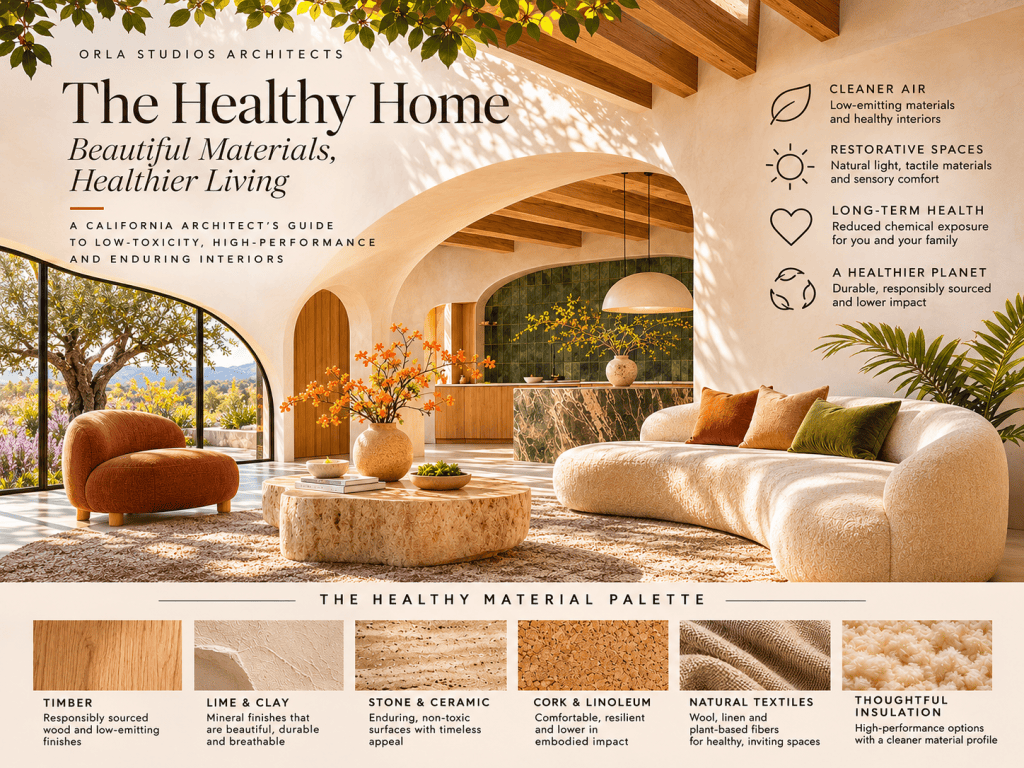
We all want our homes to be beautiful. We spend hours choosing the perfect flooring, finding just the right paint color, and falling in love with a gorgeous piece of stone or a beautifully crafted cabinet.
But have you ever wondered what’s actually in those materials?
The finishes, furnishings, and building products we choose can influence the quality of the air we breathe, the comfort of our rooms, and even the environmental footprint of our homes.
The lovely thing is that creating a healthier home doesn’t mean giving up beautiful design. Quite the opposite!
Some of the most inviting interiors combine natural textures, wonderful craftsmanship, carefully selected materials, and plenty of personality.
At Orla Studios, we believe a home should be more than somewhere beautiful to look at. It should be a place where you can relax, recharge, entertain friends, and enjoy everyday life.
So, let’s explore how thoughtful material choices can help us create homes that are both beautiful and healthier to live in.
1. What Makes a Material Healthy?
When we think about healthy interiors, we often picture natural wood, stone, linen, and perhaps a few lovely plants.
These are wonderful ingredients for a beautiful home, but there’s a little more to the story.
Some building products release chemicals into the indoor air, particularly when they’re new. These can come from paints, adhesives, flooring, cabinetry, furniture, and even some fabrics.
You may have heard of volatile organic compounds, or VOCs. These are chemicals that can evaporate into the air, sometimes contributing to indoor air pollution.
The good news is that there are many excellent products available with independently tested low emissions.
And here’s something worth remembering: natural doesn’t automatically mean healthy, and manufactured doesn’t automatically mean harmful.
A beautifully finished wood floor might contain adhesives or coatings worth investigating, while a carefully manufactured product could have excellent emissions testing and environmental credentials.
The trick is knowing what to look for.
We love materials that combine beauty, durability, transparency, and thoughtful manufacturing.
2. Beautiful Wood: A Little Warmth Goes a Long Way
There’s something about wood that makes a house feel like a home.
Whether it’s wide-plank oak flooring, beautifully detailed cabinetry, or a sculptural timber ceiling, wood brings warmth, character, and a wonderful connection to nature.
For healthier interiors, we like to consider responsibly sourced solid wood and well-documented engineered wood products.
With engineered wood, it’s worth checking the adhesives, resins, and finishes used in manufacturing.
For cabinetry, we can look for low-formaldehyde-emitting substrates and carefully selected finishes.
And don’t forget the finish! A beautiful matte surface can allow the natural character of the timber to shine without a heavy, glossy appearance.
Our design tip: Try mixing timber with stone, plaster, and colorful textiles. A little contrast makes an interior feel collected and personal rather than overly coordinated.
3. Lime and Clay Plaster: Walls With Personality
We absolutely love the softness and character of beautifully finished plaster walls.
Unlike a perfectly flat painted surface, lime and clay plasters can have gentle variations in color and texture that catch the light throughout the day.
They’re especially lovely in contemporary homes, where they can soften clean architectural lines and add a little warmth.
Some mineral-based plaster systems can also offer relatively simple material formulations, although it’s important to check the complete product, including pigments, binders, and protective coatings.
Not every plaster is suitable for every location, particularly where moisture is involved.
But when properly selected and detailed, these finishes can create beautiful, tactile interiors.
Our design tip: Consider a softly curved plaster wall or a sculptural niche. Add warm lighting, a favorite piece of art, or a beautiful ceramic vessel, and suddenly an ordinary corner becomes something special.
4. Stone and Ceramic: Beautiful, Practical and Timeless
Natural stone has a way of making a room feel grounded and timeless.
We love the subtle movement of limestone, the warmth of travertine, and the character of richly veined marble.
Ceramic and porcelain are also fantastic options, particularly in kitchens and bathrooms where durability and easy maintenance are important.
These materials can be excellent choices for healthy interiors, although the sealers, adhesives, and grouts used with them deserve attention too.
Stone fabrication also requires proper dust controls to protect workers, particularly when cutting materials that contain crystalline silica.
For homeowners, the goal is to choose a surface that is beautiful, practical, and appropriate for the way the room will be used.
Our design tip: Don’t be afraid to mix finishes! Honed stone, handmade-looking ceramic tile, and warm wood can create a wonderfully layered interior. A little color can make the combination even more interesting.
5. Cork and Linoleum: The Unexpected Favorites
Here’s a pair of materials that deserve a little more attention!
Cork is naturally warm underfoot and can be wonderfully comfortable in bedrooms, studies, and family spaces.
Natural linoleum is another interesting option. Made primarily from ingredients such as linseed oil, wood flour, and mineral fillers, it comes in a surprising range of colors.
Both materials can offer appealing alternatives to some conventional resilient flooring products.
Of course, it’s still important to check the finishes, adhesives, backing materials, and emissions testing for the complete flooring system.
Our design tip: Cork can look beautiful in a contemporary home, particularly when paired with simple cabinetry and interesting furniture. And colorful linoleum could be a fabulous choice for a playful home office or children’s room.
Healthy design doesn’t have to be beige!
6. Fabrics That Make You Want to Stay a While
A home should be comfortable.
We love a beautiful linen curtain moving gently in the breeze, a soft wool rug, and a wonderfully inviting sofa that everyone wants to curl up on.
Natural fibers such as wool, linen, and cotton can bring softness and texture to contemporary interiors.
But fabric composition is only part of the picture.
Some furnishings may contain stain-resistant treatments, flame retardants, adhesives, or synthetic backing materials.
It’s worth asking manufacturers about these components, particularly for large upholstered pieces and rugs.
We also love choosing furniture that is well made, repairable, and designed to last.
Our design tip: Mix textures and have fun with color. A curved sofa, a patterned rug, colorful cushions, and a beautiful vintage chair can make a room feel much more welcoming than an interior where everything matches.
7. The Materials You Never See Matter Too
Some of the most important materials in your home are hidden behind the walls.
Insulation, sealants, waterproofing, adhesives, and other construction products all contribute to the building’s performance.
For insulation, options worth considering include cellulose, selected mineral-wool systems, and other products with well-documented ingredients and performance.
The right choice depends on the building, the climate, fire safety requirements, moisture management, and energy performance.
In California, these considerations are especially important.
We want our homes to stay comfortable during hot summers, perform well during cooler weather, and provide healthy indoor environments when outdoor air quality is poor.
This brings us to something just as important as material selection: ventilation.
Even carefully chosen low-emitting materials cannot replace a properly designed ventilation and filtration system.
Our design tip: Spend as much time thinking about the quality of the building envelope and mechanical systems as you do choosing the beautiful finishes. You may never see these elements, but you’ll appreciate the comfort they provide every day.
8. A California Home Should Breathe Beautifully
One of the great pleasures of living in California is the connection between indoors and outdoors.
We love opening large doors onto a garden, enjoying breakfast in a sunny courtyard, or watching the evening light move across a room.
Natural ventilation can be wonderful when outdoor conditions are suitable.
But wildfire smoke, pollen, traffic pollution, and extreme heat remind us that outdoor air isn’t always healthy air.
A thoughtfully designed home should provide choices.
When conditions are lovely, we can open the windows and enjoy the breeze. When air quality is poor, a well-designed mechanical ventilation and filtration system can help maintain a healthier indoor environment with the windows closed.
Good architecture brings these two experiences together.
We can enjoy all the beauty of indoor-outdoor living without relying on open windows as our only source of fresh air.
9. A Few Simple Things to Ask Before Choosing Materials
You don’t need to become a chemist to make better material decisions!
When selecting finishes and furnishings, here are a few useful questions:
- Has the product been independently tested for low chemical emissions?
- Does the manufacturer disclose its ingredients?
- Are there any chemicals of concern that could reasonably be avoided?
- Is the material durable and easy to maintain?
- Can it be repaired rather than replaced?
- Are the adhesives, coatings, and sealers appropriate for a healthier interior?
- Does it suit the climate and the way the room will be used?
For architects and designers, resources such as Health Product Declarations, Declare labels, and California’s VOC emissions testing standards can help make these decisions more informed.
No single certification tells the whole story, but good documentation is an excellent place to start.
10. Healthy Homes Can Be Colorful, Creative and Full of Life
Perhaps our favorite thing about healthy design is that it doesn’t have to look a particular way.
You don’t need an all-white interior, a minimalist lifestyle, or a house filled with pale timber and beige furniture.
A healthy home can be colorful, playful, sophisticated, and full of personality.
It can have richly patterned textiles, beautiful artwork, sculptural furniture, vibrant tiles, and unexpected combinations of materials.
It can be contemporary, traditional, maximalist, or somewhere wonderfully in between.
What matters is that the materials have been thoughtfully selected and that the building supports comfortable, healthy everyday living.
We believe the best homes reflect the people who live in them.
They should be places for entertaining, cooking, relaxing, working, playing, and making memories.
And if we can create all of that while being a little kinder to our health and the planet, even better.
A Beautiful Home Is One That Takes Care of You
Creating a healthier home isn’t about achieving perfection.
It’s about making thoughtful choices wherever we can.
Choosing a lower-emitting paint. Finding a beautifully made piece of furniture that will last for decades. Selecting cabinetry with well-documented materials. Designing a comfortable, well-ventilated home that connects naturally with its garden.
These decisions may seem small individually, but together they can make a meaningful difference.
At Orla Studios Architects, we believe that great design should be beautiful, thoughtful, and a pleasure to live with.
We love the richness of natural materials, the character of handcrafted finishes, the joy of color, and the way architecture can make everyday life feel just a little more special.
Because the best homes don’t just look beautiful. They feel wonderful to live in.
Orla Studios Architects
Thoughtful architecture for beautiful, healthy, and joyful living.
Further Reading
For readers who would like to explore the science and standards behind healthier building materials:
- Health Product Declaration Collaborative: hpd-collaborative.org — Building product ingredient transparency.
- International Living Future Institute: Declare — Material ingredient disclosure and screening.
- California Department of Public Health: VOC Emissions — Testing standards for indoor product emissions.
- Habitable: Informed Product Guidance — Resources for comparing building materials and chemicals of concern.
- US Environmental Protection Agency: Indoor Air Quality — Practical guidance on indoor pollutants and healthier environments.


