A perspective from Orla Studios Architects
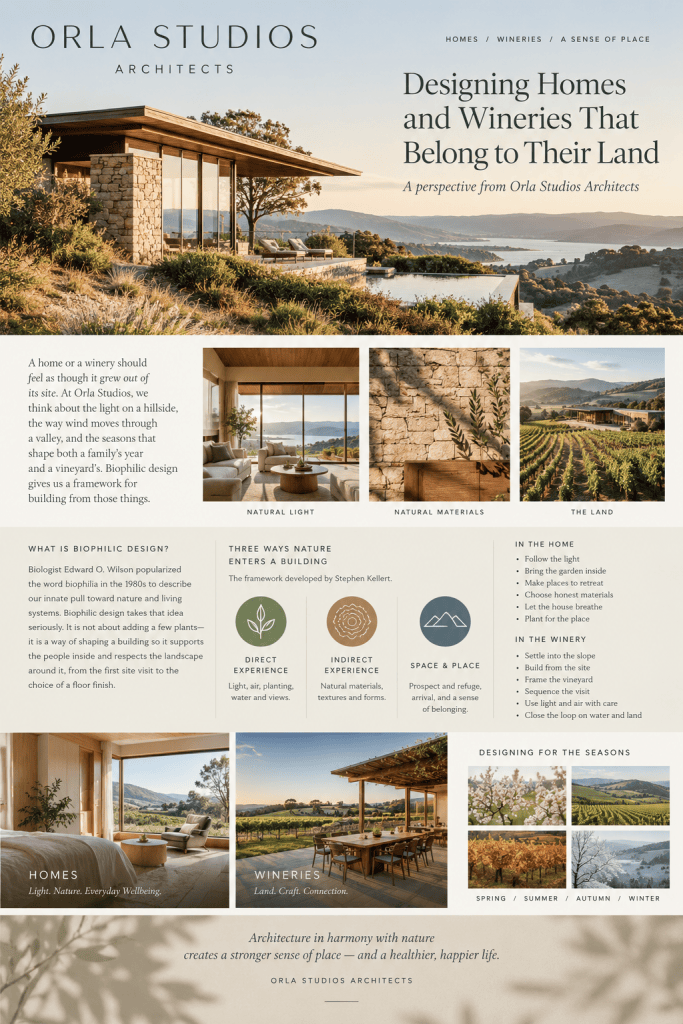
A home or a winery should feel as though it grew out of its site. At Orla Studios, we think about the light on a hillside, the way wind moves through a valley, and the seasons that shape both a family’s year and a vineyard’s. Biophilic design gives us a framework for building from those things, and a surprising amount of research and architectural thought stands behind it.
What biophilic design means
The word biophilia, “love of life,” was first used by psychoanalyst Erich Fromm in the 1960s. Biologist Edward O. Wilson popularized it in the 1980s as the biophilia hypothesis: the idea that humans have an innate tendency to seek connection with nature and other living systems. Wilson argued that because we evolved in natural settings, our minds and bodies still respond to them.
Biophilic design applies that idea to buildings. It is not about adding a few potted plants. It is a way of shaping rooms, materials, views and landscapes so they answer a need people have always had. For us, that starts on the first site visit and continues down to the choice of a floor finish.
The ideas behind the practice
Biophilic architecture draws on several overlapping theories from psychology, environmental science, design and philosophy. No single one explains everything, but together they shape how we make decisions.
The biophilia hypothesis and Kellert’s nine values. In 1993, Wilson and social ecologist Stephen Kellert edited The Biophilia Hypothesis, which brought together scholars from many fields. Kellert went on to describe nine values through which people relate to nature, among them aesthetic, symbolic, utilitarian and ecological-scientific. Later, with Judith Heerwagen and Martin Mador, he turned the theory into a design method in Biophilic Design (2008), and in Nature by Design (2018) he refined it into three categories: direct experience of nature, indirect experience of nature, and experience of space and place.
Stress Reduction Theory. Environmental psychologist Roger Ulrich proposed that natural scenes help us recover from stress because we evolved to find certain landscapes safe and restorative. His best-known study, published in 1984, followed patients recovering from surgery. Those whose windows looked onto trees tended to have shorter hospital stays and need less pain medication than those facing a brick wall. The study was small, but it launched decades of research into healing environments.
Attention Restoration Theory. Rachel and Stephen Kaplan argued that modern life demands constant, effortful concentration, and that nature restores our focus through what they called soft fascination: gentle stimulation, such as moving leaves, water or clouds, that holds attention without draining it. They identified qualities that make a setting restorative, including a sense of being away, a feeling of extent or richness, and compatibility with what we want to do there. A reading room facing a garden, or a winery terrace over vine rows, is soft fascination put into a plan.
Prospect and Refuge Theory. Geographer Jay Appleton proposed in 1975 that we prefer places where we can see without being seen: wide views paired with a sheltered position behind us. He tied this to the survival advantage of watching for opportunity and danger from a protected spot. Related ideas, such as the savanna hypothesis, suggest we may favor open landscapes with scattered trees, though that claim is debated. Window seats, deep porches, cellar thresholds and hillside terraces all draw on this thinking.
Fractals and natural patterns. Physicist Richard Taylor has studied the fractal patterns found in trees, clouds, coastlines and foliage, in which similar shapes repeat at different scales. His work suggests that people often find moderately complex fractal patterns calming, which he links to the way our visual system evolved. Architectural theorist Nikos Salingaros has made a related argument for ornament, structure and detail that offer visual richness at many scales, from a building’s massing down to the grain of a timber beam.
Pattern language. Architect Christopher Alexander’s A Pattern Language (1977) catalogued recurring design solutions, many rooted in human comfort and nature: window places, sheltering roofs, gardens, and paths that unfold slowly. Though not labeled biophilic at the time, his patterns strongly influence today’s biophilic thinking.
Organic architecture. Long before the term biophilia reached architecture, Frank Lloyd Wright described organic architecture, the idea that a building should belong to its site and grow from it. His Fallingwater, built over a waterfall, is the classic example. Alvar Aalto and Antoni Gaudí likewise worked with natural forms and materials. The language differs from the scientific literature, but the aim is shared.
Genius loci and critical regionalism. Architectural theorist Christian Norberg-Schulz revived the Roman idea of genius loci, the spirit of a place, arguing that architecture should respond to a site’s character. Kenneth Frampton’s critical regionalism similarly urges buildings to draw on local climate, materials, topography and tradition rather than imposing a universal style. For a winery, this runs parallel to the idea of terroir: the building, like the wine, should be recognizably of its place.
Phenomenology and the senses. Finnish architect Juhani Pallasmaa, in The Eyes of the Skin (1996), criticized architecture that serves the eye alone and called for buildings that engage touch, sound, smell, temperature and the movement of the body. Biophilic design shares this concern: the cool of a stone cellar, the smell of oak, the sound of water in a courtyard and the shift of light through a day all matter as much as appearance.
Design with nature, biomimicry and regenerative design. Landscape architect Ian McHarg’s Design with Nature (1969) argued for planning that begins with a site’s ecology. Janine Benyus’s Biomimicry (1997) asked designers to learn from how organisms solve problems, such as passive cooling inspired by termite mounds. More recent regenerative design goes further, aiming for buildings that improve their surroundings rather than merely reducing harm. Frameworks like the Living Building Challenge include a dedicated biophilic requirement.
Patterns of biophilic design. In 2014, the consultancy Terrapin Bright Green published 14 Patterns of Biophilic Design, a practical translation of the research into three groups: nature in the space (plants, water, light, airflow), natural analogues (natural materials, patterns and forms), and nature of the space (prospect, refuge, mystery and risk or peril). It has become a common reference for architects and clients.
Three ways nature enters a building
Drawing on these theories, we organize our work around Kellert’s three categories.
Direct experience of nature means real contact with the natural world: daylight, fresh air, planting, water and views. In a home, that might be a courtyard garden, a kitchen that opens onto an herb bed, or windows that open to catch a breeze. In a winery, it is a terrace looking straight down the vine rows.
Indirect experience of nature uses materials and forms that echo the natural world. Local stone, timber, lime plaster and clay bring texture and warmth, and shapes inspired by ridgelines, leaves or vine rows can inform a roofline or a plan.
Experience of space and place is the subtlest. It includes prospect and refuge, the sense of arrival, the path that reveals a view slowly, and the feeling that a building belongs to its region and culture.
In the home
A house is where biophilic design is felt most often, because we live inside it every day.
- Following the light. We study the sun’s path across the site so that morning light finds the kitchen, soft light reaches workspaces, and evening glow settles where the family gathers.
- Bringing the garden into the plan. Rooms that wrap a courtyard or open onto a terrace make greenery part of the daily route through the house, offering the soft fascination the Kaplans described.
- Making places to retreat. A window seat, a deep porch or a reading nook gives a view outward while feeling protected behind, in the spirit of prospect and refuge.
- Choosing honest materials. Timber, stone and natural fibres age well and engage the senses, as Pallasmaa urged. They give a home a calm, lived-in quality that synthetic finishes rarely match.
- Layering detail at every scale. Natural grain, varied textures and considered joinery provide the kind of visual richness that fractal research suggests we find restful.
- Letting the house breathe. Cross-ventilation, shading and thermal mass keep rooms comfortable and reduce the need for mechanical cooling.
- Planting for the place. Native and drought-tolerant species need little water, support pollinators and change with the seasons.
In the winery
A winery already depends on soil, sun, weather and time. Biophilic design lets the building share that logic, so a visit feels like part of the landscape instead of a stop beside it.
- Settling into the slope. Cellars set into or sheltered by the hillside use the earth’s steady temperatures and keep the building low against the vines, much as organic architecture would advise.
- Building from the site. Rammed earth, local stone and regional timber express genius loci and critical regionalism, tying the architecture to the vineyard’s geology while giving barrel halls natural thermal mass.
- Framing the vineyard. Tasting rooms and terraces are placed to frame rows, ridgelines and sky, with shaded seating that draws guests outdoors and invites a slower pace.
- Sequencing the visit. Guests might move from open fields through a threshold, down into the cool, dim cellar and back up into daylight. This uses the pattern of mystery and revelation, and echoes the journey of the wine itself.
- Engaging every sense. The smell of oak and fermenting fruit, the sound of footsteps on stone, the temperature drop on descending to the cellar: these multisensory moments are central to a memorable visit.
- Using light and air with care. Clerestories and shaded openings bring in soft light where it helps, while passive ventilation and stack effect cool production areas.
- Closing the loop on water and land. Rainwater harvesting, reed-bed treatment of process water and planting between buildings reduce demand and support local ecology, in the spirit of regenerative design.
Designing for the seasons
Homes and wineries both live through a yearly cycle, and we design so that every season has something to offer. Spring brings blossom and bud break seen from kitchen windows. Summer calls for deep eaves, shaded courtyards and thick walls that hold the heat at bay. Harvest asks for working areas that are efficient and bright, with sheltered places for gathering. Winter lets low sun reach deep into rooms, with warm materials and views of bare branches and rain.
Why it matters, and what we don’t claim
Research has linked views of greenery, daylight and natural materials with lower stress, better mood and improved attention. The practical benefits are easier to point to: good daylighting reduces electric lighting, shading and natural ventilation cut cooling loads, and planted landscapes help manage stormwater. Biophilic design often overlaps with sustainable design, though the two are not the same, since a building can be energy efficient and still feel sterile.
It is also worth being candid about the limits. Much of the evidence comes from small or observational studies, some theories (the savanna hypothesis among them) remain debated, and preferences vary with culture, age and personal history. We treat these ideas as a well-informed starting point rather than a formula, and we avoid promising measurable gains in wellbeing or productivity.
Starting with the land
Every project we take on begins with the site: its slope, soil, climate, views and history. From there, we design a house or winery that makes the most of what is already there. If you are planning a home or a winery and want it to feel connected to its setting, we would be glad to hear about your land and your plans.