The architecture of anticipation, discovery and belonging
Orla Studios Architects | The Architectural Journal
There is something rather beautiful about the experience of approaching a place we love.
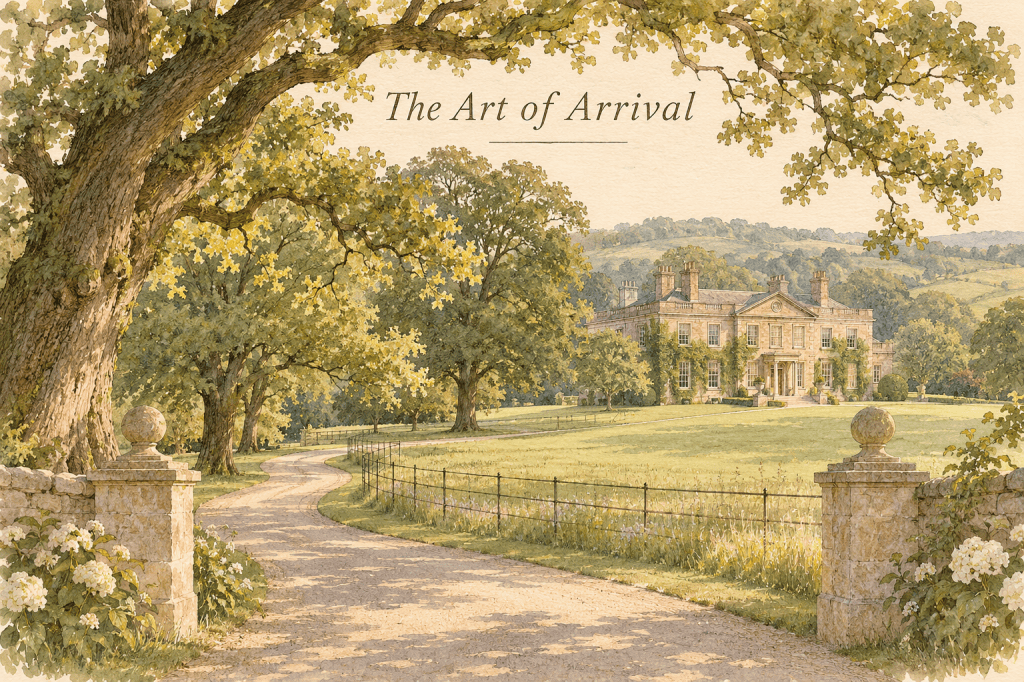
A winding driveway beneath mature trees. A glimpse of a house through the landscape. The sound of gravel underfoot. A sheltered courtyard filled with the fragrance of lavender. A warmly illuminated doorway at the end of the day.
Before we have even entered the building, architecture has already begun to shape our experience.
Arrival is one of the most powerful and often overlooked aspects of architectural design. It is the transition between the outside world and the particular character of a place, between movement and stillness, between the public and the private.
A thoughtfully designed arrival can create a sense of anticipation, discovery, comfort and belonging.
It is the opening chapter of the architectural experience.
The Ancient Origins of Arrival
Throughout history, architects have understood the importance of the journey toward a building.
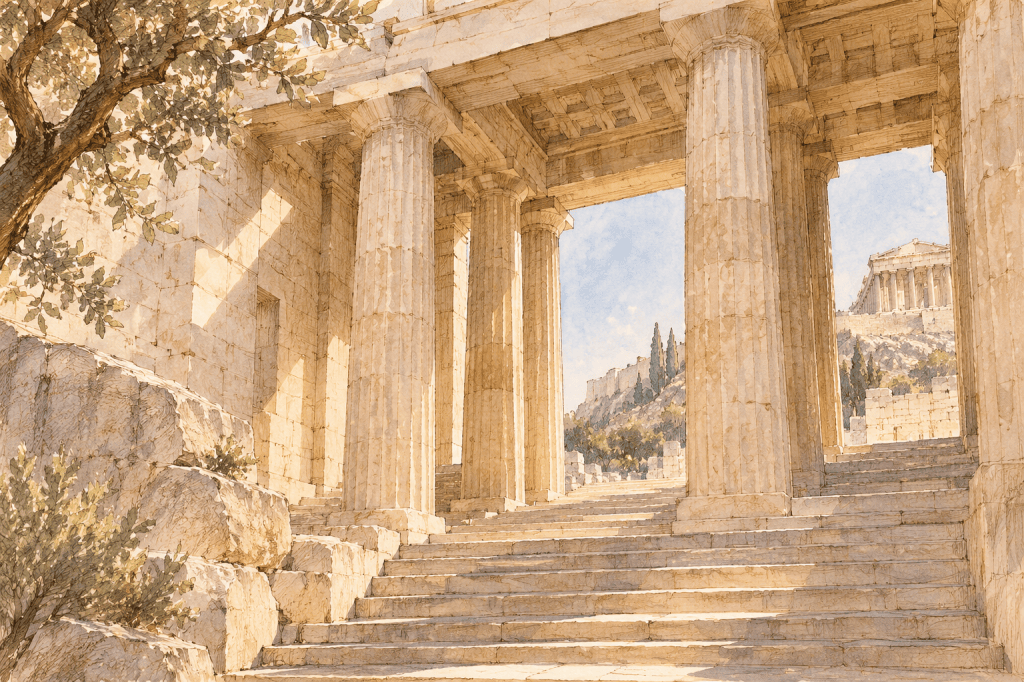
In ancient Greece, the approach to the Acropolis in Athens was experienced as a sequence of architectural discoveries. Buildings were revealed from changing perspectives as visitors moved through the landscape, allowing their relationships, proportions and sculptural qualities to unfold gradually.
The monumental gateway of the Propylaea marked a transition from the city into a sacred architectural precinct.
In ancient Rome, the arrangement of entrances, atriums, courtyards and gardens created a carefully considered progression through domestic architecture.
The entrance to a Roman house often established a visual relationship with the spaces beyond, offering glimpses into the interior while maintaining a distinction between public and private life.
These ancient traditions reveal an enduring architectural principle: our experience of a building is shaped not only by its form, but by the way we approach and enter it.
Architecture begins with the journey.
The Renaissance and the Ceremonial Approach
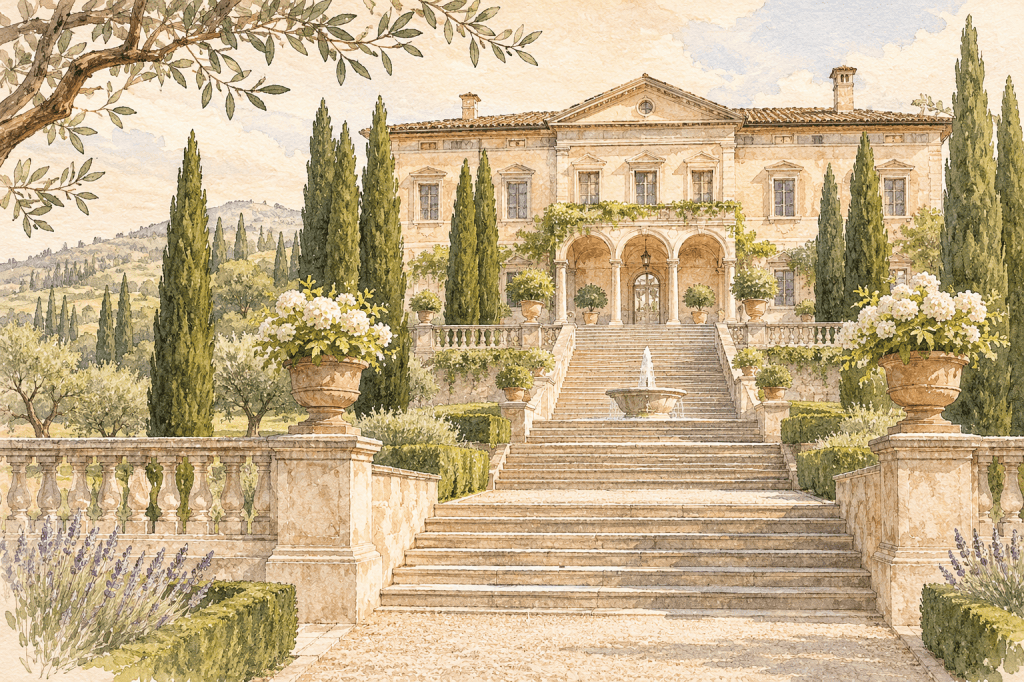
During the Renaissance, the relationship between architecture, landscape and arrival became increasingly sophisticated.
Italian villas were often positioned within their landscapes to create memorable approaches, with avenues, terraces, staircases and gardens establishing a sense of order and anticipation.
Andrea Palladio explored the relationship between the landscape and the architectural entrance through beautifully proportioned porticos and generous external staircases.
The approach to a villa was an integral part of its composition, allowing visitors to appreciate the building in relation to the surrounding countryside.
At the Villa d’Este in Tivoli, terraces, fountains, stairways and garden pathways create a remarkable sequence of experiences in which architecture and landscape are inseparable.
Movement becomes a means of discovering beauty.
While contemporary homes rarely require the ceremonial grandeur of Renaissance architecture, the underlying principles remain remarkably relevant.
A carefully framed view, a change in level or a beautifully proportioned entrance can transform an ordinary approach into a memorable experience.
The English Landscape and the Art of Discovery
The eighteenth-century English landscape movement introduced a more naturalistic interpretation of arrival.
Rather than approaching a country house along a rigidly formal axis, visitors might follow a gently curving drive through woodland, open meadows and carefully composed views.
Landscape designers such as Capability Brown and Humphry Repton understood the emotional power of gradually revealing architecture.
A house might disappear behind a grove of trees before emerging across a sweeping lawn. A bridge, a lake or a distant pavilion might provide moments of interest along the journey.
The landscape was composed almost as a series of paintings, experienced through movement rather than from a single fixed viewpoint.
These ideas continue to offer beautiful inspiration for contemporary country estates.
The pleasure of discovery can be more powerful than the immediate revelation of a building in its entirety.
Sometimes, what we choose to conceal is as important as what we choose to reveal.
The Japanese Art of Transition

Traditional Japanese architecture offers a particularly sensitive interpretation of arrival.
The approach to a tea house, for example, often takes visitors through a carefully composed garden known as a roji.
Stepping stones, moss, trees, stone lanterns and a water basin create a sequence of modest but meaningful experiences.
The garden encourages visitors to slow their pace, become more aware of their surroundings and leave behind the distractions of everyday life.
The entrance to a traditional tea room may be deliberately small, encouraging a gesture of humility as one enters.
Rather than expressing importance through monumentality, the architecture creates significance through simplicity, ritual and attention.
This approach reminds us that a memorable arrival does not require grandeur.
It can be created through the quiet beauty of a garden path, the texture of a timber door or the gentle transition from sunlight into shade.
The architecture prepares us emotionally for the experience that follows.
Arrival in Modern Architecture
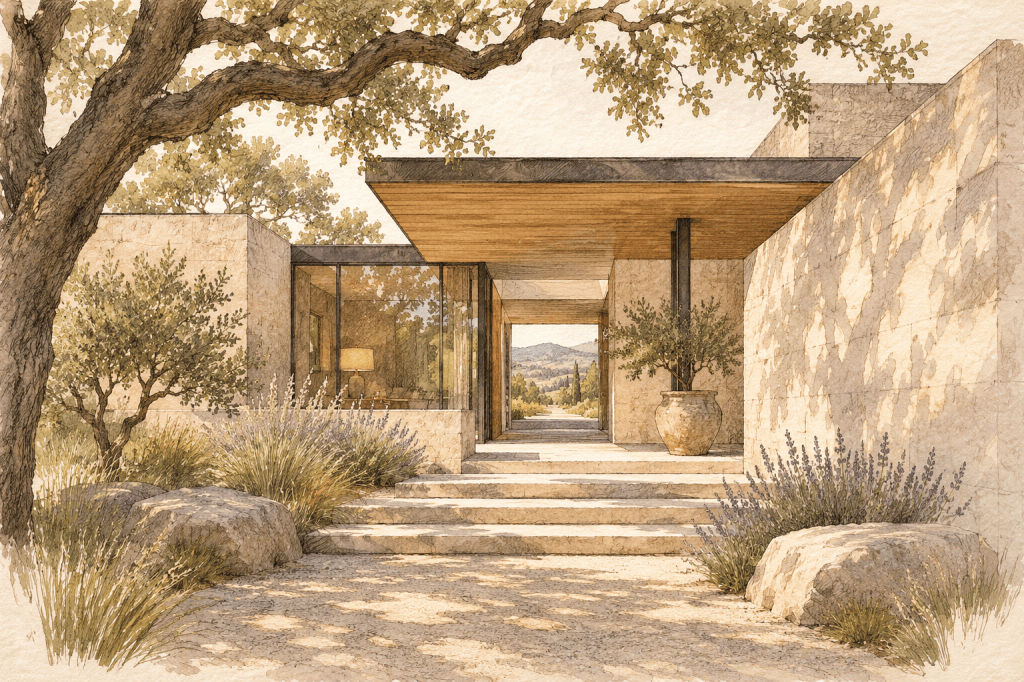
Modern architects have continued to explore the relationship between movement, anticipation and spatial experience.
Frank Lloyd Wright frequently designed entrances that were understated, sheltered or deliberately compressed before opening into more expansive living spaces.
At Fallingwater, the approach and entrance form part of a carefully orchestrated experience in which the architecture and natural landscape are gradually revealed.
Le Corbusier explored the idea of the promenade architecturale, an architectural journey in which spaces are experienced through movement, changing perspectives and relationships with light.
At Villa Savoye, the ramp becomes a central element of this experience, connecting the arrival level with the principal living spaces and roof garden.
Alvar Aalto approached arrival with particular sensitivity to natural materials, human scale and the landscape. At Villa Mairea, the entrance canopy and its timber supports evoke the surrounding woodland, creating a gentle transition between nature and architecture.
More recently, architects such as Tadao Ando and Peter Zumthor have explored the emotional qualities of arrival through restraint, materiality, shadow and carefully controlled sequences of space.
Their work demonstrates that the journey through architecture can be as meaningful as the destination itself.
Reading the Landscape
The design of a beautiful arrival begins with understanding the site.
Every landscape offers its own opportunities.
A mature oak tree may establish a natural point of orientation. A gently sloping hillside may suggest a winding approach. An existing stone wall may become part of the entrance sequence. A distant view may be carefully withheld until the visitor reaches the home.
The topography, vegetation, orientation and character of the land should inform the architectural response.
Rather than imposing a predetermined driveway or entrance upon the site, the approach can emerge from the qualities already present.
In California, the relationship between arrival and landscape is particularly rich.
The wooded hillsides of Marin, the vineyards and golden grasslands of Napa and Sonoma, and the dramatic coastal landscapes each offer different opportunities for creating a meaningful sense of arrival.
A home approached through an oak woodland will naturally possess a different character from one revealed across an open meadow or at the end of a vineyard avenue.
The most memorable arrivals celebrate the individuality of their surroundings.
The Driveway as an Architectural Experience
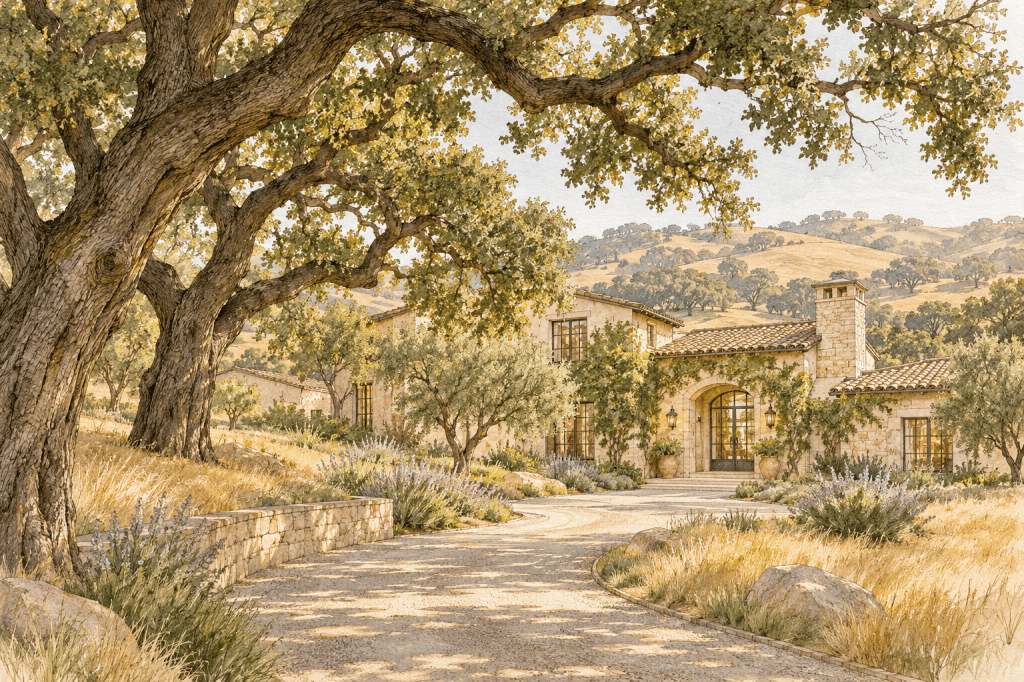
A driveway is often considered a purely practical requirement, providing access from the road to the residence.
Yet it can become one of the most beautiful elements of an estate.
Its alignment, width, surface materials and relationship to the landscape influence the way a place is experienced.
A gently curving drive can encourage a slower pace and allow views to unfold gradually.
An avenue of trees can establish rhythm and enclosure. A low stone wall can guide movement while reinforcing the character of the landscape. An orchard or meadow can provide a sense of openness before the approach becomes more intimate.
The driveway should also respond to practical considerations, including accessibility, emergency access, drainage, gradients and the movement of vehicles.
These requirements can be integrated thoughtfully into the landscape rather than treated as separate engineering interventions.
A beautifully designed approach feels natural and effortless, even when considerable technical consideration lies behind it.
The journey from the road to the home becomes part of the pleasure of living there.
The Art of Framing a View
One of the most powerful tools in the design of arrival is the carefully framed view.
A glimpse of a distant landscape through an entrance archway can draw us forward. A window at the end of a hallway can establish a sense of direction. A courtyard opening can reveal the branches of a mature tree against the sky.
These moments create a visual dialogue between architecture and landscape.
A view need not be expansive to be meaningful.
A small garden, a sculptural tree, a beautiful stone wall or a shaft of sunlight can become the focus of an architectural composition.
Sometimes, a distant view is most powerful when it is not immediately visible.
By allowing the landscape to reveal itself at a particular moment, the architect can create a sense of discovery that becomes part of the memory of a place.
The architecture becomes a frame through which we experience the world beyond.
The Arrival Courtyard
Courtyards have served as places of arrival across many architectural traditions.
From Mediterranean villas and Spanish haciendas to Moroccan riads and traditional Asian residences, the courtyard has provided a sheltered transition between the wider world and the intimacy of the home.
In contemporary residential architecture, an arrival courtyard can create a wonderful sense of enclosure and welcome.
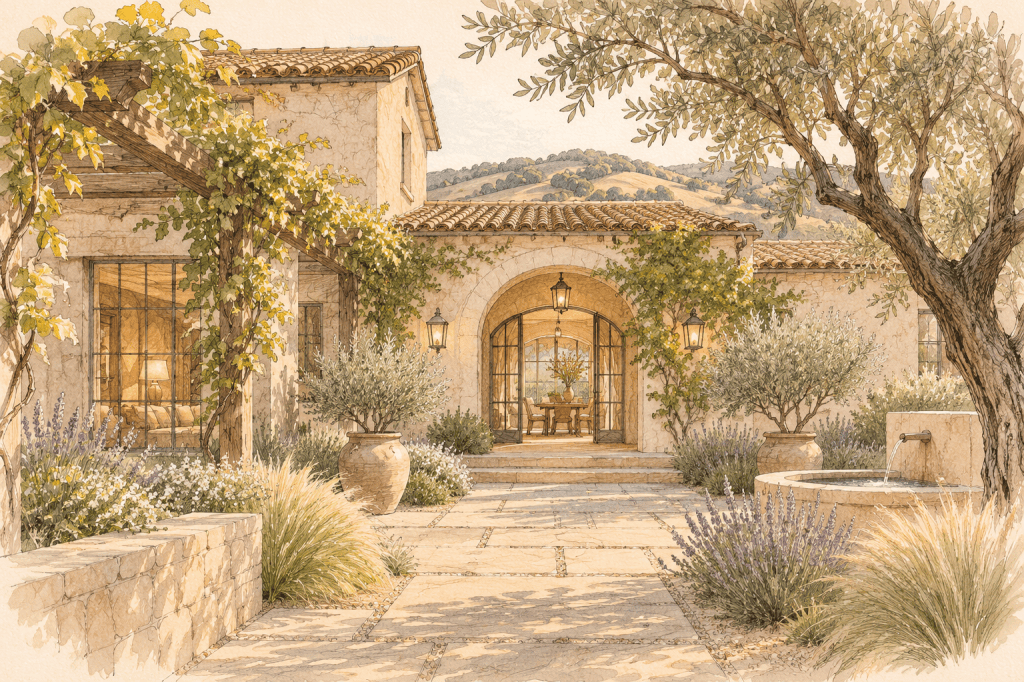
It may be organized around a mature olive tree, a simple fountain, a beautifully planted garden or a composition of natural stone and timber.
The surrounding architecture can provide shelter from the wind, establish privacy and soften the scale of a larger residence.
A courtyard also offers an opportunity to distinguish the experience of arriving from the practical requirements of parking and vehicle circulation.
Where space permits, garages and service areas can be positioned so that they do not dominate the principal entrance.
The visitor arrives not simply at a building, but within a beautifully composed outdoor room.
In California’s temperate climate, the arrival courtyard can become an integral part of the home’s everyday experience.
Compression and Release
One of the most compelling spatial principles in architecture is the relationship between compression and release.
A relatively intimate entrance can heighten the experience of entering a more generous space.
A sheltered passage beneath a low roof may open into a light-filled courtyard. A modest entrance hall may lead into a living room with expansive views of the landscape. A narrow garden path may reveal an open terrace overlooking the countryside.
The contrast between these spaces creates emotional and spatial richness.
Without moments of intimacy, grandeur can lose its meaning. Without areas of shadow, light can become less expressive.
The art lies in establishing a sequence of experiences that complement one another.
This principle is particularly beautiful in residential architecture, where the transition from the outside world to the home can be expressed through subtle changes in scale, ceiling height, materiality and illumination.
A home does not need a monumental entrance to create a memorable arrival.
Sometimes, the most extraordinary experience comes from passing through a modest doorway into a space of unexpected beauty.
The Threshold: Between Inside and Outside
The threshold occupies a special place in architecture.
It marks the moment of transition between two worlds.
Historically, thresholds have carried cultural, symbolic and practical significance. They distinguish the public from the private, the exposed from the sheltered and the familiar from the unfamiliar.
In residential architecture, the threshold is an opportunity to express welcome through detail.
The depth of a doorway, the texture of its surrounding materials, the warmth of a timber door and the craftsmanship of its hardware all contribute to the experience.
A covered porch, loggia or entrance canopy can provide a gentle intermediate space between the landscape and the interior.
These transitional spaces offer protection from the weather while allowing visitors a moment to pause.
Thoughtful detailing can also create a comfortable, accessible transition between levels and materials.
A beautifully designed threshold is both practical and poetic.
It is a small architectural moment with an extraordinary capacity to communicate the character of a home.
The Front Door as an Expression of Character
The front door is one of the most personal elements of a building.
It is the point at which architecture becomes an invitation.
Its proportions, materials, color and craftsmanship establish an immediate impression of the home beyond.
A substantial oak door may communicate warmth and permanence. A finely detailed bronze entrance may express refinement. A glazed doorway may offer a glimpse of a garden or a beautifully illuminated interior.
The relationship between the door and the surrounding architecture is as important as the door itself.
Its scale should respond to the proportions of the façade, the depth of the entrance and the human experience of approaching it.
Beautiful hardware, carefully considered lighting and the tactile qualities of natural materials can elevate even the simplest architectural composition.
The most successful entrances feel distinctive without being intimidating.
They communicate the personality of the home while making visitors feel genuinely welcome.
The Entrance Hall as the First Interior Experience
The entrance hall introduces the architectural language of the home.
It establishes the relationship between spaces, provides a sense of orientation and offers the first experience of the interior’s light, materials and proportions.
A thoughtfully designed entrance hall should feel welcoming and intuitive.
Visitors should have a natural understanding of where to go, whether toward a living room, a courtyard, a staircase or a principal gathering space.
The entrance can also provide an opportunity for a beautiful visual connection with the landscape beyond.
A window aligned with the front door, a framed garden view or a glimpse of a distant hillside can establish a sense of continuity between the approach and the interior.
Practical details deserve equal consideration.
A comfortable place to sit, a discreet coat closet, a surface for placing belongings and sufficient space for people to move comfortably all contribute to the feeling of being welcomed.
The entrance hall need not be large.
Its success lies in the clarity of its composition and the generosity of its experience.
Arrival Through the Senses
Architecture is experienced through far more than sight.
The sound of footsteps on gravel, the fragrance of rosemary beside a pathway, the coolness of a shaded stone wall and the warmth of a timber door handle all contribute to our perception of arrival.
A fountain can introduce the gentle sound of moving water. Trees can filter sunlight and soften the surrounding atmosphere. Seasonal planting can bring changing fragrances and colors to familiar spaces.
Materials possess their own sensory qualities.
Natural stone communicates solidity and permanence. Timber introduces warmth and texture. Lime plaster responds beautifully to changing light. Gravel and brick establish distinctive rhythms beneath our feet.
These qualities create experiences that are difficult to capture in photographs but become deeply embedded in our memories.
A thoughtfully designed arrival engages the senses without overwhelming them.
It allows us to become more present in the experience of a place.
The Role of Light and Shadow
Light is one of the most expressive elements in the architecture of arrival.
During the day, the changing relationship between sunlight and shadow can transform the experience of approaching a building.
A pergola may cast delicate patterns across a pathway. A deep entrance reveal can create a sense of shelter. A courtyard may capture reflected light from surrounding stone walls.
As evening approaches, artificial lighting takes on a more intimate role.
A softly illuminated doorway, discreet pathway lighting and the warm glow of interior spaces can create a wonderful feeling of welcome.
Exterior lighting should be carefully integrated into the architecture and landscape, providing comfortable visibility without excessive brightness or glare.
Shielded fixtures and restrained illumination can help preserve the natural darkness of the night sky.
The most beautiful evening arrivals often reveal only what is necessary.
The surrounding landscape remains quiet, while the home offers a gentle point of warmth and reassurance.
There is something deeply comforting about seeing the light of home in the distance.
The Art of Arrival in the Country Estate
A country estate offers particular opportunities to explore arrival as a complete architectural and landscape experience.
The journey may begin at a modest entrance from the road before passing through woodland, orchards, vineyards or open meadows.
The residence may be revealed gradually, with secondary buildings, garden walls and courtyards contributing to the composition.
A collection of smaller buildings can create a more intimate sense of arrival than a single monumental structure.
The guest cottage, pool pavilion, garden buildings and principal residence can each possess their own entrance experience while contributing to a coherent architectural whole.
Carefully considered pathways can connect these buildings, encouraging movement through the landscape and creating opportunities for discovery.
The arrival sequence becomes more than a route to the front door.
It becomes an introduction to the character, rhythms and pleasures of the estate itself.
Arrival in Boutique Hotels and Wineries
In hospitality architecture, the experience of arrival is particularly important.
A guest visiting a hotel or winery is often encountering the place for the first time. The architecture must establish a sense of orientation, welcome and identity while introducing the experience that lies ahead.
At a boutique hotel, a beautifully composed courtyard or a welcoming reception lounge can establish an atmosphere of warmth and individuality.
The transition from the entrance to the guest accommodation should feel natural, intuitive and comfortable.
At a winery, the approach can introduce visitors to the relationship between the land, the vineyards and the architecture.
A gently winding drive through cultivated fields, a sheltered tasting terrace or a framed view of the surrounding hills can establish a meaningful connection with the place.
The most memorable hospitality environments do not reveal everything at once.
They offer a series of discoveries, allowing guests to develop their own relationship with the architecture and landscape.
Arrival becomes the beginning of a story.
Privacy Without Isolation
For many contemporary homeowners, particularly those designing private residences and country estates, arrival must balance hospitality with privacy.
The architecture should offer a sense of refuge without creating an atmosphere of exclusion.
Thoughtfully positioned buildings, landscape planting, changes in level and carefully composed garden walls can establish privacy without relying entirely on imposing gates or barriers.
The principal entrance can remain welcoming while the more private areas of the home are protected from direct views.
Guest circulation can be organized independently from service access and the everyday routines of the household.
These relationships are best considered during the earliest stages of architectural design.
Privacy should feel like a natural quality of the landscape and architecture, rather than something imposed upon them.
A home can be beautifully sheltered while remaining warm and inviting.
Designing an Arrival That Welcomes Everyone
The art of arrival must also consider the diversity of the people who experience architecture.
Children, older adults, people with mobility limitations and visitors unfamiliar with a building should all be able to approach and enter comfortably.
Gentle gradients, stable walking surfaces, clear circulation, appropriate lighting and sheltered places to pause can be integrated beautifully into the architectural composition.
A step-free entrance need not be treated as a separate or secondary route. It can become the principal architectural experience, offering the same sense of dignity, beauty and welcome to everyone.
Clarity is equally important.
Visitors should not feel uncertain about which path to follow or which doorway to approach.
Architecture can provide intuitive guidance through the arrangement of planting, paving, walls, lighting and views.
True architectural generosity is expressed through consideration for the people who use a place.
A More Sustainable Approach to Arrival
The design of arrival also offers opportunities for environmental responsibility.
Preserving existing trees, minimizing unnecessary grading and reducing extensive paved surfaces can help protect the natural character of a site.
Where appropriate, permeable paving and gravel systems can support stormwater infiltration, while planted drainage features can be integrated into the landscape.
Climate-appropriate vegetation can reduce irrigation demand and provide habitat for native wildlife.
In California, the design of entrance landscapes must also respond thoughtfully to wildfire resilience, emergency vehicle access and the long-term management of vegetation.
These practical and environmental considerations need not diminish the beauty of the approach.
On the contrary, they can encourage a more sensitive relationship between architecture and the land.
The most enduring landscapes are those that respond to the natural conditions of their surroundings rather than continually working against them.
The Luxury of Anticipation
In an increasingly fast-moving world, the experience of arrival offers an opportunity to slow down.
The few moments spent approaching a home can become a welcome transition from the demands of everyday life.
A quiet drive through trees. A walk beside a garden wall. A familiar doorway illuminated in the evening.
These experiences possess a richness that has little to do with extravagance.
They are expressions of thoughtfulness, beauty and connection.
A memorable arrival does not need to announce the importance of a building. It can communicate its character through restraint, proportion, craftsmanship and the gradual unfolding of space.
Perhaps the most refined architectural experiences are those that allow us to discover their beauty for ourselves.
Designing the Art of Arrival at Orla Studios
At Orla Studios, we consider arrival to be an integral part of the architectural design process.
From the earliest stages of a project, we explore the relationship between the site, the landscape, the approach and the entrance to the home.
We consider how the architecture will be revealed, how visitors will move through the landscape, where views might be framed and how the transition between exterior and interior can be experienced.
Through site plans, architectural sections, perspective drawings and three-dimensional studies, we explore the sequence of spaces that leads from the wider landscape to the intimacy of the home.
We consider the practical requirements of access and circulation alongside the more emotional qualities of anticipation, discovery and welcome.
Whether designing a contemporary residence, a country estate, a winery or a hospitality environment, our ambition is to create an arrival that feels natural, meaningful and deeply connected to its surroundings.
Every place has its own story.
The arrival is where that story begins.
The Beauty of Coming Home
Of all the experiences architecture can offer, perhaps one of the most meaningful is the simple pleasure of coming home.
The familiar landscape. The tree that marks the turning of the driveway. The garden changing with the seasons. The warmth of light through a window. The quiet moment of crossing the threshold.
Over time, these architectural experiences become woven into the fabric of our lives.
What was once a carefully considered composition becomes something much more personal.
It becomes a place of familiarity, comfort and belonging.
The art of arrival reminds us that architecture is not simply about creating beautiful buildings. It is about shaping the experiences that connect us to them.
A beautiful arrival welcomes us, invites us to slow down and gently reminds us that we have reached somewhere meaningful.
And perhaps the greatest achievement of all is the feeling that we are exactly where we want to be.
Home.
Orla Studios Architects
Exploring the relationship between architecture, nature, craftsmanship and the art of living well.


