Different brains need different spaces.
Designing for neurodiversity creates better workplaces for everyone
Designing for the Mind: The Architecture of Neuroinclusive Spaces
The most widely cited global estimate is that about 15–20% of the world’s population is neurodivergent, which translates to roughly 1.2 to 1.6 billion people worldwide
The question is no longer:
“How do we accommodate neurodivergent employees?”
The question is now:
“How do we redesign the workplace so that different ways of thinking can thrive?”

Traditional accessibility frameworks—such as the Americans with Disabilities Act (ADA) in the US or Part M in the UK—have long prioritized physical and mobility access. However, a growing architectural movement expands accessibility to encompass “invisible,” cognitive, and sensory needs. Neurodivergent design retrofits and shapes environments to support individuals with autism, ADHD, dyslexia, dyspraxia, and other neurological differences.

By prioritizing sensory processing, cognitive clarity, and individual choice, neuroinclusive spaces reduce stress and fatigue for neurodivergent occupants while creating higher-performing environments for everyone.
1. The Science: Sensory Processing & Biological Need
Neurodivergent individuals frequently experience hyper- or hyposensitivity to environmental stimuli like lighting, acoustics, textures, and odors. These are not mere preferences; they are rooted in distinct neurological mechanisms, these are distinct differences in the way their brains process the environment from neurotypical employees.
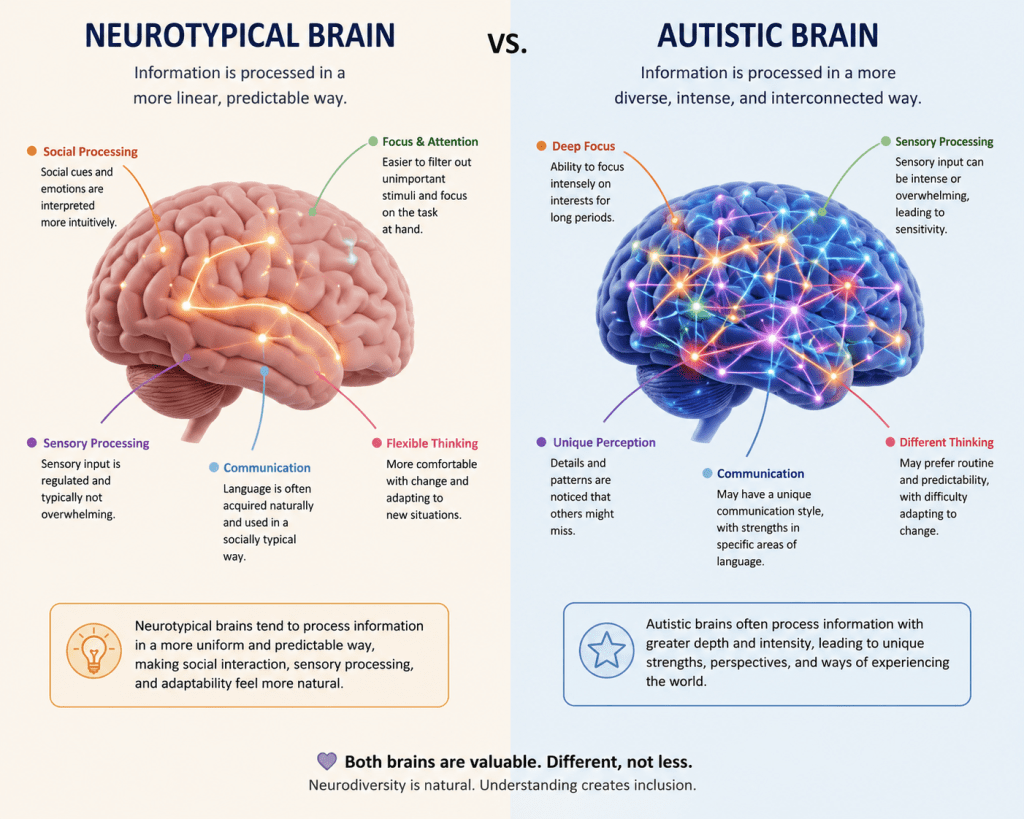
- The Fluorescent Flicker Effect: Many autistic individuals process visual input differently. Reduced GABA-mediated neural inhibition can make it harder for the brain to filter out sub-perceptual light oscillations. Where a neurotypical brain perceives a steady glow, a neurodivergent brain may process rapid, high-frequency flickering alongside intense glare.
- The Cognitive Toll: Exposure to unmitigated sensory friction leads to eye strain, severe headaches, rapid cognitive fatigue, and sensory overload—diminishing an individual’s ability to focus or stay present.

The Metaphor: The “Skyscraper” of Self-Regulation
As autistic psychologist Dr. Dan Wendler PHD explains, self-regulation for neurodivergent people functions like navigating a skyscraper:
“Imagine you need to go somewhere in the city, but you’re at the top of a skyscraper. You have to reach the ground floor before you can move forward. Existing in standard environments puts neurodivergent people on a higher floor by default due to constant sensory friction and masking. Descending to the ‘ground floor’ (a state of calm) requires taking the stairs rather than an elevator—it takes more time and deliberate energy.”
Without physical environments designed to help people reach that “ground floor,” continuous demands inevitably lead to burnout.
2. Key Standards & Architectural Frameworks
While neurodiversity is not yet universally mandated in building codes, several leading standards provide evidence-based guidelines for inclusive design:
| Framework / Standard | Origin | Key Focus & Principles |
| PAS 6463:2022 (Design for the Mind) | British Standards Institution (BSI) | The first national standard for neurodiversity in built environments. Centers on Clarity, Control, and Calm across lighting, acoustics, wayfinding, and natural elements. |
| ASPECTSS™ Design Index | Magda Mostafa | An evidence-based autism design framework assessing 7 criteria: Acoustics, Spatial Sequencing, Sensory Zoning, Transition Zones, Safety, Escape/Quiet Spaces, and Compartmentalization. |
| Stimpunks Standards | Stimpunks Foundation | Defines operational tiers (ND-1 Friendly to ND-3 Native) prioritizing sensory safety, attention protection, bodymind breaks, and reduced masking pressure. |

3. Core Design Recommendations
Applying neurodivergent design principles relies on balancing environmental predictability with personal choice.
Sensory Comfort
- Lighting: Replace fluorescent fixtures with dimmable, diffused natural light or warm LEDs. Minimize direct glare and polished reflections.
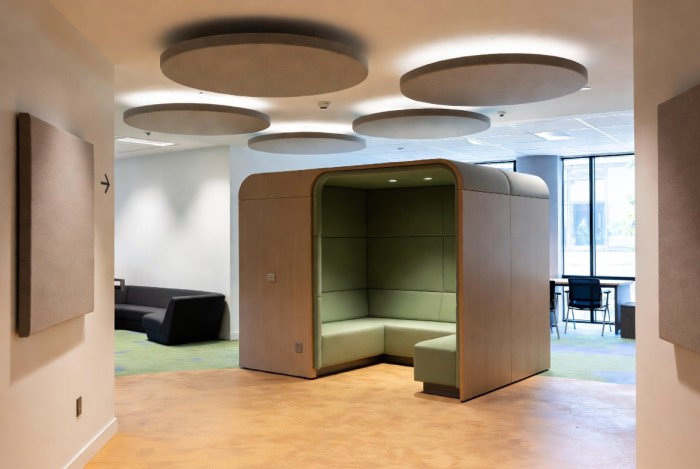
- Acoustics: Integrate sound-absorbing wall panels, acoustic baffles, and quiet zones to dampen background noise and echo.
- Visuals & Odors: Choose low-pattern, neutral finishes and high-efficiency HVAC filtration to eliminate strong chemical or food odors.
Layout & Predictability
- Spatial Sequencing: Create intuitive pathways with logical movement between zones so occupants can anticipate what comes next.
- Transition Zones: Establish clear threshold spaces between high-stimulus areas (e.g., cafeterias, open desks) and low-stimulus zones to give individuals time to recalibrate.
- Sensory Zoning: Group activities by noise and energy levels, separating collaborative hubs from quiet focus pods.
Choice, Control & Regulation
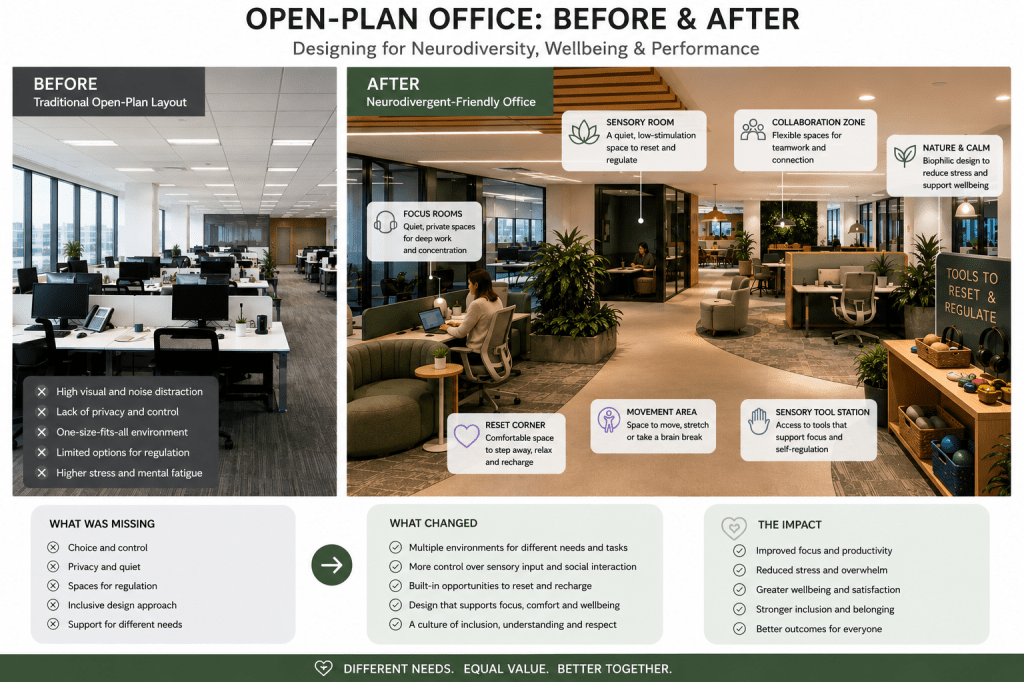
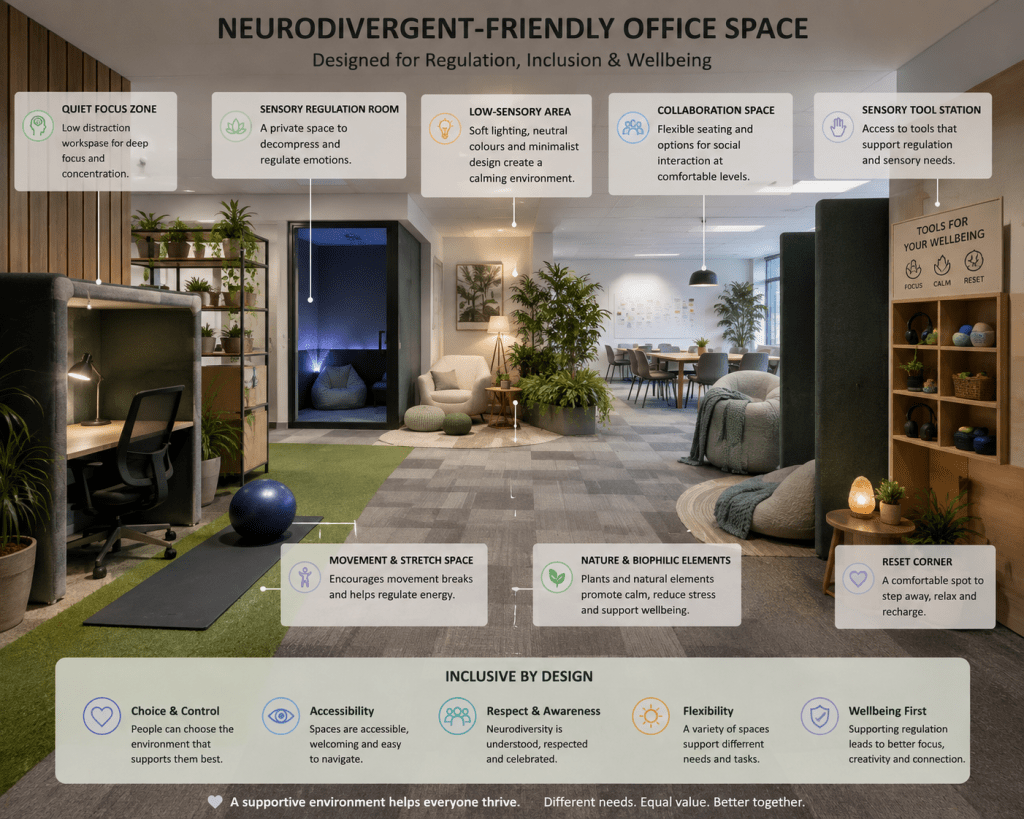
- Micro-Environments: Offer a variety of spaces (e.g., active collaboration areas, standing desks, fully enclosed focus pods, and low-lit sensory rooms).
- Biophilic Access: Provide visual or physical access to outdoor green spaces, large scale water features like reflecting pools, pocket parks, and natural light to accelerate nervous system recovery.
4. Universal Design: Benefits Beyond Neurodivergence
While engineered around neurodivergent requirements, these design choices embody the principles of Universal Design.
Controlling acoustic bounce, eliminating harsh lighting glare, providing clear wayfinding, and building quiet retreat spaces directly benefits:
- Employees experiencing migraines, sensory fatigue, or chronic stress.
- Individuals with dementia or age-related cognitive changes.
- Anyone requiring deep, uninterrupted concentration in modern open-plan spaces.
By collaborating directly with neurodivergent individuals during the design process, organizations create spaces that are not only accessible, but deeply supportive of human well-being and performance.
Neurological Basis:
Some research suggests that differences in GABA-mediated inhibition may make it harder for the brain to filter or reduce certain visual signals. This can make the brightness, glare, or flicker of fluorescent lights feel unusually intense.
For some autistic people, this sensitivity can cause headaches, eye strain, fatigue, difficulty concentrating, or sensory overload. However, not every autistic person experiences light sensitivity, and researchers are still studying the exact neurological mechanisms involved.
Quiet, low-lit spaces in open-plan offices can help autistic people by providing a break from sensory overload. Open offices often combine noise, movement, conversations, and bright lighting, which can be overwhelming.
A quiet, low-lit space can:
- Reduce sensory overload from noise, bright lights, and visual distractions.
- Improve concentration by creating a calmer environment for focused work.
- Reduce stress and fatigue by giving the brain time to recover from constant stimulation.
- Support self-regulation when someone feels overwhelmed or needs a short sensory break.
- Improve productivity and comfort by allowing employees to choose an environment that works best for their sensory needs.
These spaces can benefit many employees, not just autistic people, particularly anyone who needs a quiet environment for concentration or recovery.
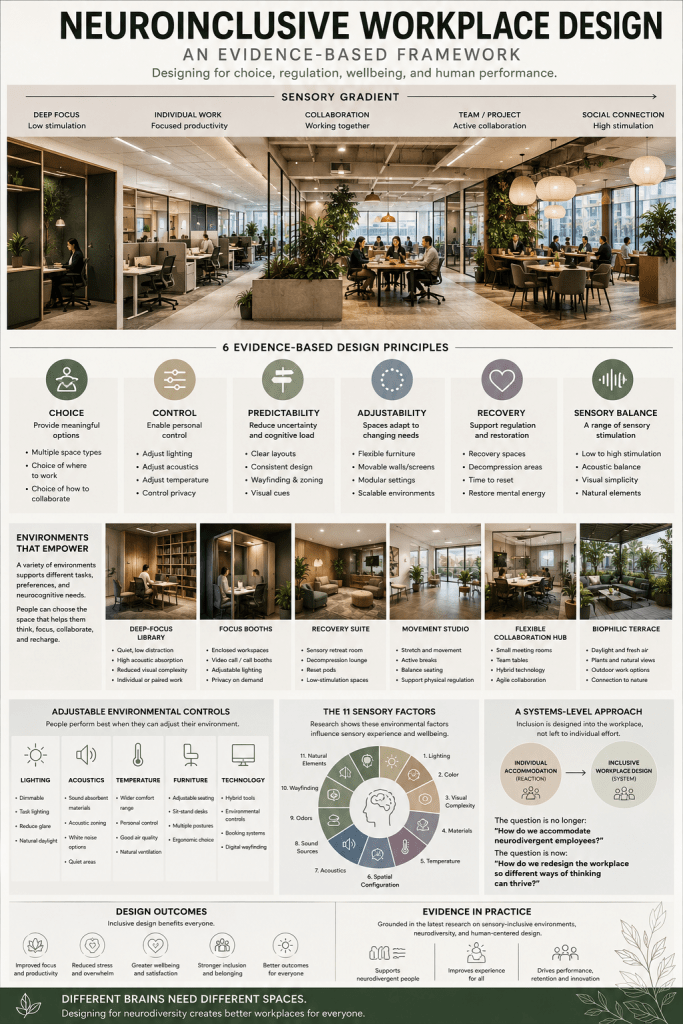
A. Add choice and control as the central design principle
Instead of designing one “perfect” workspace, current research suggests offering a range of environments so employees can choose the setting that best supports their cognitive and sensory needs.
CHOICE & CONTROL
- Choose where to work
- Choose how to collaborate
- Choose sensory conditions
- Choose levels of privacy
- Choose when to engage and when to retreat
B. Replace “quiet rooms” with recovery spaces
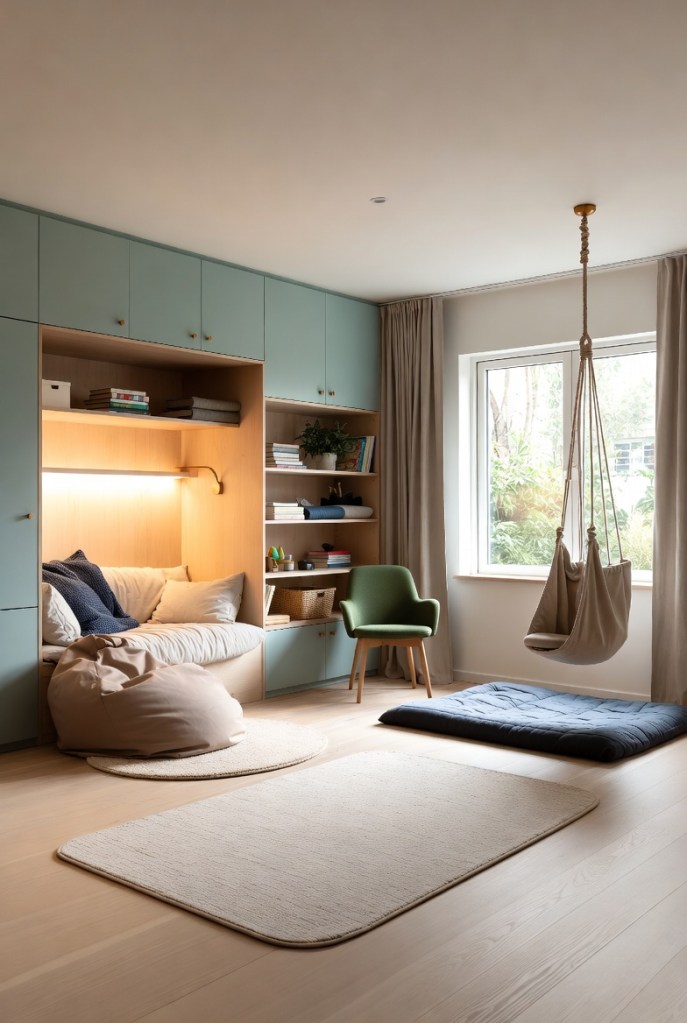
The latest research identifies recovery as a key design quality, rather than simply reducing stimulation. A recovery space isn’t just quiet. It’s a place where employees can actively regulate, reset, and return to work when they’re ready.
Suggested spaces:
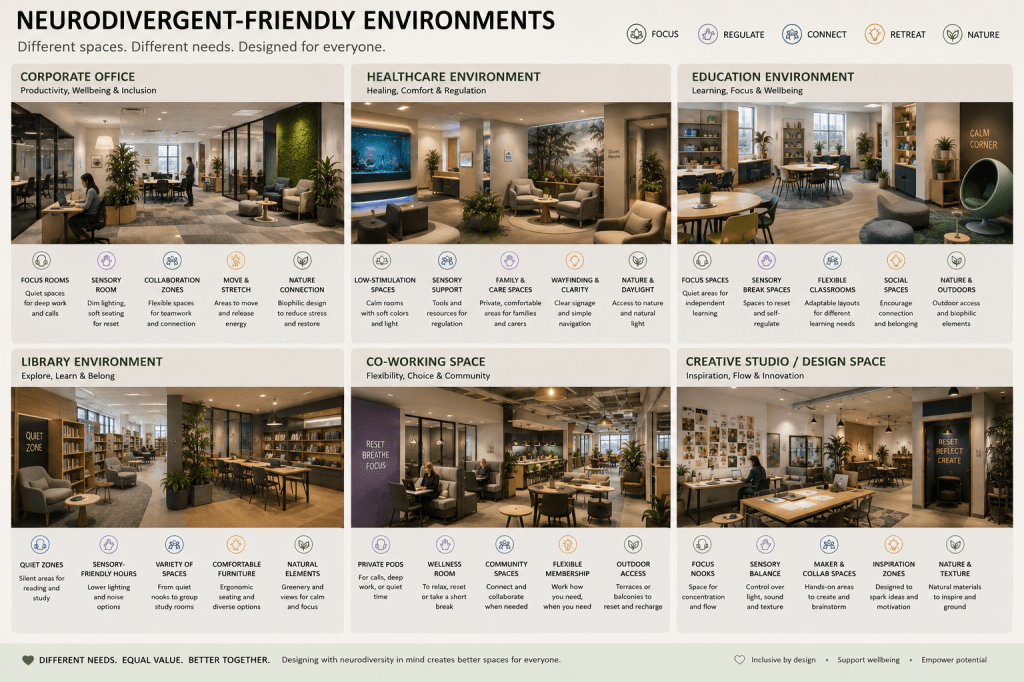
- Sensory retreat room
- Reset pod
- Wellness room
- Technology-free space
- Decompression lounge
C. Add adjustable sensory environments
One-size-fits-all environments are increasingly being challenged. Research emphasizes adjustability rather than standardized settings.
Adjustable features could include:
- Dimmable lighting
- Task lighting
- Noise-control options
- Movable screens
- Adjustable desks
- Flexible seating
- Temperature preferences
- Individual control of environmental settings
D. Add predictability and wayfinding
Predictability consistently appears in recent sensory-inclusive design research. Unexpected changes, unclear circulation, and ambiguous spaces can increase cognitive load. Clearer environments reduce mental fatigue.
New design features:
- Consistent layouts
- Clear signage
- Visual cues
- Defined zones
- Intuitive circulation
- Easy navigation
E. Create sensory gradients instead of separate rooms
Instead of labeling spaces as either “quiet” or “collaborative,” designers are increasingly creating a spectrum of stimulation.
Low stimulation → Moderate stimulation → High stimulation
- Deep-focus rooms
- Individual workstations
- Small collaboration areas
- Team spaces
- Social hubs
F. Add prospect and refuge
Emerging research suggests that desk orientation and enclosure matter, particularly for people with ADHD. Having a protected workspace while maintaining visibility of the surrounding environment may reduce hypervigilance and cognitive demand.
Design strategies:
- Avoid seating people with their backs to circulation
- Provide visual backing
- Add partially enclosed work areas
- Create refuge spaces without complete isolation
G. Include biophilic design as a regulatory tool
Plants are often treated as decoration, but current research increasingly frames natural elements as sensory regulation tools.
Biophilic elements:
- Living walls
- Indoor plants
- Natural materials
- Daylight
- Outdoor work areas
- Nature views
H. Expand the sensory categories
The newest research identifies 11 environmental factors that influence sensory experience.
| Environmental factor | Workplace design response |
|---|---|
| Lighting | Adjustable lighting |
| Color | Muted, balanced palettes |
| Visual complexity | Reduced clutter |
| Materials | Comfortable textures |
| Temperature | Thermal choice |
| Spatial configuration | Multiple workspace types |
| Acoustics | Sound management |
| Sound sources | Controlled noise |
| Odors | Better air quality |
| Wayfinding | Clear navigation |
| Natural elements | Biophilic design |
I. “Different brains need different spaces”
Recent workplace research suggests moving away from individualized accommodations toward organizational and systems-level design. The question becomes:
“How should we redesign the workplace?” rather than “How should employees adapt?”
Key Standards and Guidelines
- PAS 6463:2022 – Design for the Mind – Neurodiversity and the Built Environment (British Standards Institution): This is the most prominent formal guide, believed to be the first national standard specifically addressing neurodiversity in the built environment. It covers buildings, external spaces, public/commercial use, and residential settings.Core principles include clarity, comfort, control, and choice (often summarized as “clarity, control, and calm”). It provides recommendations on:
- Lighting (adjustable, diffused, minimize glare/flicker; avoid harsh fluorescents).
- Acoustics (sound absorption, reduced echo/reverberation, quiet zones).
- Wayfinding and layout (predictable, intuitive navigation; clear signage with good contrast; reduced cognitive load).
- Sensory zoning and materials (minimize visual clutter, strong odors, overwhelming patterns/textures).
- Thermal comfort, air quality, and access to nature (e.g., pocket parks or quiet outdoor spaces for regulation).
- Flexibility, stakeholder engagement (including lived experience), and safety features.
- ASPECTSS™ Design Index (Magda Mostafa): An evidence-based framework specifically for autism-friendly design, usable as an assessment and development tool. Key criteria:
- Acoustics: Control noise, echo; vary by activity.
- Spatial Sequencing: Logical flow and predictability in layouts.
- Sensory Zoning: Group spaces by stimulus level (high/low) with transitions.
- Transition Zones: Areas to recalibrate senses.
- Safety: Rounded edges, etc.
- Quiet/Withdrawal Spaces: Low-stimulation respite areas.
- Compartmentalization: Clear, single-function sensory environments.
- Other Resources:
- Stimpunks Neurodivergent Design Standards: Defines levels (ND-1 Friendly, ND-2 Supportive, ND-3 Native) emphasizing proactive design for attention, sensory safety, bodymind breaks, and reduced masking.
- RIBA Inclusive Design Overlay, HOK guides, and various placemaking or campus-specific frameworks.
- Emerging efforts (e.g., in Australia) for national neuro-inclusive standards.
Summary of Common Design Recommendations
These draw from the above and broader best practices:
- Sensory Comfort — Adjustable/dimmable lighting (natural + warm LEDs); sound-absorbing materials and quiet zones; neutral colors, minimal patterns/clutter; good ventilation and odor control.
- Predictability & Navigation — Clear, consistent wayfinding; logical spatial flow; visual cues.
- Choice & Flexibility — Variety of spaces (focus pods, collaborative areas, sensory rooms); movable furniture; options for privacy or stimulation.
- Regulation Support — Access to nature, movement-friendly areas, bodymind break spaces.
- Universal Benefits — Many features (e.g., better acoustics, less clutter) improve usability for all users, including those with dementia or migraines.
Implementation is still evolving and not yet mandatory in most building codes (e.g., not fully integrated into US ADA or equivalent everywhere). Best results come from co-design with neurodivergent people.
For practical application, consult the full PAS 6463 document (available via BSI), ASPECTSS resources, or engage specialists. Architects and neurodiversity-focused firms increasingly incorporate these principles. If you’re designing, renovating, or advocating for a specific building type, more tailored advice is possible with additional details.
Simple Additional hacks for companies to provide for a neuro inclusive workspace from Professor Sol Smith, Sol holds a Master of Science in Psychology, MFA in Writing, Education Specialist degree, and is CAS-certified. He has over 20 years as a college professor and runs an online neurodivergent learning community. “Getting the job done, getting the job done on time, getting the job done right are rarely the problem for autistic people” Sol says, “they are the most over qualified, competent people in the workforce, a little bit of understanding could make such a huge difference” He suggests these small changes would be transformative:
Provide noise cancelling headphones on site
Let workers work uninterrupted, no meetings for long periods, at their discretion
No task switching, task switching only when they indicate they are ready
More frequent breaks, breaks taken at their descretion
Always clear written instructions, rather than implied instructions
Provide mentors
Flexible schedules and time to have a sensory detox on site at their discretion
Orla Huq.

