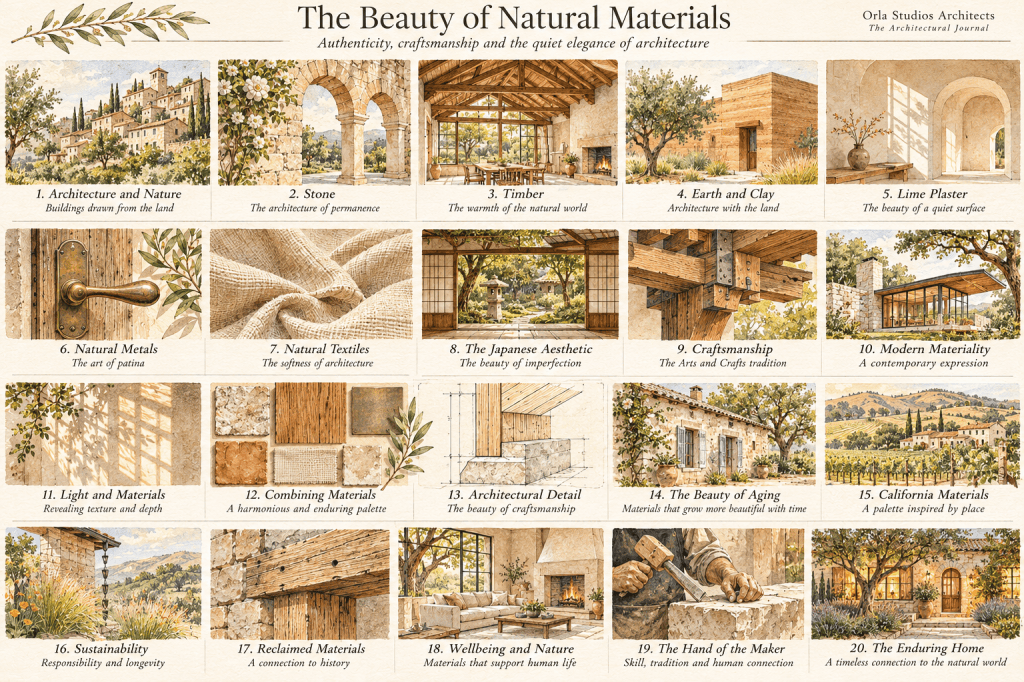
Authenticity, craftsmanship and the quiet elegance of architecture
Orla Studios Architects | The Architectural Journal
There is something deeply comforting about the presence of natural materials in a home.
The warmth of an oak floor beneath bare feet. The subtle texture of a limestone wall. The softness of linen in the morning light. The gentle irregularities of hand-applied plaster. The patina of a bronze door handle that has been touched countless times.
These materials connect us to something older and more enduring than architecture itself.
They carry within them the history of the natural world, the character of the landscapes from which they originate and the skill of the hands that transform them.
In an age in which almost any surface can be manufactured to imitate another, there is something particularly meaningful about the authenticity of natural materials.
Their beauty lies not in perfection, but in individuality, texture, depth and the capacity to change gracefully over time.
Natural materials remind us that architecture is not simply something we see. It is something we touch, inhabit, experience and grow to love.
The Ancient Relationship Between Architecture and Nature
For much of human history, architecture emerged directly from the materials available within the surrounding landscape.
Stone was quarried from nearby hillsides. Timber was harvested from local forests. Clay was shaped into bricks and tiles. Earth was compacted into walls, and lime was transformed into mortar and plaster.
Buildings developed a natural relationship with their surroundings because their materials were quite literally drawn from the land.
The limestone architecture of the Mediterranean, the timber buildings of northern Europe, the earthen architecture of the American Southwest and the delicate wooden structures of Japan each express a distinctive relationship between geography, climate, culture and craftsmanship.
These buildings possess a sense of belonging that remains deeply appealing today.
Their colors echo the landscape. Their textures reflect local geology and vegetation. Their construction methods reveal generations of accumulated knowledge.
Long before sustainability became an architectural consideration, many traditional buildings embodied an intimate understanding of local resources and environmental conditions.
There is much we can learn from this relationship as we design for the future.
Stone: The Architecture of Permanence
Few materials communicate a sense of permanence as beautifully as natural stone.
Formed over geological time, stone possesses a depth and individuality that cannot easily be replicated.
Limestone, marble, granite, sandstone, slate and travertine each have their own distinctive character, reflecting the conditions under which they were formed.
The ancient Egyptians used stone to express monumentality and endurance. Greek architects explored its sculptural qualities through proportion and detail. Roman builders developed sophisticated techniques for its structural and decorative use.
During the Renaissance, stone became an extraordinary medium for architectural expression, from the rusticated façades of Florentine palaces to the delicately carved details of Italian villas.
In contemporary architecture, stone can be equally expressive when used with simplicity and restraint.
A beautifully proportioned limestone fireplace, a solid stone threshold, a garden wall or a continuous stone floor extending from the interior onto a terrace can establish a profound sense of connection between architecture and landscape.
Stone responds beautifully to natural light. Its subtle variations become more apparent as sunlight moves across its surface, revealing textures, mineral deposits and traces of its geological origins.
Its beauty is both visual and tactile.
A thoughtfully detailed stone surface brings a quiet sense of solidity and timelessness to a home.
Timber: The Warmth of the Natural World
Timber brings a particularly intimate quality to architecture.
Unlike many other building materials, wood carries visible evidence of its life. Its grain, knots, growth rings and variations in color tell the story of a living organism shaped by its environment.
Throughout history, timber has been used to create buildings of extraordinary beauty.
Traditional Japanese architecture celebrates the precision of timber joinery and the natural character of wood. Medieval European buildings reveal the expressive qualities of exposed structural framing. The Arts and Crafts movement embraced timber as a material through which the beauty of craftsmanship could be rediscovered.
In the twentieth century, architects such as Frank Lloyd Wright and Alvar Aalto explored the warmth and human qualities of wood within modern architecture.
Today, timber continues to offer wonderful opportunities for architectural expression.
Exposed beams can establish rhythm and proportion. Timber ceilings can bring warmth to generous interior volumes. Carefully crafted wall paneling can create intimacy and acoustic comfort. Timber screens can filter sunlight and establish a delicate relationship between privacy and openness.
Oak, walnut, cedar, ash and Douglas fir each bring a different character to a space.
The choice of species, grain, finish and detailing can transform the atmosphere of an interior.
Responsibly sourced timber also offers important environmental opportunities, particularly when used in durable construction and thoughtfully considered structural systems.
Perhaps one of the most beautiful qualities of timber is its ability to make even the most contemporary architecture feel warm, familiar and welcoming.
Earth and Clay: Architecture Drawn from the Land
Earth is among the oldest building materials in the world.
For thousands of years, civilizations have used adobe, rammed earth, cob and clay brick to create buildings that respond to their local climates and landscapes.
The earthen architecture of North Africa, the Middle East and the American Southwest demonstrates the extraordinary architectural possibilities of this seemingly humble material.
Rammed earth, in particular, possesses a remarkable visual character.
Its horizontal layers reveal the process of construction, creating subtle bands of color and texture that resemble geological formations.
A rammed-earth wall can feel almost like a section of the landscape itself.
Clay also offers beautiful opportunities at a more intimate architectural scale.
Terracotta floor tiles, handmade bricks and ceramic surfaces introduce warmth, texture and individuality into a building.
Their gentle variations in color and form bring a richness that is often absent from highly standardized manufactured surfaces.
In California, the warm tones of earth and terracotta resonate particularly beautifully with the golden hills, agricultural landscapes and Mediterranean qualities of the region.
When appropriately designed for structural, seismic and moisture conditions, earthen materials can also contribute to thermal mass and environmentally responsible construction.
Their enduring appeal lies in their simplicity.
They remind us that some of the most beautiful architecture can emerge from the most ordinary materials beneath our feet.
Lime Plaster: The Beauty of a Quiet Surface
There is an extraordinary beauty in a simple plaster wall.
Unlike perfectly uniform painted surfaces, traditional lime plaster possesses subtle variations in texture, tone and depth.
It responds to changing light in a particularly delicate way, becoming almost luminous in certain conditions and softly textured in others.
Lime plaster has been used in architecture for thousands of years, from ancient Roman villas to Mediterranean farmhouses and Renaissance palaces.
Its understated character allows other architectural elements to become more expressive.
The grain of a timber door, the texture of a stone fireplace or the shadow cast by a deeply recessed window can become particularly beautiful against a quiet plaster surface.
In contemporary interiors, lime plaster offers an opportunity to create spaces that feel refined without being overly formal.
Its natural irregularities introduce a human quality into otherwise precise architectural compositions.
Traditional lime-based finishes can also offer vapor-permeable properties when used within compatible wall assemblies.
A beautifully crafted plaster wall does not demand attention.
Instead, it provides a gentle backdrop to the changing qualities of light, material and everyday life.
Natural Metals and the Art of Patina
Bronze, copper, brass and iron possess a wonderful capacity to develop character over time.
Their surfaces respond to touch, air, moisture and the surrounding environment, gradually acquiring a patina that becomes part of their identity.
Historically, metals have been used to express some of the most intimate details of architecture.
Door handles, hinges, balustrades, lanterns, window frames and decorative fittings bring us into direct physical contact with a building.
These small elements often become some of the most memorable aspects of architectural craftsmanship.
An unlacquered brass handle may become softer and darker with use. A bronze entrance door may develop subtle variations in color. Copper roofing can gradually acquire its distinctive green patina.
Rather than viewing these changes as imperfections, architecture can celebrate them as evidence of time and use.
The most beautiful architectural details often possess a sense of familiarity that develops gradually.
They become richer through their relationship with the people who inhabit the building.
Natural Textiles and the Softness of Architecture
While stone, timber and plaster establish the physical character of a building, natural textiles introduce softness and intimacy.
Linen, wool, cotton, silk and other natural fibers bring texture, movement and warmth to architectural interiors.
A linen curtain can transform the quality of sunlight entering a room. A wool rug can soften the acoustics of a stone-floored interior. Upholstered furniture can introduce a sense of comfort within a more sculptural architectural space.
Natural textiles are particularly beautiful when they complement the inherent qualities of the architecture.
Their colors may echo the landscape beyond the windows. Their textures may provide a gentle contrast to stone, timber or plaster.
They also allow an interior to evolve over time without altering the fundamental architectural composition.
A thoughtfully designed home provides a timeless architectural framework within which these softer elements can change with the seasons, the preferences of its inhabitants and the rhythms of everyday life.
The Japanese Appreciation of Imperfection
Traditional Japanese aesthetics offer a particularly beautiful understanding of natural materials.
The concept of wabi-sabi is often associated with an appreciation of impermanence, simplicity and the beauty found in imperfection.
A weathered timber beam, an irregular ceramic vessel, a moss-covered stone or a softly worn surface can possess a quiet richness precisely because it reveals the passage of time.
In traditional Japanese architecture, materials are often celebrated for their inherent qualities rather than transformed into something unrecognizable.
The grain of wood remains visible. Paper screens reveal the delicate character of filtered light. Stone retains its natural irregularities.
In his influential essay In Praise of Shadows, Jun’ichirō Tanizaki explored the relationship between subdued illumination, natural materials and the atmosphere of traditional Japanese interiors.
His observations remain remarkably relevant to contemporary architecture.
They encourage us to appreciate subtlety rather than spectacle, depth rather than gloss, and the gentle beauty of materials that reveal themselves gradually.
A home need not be flawless to be beautiful.
Sometimes, it is the very absence of perfection that makes a place feel most human.
The Arts and Crafts Movement: Rediscovering the Handmade
During the nineteenth century, the Arts and Crafts movement emerged partly in response to the increasing industrialization of manufacturing.
Designers and thinkers such as William Morris and John Ruskin championed the importance of craftsmanship, the integrity of materials and the relationship between beauty and everyday life.
Architecture became an opportunity to celebrate the skill of the maker.
Timber joinery, handcrafted tiles, carved stone, decorative metalwork and carefully detailed interiors expressed a belief that ordinary domestic objects deserved thoughtful design.
In California, architects Charles and Henry Greene developed a particularly beautiful interpretation of these principles.
The Gamble House in Pasadena demonstrates an extraordinary sensitivity to timber, joinery, proportion and the relationship between architectural detail and the whole building.
Its craftsmanship is not simply decorative. It is integral to the architectural experience.
These traditions continue to inspire contemporary architecture.
In an increasingly automated world, the evidence of human skill within a building can possess particular meaning.
A beautifully crafted staircase, a handmade tile or a carefully resolved timber joint reminds us that architecture is ultimately a collaboration between designers, makers and the natural world.
Natural Materials in Modern Architecture
Modern architecture is sometimes associated with industrial materials, abstraction and geometric simplicity.
Yet many of its most beautiful buildings demonstrate a profound appreciation of natural materials.
Frank Lloyd Wright developed an architectural philosophy in which buildings, materials and landscapes were understood as interconnected.
At Fallingwater, locally quarried sandstone establishes a powerful relationship between the house and the surrounding rock formations.
Alvar Aalto explored the expressive and human qualities of timber, brick and natural materials, bringing warmth and individuality to modern architectural spaces.
Louis Kahn revealed the monumental beauty of materials through clarity of form, structure and light.
Carlo Scarpa explored the relationship between traditional craftsmanship and modern architectural expression through extraordinarily refined combinations of stone, timber, glass and metal.
More recently, Peter Zumthor has demonstrated how the sensory qualities of materials can become the very foundation of an architectural experience.
At the Therme Vals in Switzerland, layers of local quartzite create an atmosphere of geological depth, intimacy and permanence.
These architects remind us that modernity and natural materials are not opposing ideas.
Contemporary architecture can be remarkably innovative while remaining deeply connected to the timeless qualities of the natural world.
Material Honesty
One of the most enduring principles of architectural design is the idea of material honesty.
At its simplest, it means allowing a material to express its inherent character.
Stone can communicate weight and solidity. Timber can reveal its grain and structural rhythm. Brick can express the dimensions and repetition of its individual units. Metal can reveal its precision, strength and capacity for delicate detailing.
When materials are used in ways that respect their properties, architecture often acquires a natural sense of clarity.
The connections between materials become particularly important.
The meeting of a timber ceiling and a plaster wall, the transition between a stone floor and a garden terrace, or the junction of a bronze window frame and a limestone surround can become beautiful architectural moments.
These details reveal the care with which a building has been conceived.
Material honesty does not require every structural element to remain exposed, nor does it preclude contemporary manufacturing techniques.
Rather, it encourages an understanding of what each material does particularly well and how its qualities can contribute to the architectural whole.
The result is often an architecture that feels quietly confident and authentic.
The Relationship Between Light and Materials
Natural materials possess an extraordinary relationship with light.
A limestone wall may appear almost white in the morning, warm and golden in the afternoon, and softly grey as evening approaches.
Timber reveals different aspects of its grain depending on the direction and intensity of illumination.
Plaster becomes luminous in reflected daylight, while textured stone becomes particularly expressive when light falls across its surface at a shallow angle.
These changing qualities bring architecture to life.
A material should therefore never be selected solely from a small sample viewed under artificial lighting.
Its relationship with orientation, surrounding materials, scale and natural illumination deserves careful consideration.
A beautifully designed interior may rely on a very restrained palette, allowing the changing qualities of light to introduce variety throughout the day.
The architecture becomes richer without the need for additional ornamentation.
Light reveals the beauty that is already present.
The Art of Combining Materials
The beauty of a material is often enhanced by the materials surrounding it.
The warmth of oak can provide a gentle contrast to the coolness of limestone. The softness of linen can complement the solidity of a stone wall. Bronze can introduce a subtle richness against pale plaster.
The art lies in establishing a dialogue between these different qualities.
Too many competing materials can diminish the clarity of an architectural composition.
A restrained palette, thoughtfully developed, allows each material to express its own character while contributing to a harmonious whole.
Continuity can also be particularly powerful.
A stone floor extending from an interior living space onto an outdoor terrace can establish a sense of connection with the landscape.
A timber ceiling continuing beneath a covered veranda can soften the transition between inside and outside.
A garden wall constructed from the same stone as the house can bring the architecture and landscape into a single composition.
Rather than selecting materials independently for each room, the architect can consider the home as a complete material experience.
The result is a sense of coherence that can be felt throughout the building.
Craftsmanship and the Architectural Detail
Beautiful materials alone do not guarantee beautiful architecture.
Their potential is realized through proportion, detailing and craftsmanship.
The thickness of a stone edge, the depth of a window reveal, the alignment of timber boards and the precision of a cabinetmaker’s joint all influence the way a material is experienced.
A carefully resolved detail can elevate an otherwise simple composition.
A recessed bronze handle within an oak door. A beautifully finished timber handrail. A stone bench integrated into a garden wall. A delicate shadow gap between plaster and cabinetry.
These are small moments, yet collectively they establish the character of a building.
Craftsmanship also requires an understanding of how materials behave.
Timber expands and contracts with changes in moisture. Stone varies in porosity and strength. Metals respond differently to environmental exposure. Plaster requires appropriate substrates and detailing.
The architect’s role is to bring together the artistic and technical aspects of these decisions.
Working closely with skilled builders, cabinetmakers, stone masons, metalworkers and other craftspeople allows the inherent qualities of materials to be expressed beautifully and appropriately.
The most successful details often appear remarkably simple.
Their simplicity is the result of considerable thought.
The Beauty of Materials That Age Gracefully
Contemporary culture often places considerable value on newness.
Yet architecture offers a different perspective.
A building may become more beautiful through decades of use, developing a character that could never have been achieved on the day construction was completed.
Timber gradually deepens or softens in color. Natural stone develops a gentle patina. Bronze records the traces of human touch. Gardens mature around weathered walls.
These changes establish a sense of continuity between architecture and life.
There is an important distinction, however, between graceful aging and deterioration.
Thoughtful material selection must consider durability, maintenance, moisture, ultraviolet exposure and the particular environmental conditions of a site.
Appropriate detailing allows materials to weather beautifully while continuing to perform their architectural functions.
A well-designed building should not require constant intervention simply to preserve its original appearance.
It should be capable of developing character over time.
The beauty of natural materials invites us to design not only for the present moment, but for the decades that follow.
Natural Materials and Human Wellbeing
Our relationship with the natural world is an important part of the human experience.
Architecture can help maintain this connection even when we are indoors.
The visible grain of timber, the texture of stone, the softness of natural fibers and the changing appearance of materials in daylight can introduce sensory richness into our everyday surroundings.
Biophilic design explores these relationships between people, nature and the built environment.
Natural materials, daylight, views of vegetation and opportunities for contact with the outdoors can contribute to environments that feel comfortable, restorative and connected to nature.
Material selection also has practical implications for indoor environmental quality.
Low-emitting finishes, appropriate adhesives, moisture management and thoughtfully selected products can help support healthier interior environments.
A material’s natural origin does not automatically make it healthy or environmentally preferable. Its processing, treatments, installation and long-term performance must also be considered.
A beautifully designed home brings together these practical considerations with the emotional and sensory qualities of architecture.
The objective is to create spaces that are not only beautiful to look at, but genuinely pleasurable to inhabit.
Natural Materials and Environmental Responsibility
The growing importance of environmentally responsible architecture invites us to reconsider where our materials come from, how they are produced and what happens to them over the life of a building.
Natural materials can offer significant environmental opportunities when selected thoughtfully.
Responsibly harvested timber can store biogenic carbon during its service life. Reclaimed materials can reduce the need for new extraction and preserve existing craftsmanship. Locally sourced stone may reduce transportation impacts while strengthening a building’s relationship with its region.
Earth-based materials can offer low-impact construction opportunities in suitable applications.
Durability is equally important.
A material that performs beautifully for generations may offer greater long-term value than one that requires frequent replacement.
However, natural materials are not inherently sustainable simply because they originate in nature.
Quarrying, forestry practices, manufacturing, transportation, installation and maintenance all influence their environmental impact.
Thoughtful architectural design considers the complete life cycle of a material, including its embodied carbon, durability, repairability and potential for future reuse.
One of the most meaningful environmental strategies is to create buildings that people value enough to preserve.
Architecture that is adaptable, well crafted and enduringly beautiful is less likely to be unnecessarily demolished or replaced.
Beauty and sustainability can share a common purpose: longevity.
The Beauty of Reclaimed Materials
Reclaimed materials offer a particularly meaningful connection between architecture and history.
Timber recovered from an old barn, stone salvaged from an earlier building or antique terracotta tiles can introduce a sense of continuity into contemporary architecture.
These materials possess qualities that are difficult to reproduce.
Their surfaces carry traces of earlier uses, craftsmanship and exposure to the elements.
When thoughtfully incorporated into a new home, they establish a dialogue between past and present.
A reclaimed timber beam may become the defining feature of a contemporary living room. Antique stone paving can bring character to a newly designed courtyard. Restored bronze hardware can introduce a beautiful sense of individuality into an otherwise modern interior.
Their use requires care, including appropriate assessment of structural integrity, previous treatments and suitability for the intended application.
When these considerations are addressed, reclaimed materials can offer both environmental and architectural richness.
They remind us that creating something new does not always require beginning with new materials.
Natural Materials and the California Landscape
California offers an extraordinarily rich palette of architectural inspiration.
The golden tones of its summer hills, the silvery greens of olive trees, the deep textures of oak woodland, the warm colors of coastal sandstone and the soft greys of the Pacific coastline create a distinctive natural language.
Architecture can draw from these qualities without literally imitating the landscape.
In Marin County, natural timber, muted stone and soft plaster can establish a beautiful relationship with wooded hillsides and mature oak trees.
In Napa and Sonoma, limestone, terracotta, weathered timber and earthy tones can complement the agricultural character of vineyards and country estates.
Along the coast, restrained palettes of stone, mineral finishes and appropriately detailed materials can respond to the changing atmosphere of fog, sunlight and ocean air.
The selection of materials must also consider California’s particular environmental conditions, including seismic activity, wildfire exposure, drought and coastal weathering.
Natural materials can be incorporated into resilient architecture through appropriate assemblies, protective detailing and careful consideration of their location and performance.
The most beautiful California homes often possess a material palette that feels inseparable from the landscape.
Their architecture does not compete with the natural environment.
It becomes part of its composition.
A Quieter Expression of Luxury
Natural materials offer a particularly enduring interpretation of luxury.
Their beauty does not depend on elaborate decoration, conspicuous expense or passing trends.
It can be found in the simplest architectural gestures.
A beautifully crafted oak door.
A generous stone window seat warmed by the afternoon sun.
A softly textured plaster wall.
A linen curtain moving gently in the breeze.
A bronze handle polished by years of use.
These experiences possess a richness that is both intimate and timeless.
True material luxury lies not necessarily in rarity, but in authenticity, appropriateness and the quality of craftsmanship.
A modest material used with extraordinary care can be more beautiful than an expensive material used without sensitivity.
The most refined interiors often possess a quiet simplicity that allows their materials to speak for themselves.
Nothing needs to be exaggerated.
The beauty is already there.
Designing with Natural Materials at Orla Studios
At Orla Studios, we consider materials to be fundamental to the architectural design process.
From the earliest stages of a project, we explore the relationship between the landscape, architectural form, natural light and the material character of the home.
We consider how materials will be experienced at different scales, from the overall composition of a building to the intimate details encountered through touch.
We explore how stone might connect a residence to its landscape, how timber might introduce warmth and rhythm, how plaster might reveal the changing qualities of light and how beautifully crafted details might enrich everyday experiences.
We are interested in materials that possess authenticity, durability and a capacity to age gracefully.
Our approach brings together architectural tradition, contemporary design, environmental responsibility and an appreciation of the skill of craftspeople.
Whether designing a new residence, transforming an existing home or creating a country estate, our ambition is to establish a material language that feels personal, harmonious and deeply connected to its surroundings.
Every material has its own story.
Architecture offers an opportunity to bring these stories together into something meaningful and enduring.
The Enduring Beauty of the Natural World
Perhaps the greatest beauty of natural materials is that they remind us of our place within a much larger story.
The stone in a wall may have formed millions of years before the building was conceived.
The timber in a ceiling once stood within a living forest.
The clay beneath our feet was shaped by the earth long before it was shaped by human hands.
Architecture brings these materials together, transforming them into places where life can unfold.
Over time, they become part of our own stories.
The floor across which children take their first steps. The timber table around which generations gather. The stone terrace where summer evenings are spent. The familiar doorway that welcomes us home.
These materials become meaningful not only because of their natural beauty, but because of the lives they quietly accompany.
Perhaps this is why natural materials possess such an enduring appeal.
They connect us to the earth, to the passage of time, to the skill of human hands and to the simple pleasure of inhabiting a beautiful place.
They remind us that architecture, at its most meaningful, is not about creating something entirely separate from nature.
It is about finding a beautiful way to belong to it.
Orla Studios Architects
Exploring the relationship between architecture, nature, craftsmanship and the art of living well.


