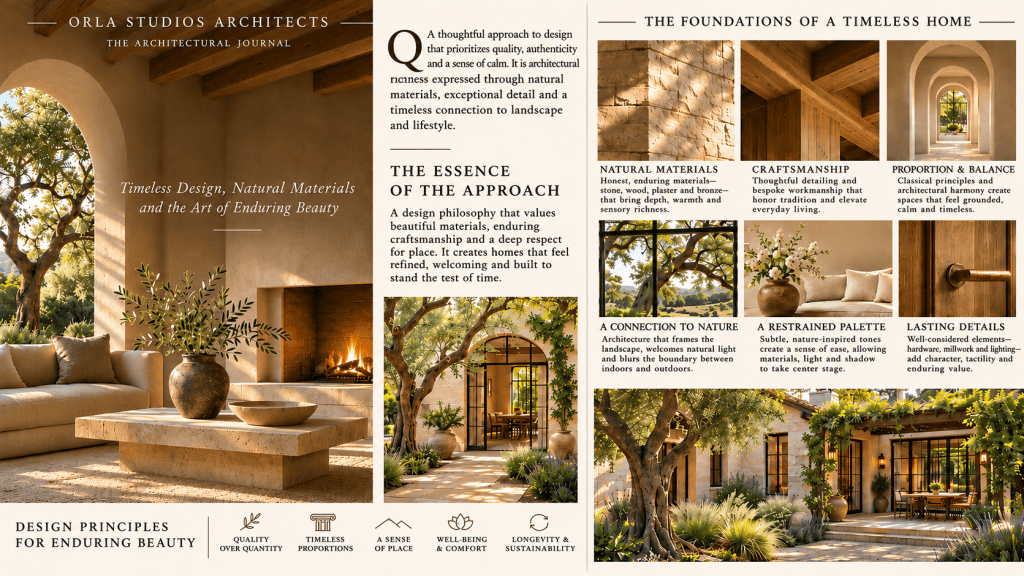
The enduring beauty of restraint, craftsmanship and thoughtful design.
ORLA STUDIOS ARCHITECTS | The Architectural Journal
There is a particular kind of beauty in architecture that does not demand attention. It reveals itself slowly, through the movement of sunlight across a plaster wall, the texture of natural stone, the proportions of a doorway, the warmth of timber and the quiet relationship between a home and its surrounding landscape.
The idea that beauty can emerge from restraint has deep roots in architectural history.
The classical architecture of ancient Greece celebrated harmony, balance and proportion. Renaissance architects such as Andrea Palladio explored mathematical relationships and the composition of spaces to create buildings of remarkable elegance.
Georgian architecture refined these principles through carefully proportioned rooms, symmetrical compositions and understated architectural detailing.
Traditional Japanese architecture developed a parallel philosophy, embracing simplicity, natural materials, imperfection and the contemplative relationship between architecture and nature.
In the twentieth century, architects such as Ludwig Mies van der Rohe, Alvar Aalto and, later, John Pawson explored how simplicity could reveal the essential qualities of space and material.
Across these different traditions, a beaut=iful common principle emerges: architectural richness can be found in the quality of materials, the harmony of proportions and the thoughtful composition of space.
These enduring ideas continue to inspire the homes we design today.
Proportion: The Invisible Language of Beauty
The most beautiful rooms often possess a quality that is difficult to articulate.
Their ceilings feel appropriately scaled. Windows relate naturally to the walls that surround them. Doorways, fireplaces and architectural elements appear to belong precisely where they are.
This is the art of proportion.
Quiet luxury begins long before the selection of finishes, furniture or decorative objects. It begins with the fundamental architectural composition of the home.
The relationship between height and width, solid and void, openness and enclosure, symmetry and asymmetry establishes the character of a space.
As architects, we particularly enjoy exploring these relationships and discovering how subtle adjustments can transform the experience of a room.
When these elements are thoughtfully resolved, even a relatively simple space can possess extraordinary beauty.
The Authenticity of Natural Materials
Natural materials are central to the architecture of quiet luxury.
They possess depth, individuality and subtle variation. They respond to light, develop character with age and bring a lovely connection to the natural world into our homes.
Natural Stone
Limestone, travertine and marble bring geological history, texture and permanence into architecture. Each piece carries its own unique markings, reflecting the extraordinary processes through which it was formed.
Natural Timber
Oak, walnut, ash and cedar introduce warmth, grain and a tactile connection to nature. Whether expressed through architectural paneling, flooring, ceilings or bespoke cabinetry, timber brings a wonderful sense of intimacy to interior spaces.
Architectural Plaster
Lime plaster and handcrafted finishes create subtle variations that respond beautifully to changing daylight. Their soft textures bring depth and character to even the simplest architectural forms.
Living Metals
Bronze, brass and copper develop a natural patina, recording the passage of time and becoming increasingly individual through everyday use.
Natural Textiles
Linen, wool, silk and other natural fibers complement architectural materials, bringing softness, texture and comfort to our living environments.
The luxury of these materials lies in their authenticity and the sensitivity with which they are used.
A beautifully detailed limestone wall or a thoughtfully crafted timber ceiling can bring extraordinary richness to a home.
Craftsmanship:
Some of the most beautiful aspects of architecture are found in details that are barely noticed.
The precise junction between timber and stone. The alignment of architectural paneling. A beautifully resolved window reveal. The integration of a concealed door. The way a handrail feels beneath the hand.
These details require time, knowledge and collaboration between architects, builders and skilled craftspeople.
One of the great pleasures of designing a home is working with talented craftspeople who bring their knowledge, experience and artistry to the architectural vision.
This is not necessarily simple to achieve. The apparent simplicity of a beautifully resolved interior often requires considerable technical sophistication.
Each detail contributes to the overall harmony of the architecture, creating a sense of quality that can be appreciated throughout the home.
Natural Light as an Architectural Material
Perhaps the most extraordinary material available to an architect is light.
Morning sunlight entering a kitchen. The soft illumination of a north-facing studio. The shifting shadows of trees across a timber wall. The golden light of late afternoon falling across a limestone floor.
These beautiful moments can become part of the architecture itself.
The orientation of a building, the depth of window openings, the positioning of skylights and the relationship between interior spaces and the landscape determine how light becomes part of daily life.
We love considering how a home will be experienced at different times of the day, from the first moments of morning to the softer light of the evening.
Quiet luxury embraces the changing character of a home throughout the day and across the seasons.
Architecture becomes a living experience, continually enriched by the natural world around it.
The Art of Restraint
Restraint is not the absence of design. It is the thoughtful consideration of each element within a space.
Quiet does not necessarily mean minimalism, monochromatic interiors or an absence of historical ornamentation. A beautifully paneled Georgian residence can embody quiet luxury just as wonderfully as a contemporary minimalist home.
What matters is the coherence of the architectural language.
A carefully considered material palette allows individual materials to express their character. Architectural details establish rhythm and harmony. Furniture, art, antiques and treasured personal objects are given space to be appreciated.
Color, pattern and ornament can all contribute to this approach when they are thoughtfully integrated into the architecture.
The result is an environment that feels balanced, individual and welcoming.
The ultimate expression of restraint is not emptiness, but harmony.
A Profound Connection to Nature
Some of the most luxurious experiences within a home are also life’s simplest pleasures.
The ability to open a bedroom door onto a private garden. To enjoy breakfast beneath a mature oak tree. To watch the changing seasons from a beautifully framed window. To hear the gentle movement of water in a courtyard.
Architecture can facilitate these experiences through the thoughtful integration of buildings and landscapes.
Here in Northern California, we are fortunate to have an extraordinary natural environment to inspire our architecture. Rolling hills, coastal landscapes, native oak woodlands and the distinctive quality of California light offer wonderful opportunities to create homes deeply connected to their surroundings.
Courtyards, sheltered terraces, loggias, expansive glazing and carefully positioned openings extend the experience of the home beyond its physical boundaries.
A garden can become an outdoor living room, a courtyard can bring nature into the heart of a home, and a thoughtfully positioned window can transform a beautiful tree into a living work of art.
The landscape becomes an essential part of the architecture, enriching the experience of everyday life.
The Luxury of Space, Privacy and Silence
In contemporary life, some of our most treasured experiences are increasingly intangible.
Time. Privacy. Silence. Space.
A thoughtfully designed home can offer a wonderful retreat from the intensity of the outside world.
Architectural planning can establish a natural progression between public and private spaces, creating opportunities for gathering, contemplation and restoration.
A quiet library, a secluded courtyard, a window seat overlooking a garden or a beautifully illuminated bathing space can become places of extraordinary personal significance.
Equally important are the less visible qualities of a home: acoustic comfort, thermal comfort, indoor air quality and intuitive spatial organization.
These qualities may not be immediately apparent in architectural photography, yet they profoundly influence our enjoyment of a home.
Luxury is not only how a home looks. It is how it feels to live within it.
The Beauty of Imperfection and Patina
There is something particularly lovely about architecture that becomes more beautiful with time.
Natural oak deepens in color. Bronze develops a patina. Limestone gradually softens through use. Handcrafted plaster reveals subtle variations in texture.
These changes become part of the character and history of a building, reflecting the natural qualities of its materials and the lives of the people who inhabit it.
The Japanese philosophy of wabi-sabi offers a particularly meaningful perspective, recognizing beauty in impermanence, individuality and the natural aging of materials.
A home does not need to remain pristine to remain beautiful.
We love the idea of materials that can be cared for, restored and enjoyed across generations, acquiring a richness and individuality that only time can bring.
The most meaningful architecture becomes richer through the lives lived within it.
=Sustainability as an Expression of Luxury
Quiet luxury and sustainable architecture share a fundamental principle: an appreciation for quality and longevity.
A home designed to endure for generations offers a wonderful opportunity to bring architectural beauty and environmental responsibility together.
This philosophy encourages:
- Preservation and thoughtful adaptation of existing buildings.
- Responsibly sourced natural materials.
- Durable, repairable architectural components.
- Passive heating, cooling and daylighting strategies.
- Energy-efficient building envelopes and clean energy systems.
- Healthy, low-emission interior finishes.
- Native planting and biodiversity.
- Productive gardens and meaningful connections to nature.
- Flexible spaces that adapt to changing family needs.
- Craftsmanship that rewards maintenance rather than replacement.
Environmental responsibility can become one of the most meaningful foundations of beautiful architecture.
By carefully considering the materials we use, the energy our homes consume and their relationship with the surrounding landscape, we can create homes that are both beautiful to inhabit and thoughtful in their impact.
Perhaps one of the greatest luxuries is creating something beautiful that future generations can continue to enjoy.
Across Architectural Styles
One of the wonderful qualities of home is that it is not limited to a single architectural aesthetic. It is a philosophy that can be expressed through many different architectural traditions.
Classical Architecture
Harmony, symmetry, refined proportions and beautifully composed architectural elements.
Georgian Architecture
Restrained ornament, elegant architectural composition and a wonderful sense of balance.
French Country Architecture
Natural limestone, aged timber, soft plaster finishes and authentic craftsmanship.
Mediterranean Architecture
Shaded courtyards, textured plaster walls, natural stone and a beautiful connection to landscape.
Japanese Architecture
Simplicity, contemplation, natural materials and an appreciation of imperfection.
Scandinavian Architecture
Warmth, natural light, thoughtful functionality and the beauty of everyday objects.
Mid-Century Modernism
Honest materials, clean architectural geometry and seamless indoor-outdoor living.
Contemporary Architecture
Refined detailing, sculptural forms, material integrity and innovative approaches to space.
Each architectural language offers its own beautiful interpretation of the same underlying values.
The opportunity for the architect is to discover which architectural language best reflects the character of the place and the individuality of the people who will inhabit it.
The Ten Principles of Timelessness
01. Beautiful Proportions
Establish harmony through thoughtful architectural composition.
02. Quality Over Quantity
Choose materials and objects for their beauty, meaning and enduring character.
03. Authenticity of Materials
Celebrate the inherent qualities of natural stone, timber, plaster and metals.
04. Exceptional Craftsmanship
Invest in the care, precision and artistry of architectural details.
05. The Beauty of Natural Light
Allow daylight to reveal the character of spaces and materials.
06. Architectural Harmony
Create a cohesive relationship between architecture, interiors, furnishings and art.
07. Nature as an Architectural Partner
Integrate the home with its surrounding landscape and natural environment.
08. Well-Being and Comfort
Prioritize the sensory experience and simple pleasures of everyday life.
09. Longevity and Sustainability
Create beautiful homes that can be enjoyed and cherished across generations.
10. Individuality and Meaning
Design architecture that reflects the lives, aspirations and personalities of its inhabitants.
The Orla Studios Architects Perspective
At Orla Studios Architects, we believe that the most enduring expressions of timelessness emerge from the thoughtful integration of architecture, interiors, craftsmanship and landscape.
Our approach is grounded in an appreciation of architectural history, classical proportion, contemporary innovation and the inherent beauty of natural materials.
We love exploring the unique character of each place, each home and each client, discovering opportunities to create architecture that feels both timeless and deeply personal.
We believe that architecture should enhance the rituals of everyday life — the experience of waking to natural light, gathering with family, entertaining friends, finding solitude and connecting with the natural environment.
Designing a home is a wonderful collaborative journey. Each client brings their own experiences, aspirations and understanding of what makes a home special.
Our role as architects is to bring these ideas together through thoughtful design, creating spaces that reflect the individuality of the people who inhabit them.
Whether designing a contemporary California residence, restoring a historic estate or reinterpreting classical architecture, our aspiration is to create homes that possess a sense of authenticity, warmth and permanence.
Homes that are elegant and welcoming.
Homes that celebrate craftsmanship and individuality.
Homes that feel as beautiful to live in as they are to experience architecturally.
The Quiet Confidence of Enduring Architecture
Ultimately, quiet luxury is about creating an experience.
It is the quiet confidence of beautifully considered architecture. The authenticity of natural materials. The elegance of spaces that feel naturally balanced. The warmth of a home that reflects the people who inhabit it.
In an increasingly complex world, architecture has the extraordinary ability to offer clarity, comfort and connection.
The most luxurious home may not be the largest, the most expensive or the most elaborate.
It may simply be the one in which we feel most deeply at home.
Orla Studios Architects — Timeless Architecture. Contemporary Living. Connected to Nature.


