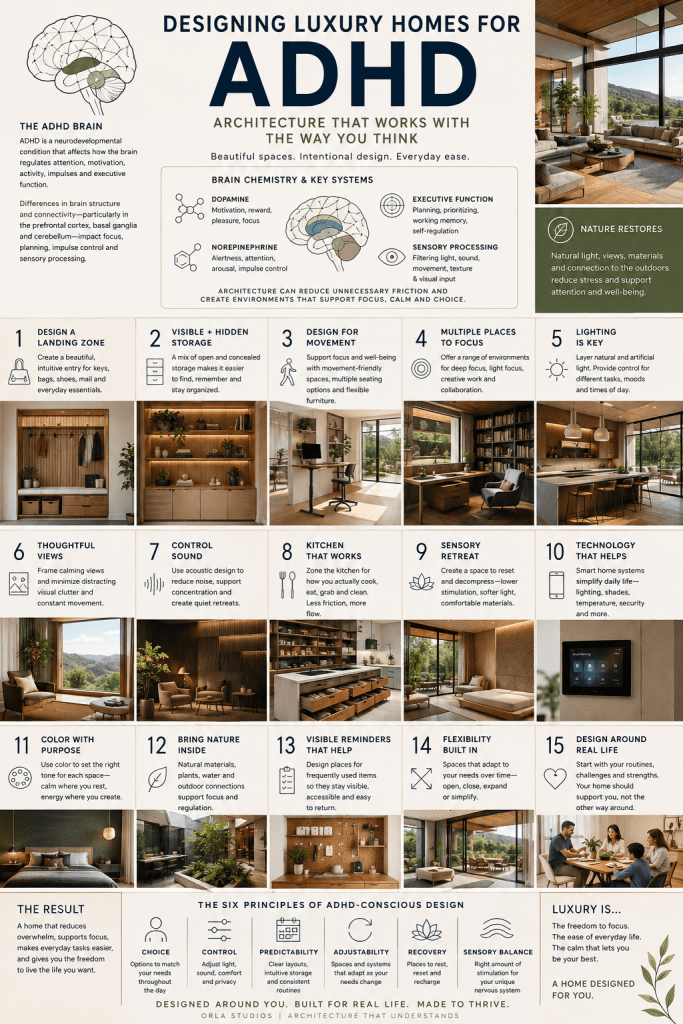
Understanding ADHD: The Brain Behind the Behavior
Before designing a home for someone with ADHD, it helps to understand that ADHD is not simply a matter of being distracted, disorganized, or unable to sit still.
ADHD is a neurodevelopmental condition that affects the way the brain regulates attention, motivation, activity, impulses, working memory, and executive functions.
And importantly, ADHD is not one single brain type. It is a highly variable neurological profile. Two people with ADHD can have completely different strengths, challenges, sensory preferences, and ways of interacting with their environment.
What Happens in the ADHD Brain?
Research using brain imaging and other neurological methods has identified differences associated with ADHD in several brain systems, including networks involved in executive function, attention, reward processing, motivation, emotional regulation, and movement.
Some studies have found differences in the development, structure, and connectivity of regions such as the prefrontal cortex, basal ganglia, cerebellum, and related brain networks. These areas are involved in planning, prioritizing, inhibiting impulses, maintaining attention, switching between tasks, and regulating behavior.
Neurotransmitters Matter Too
The differences are subtle and highly variable. ADHD is a different neurodevelopmental pattern.
Two neurotransmitter systems that receive particular attention in ADHD research are dopamine and norepinephrine.
These chemical messengers play important roles in attention, motivation, reward, alertness, and the ability to regulate behavior.
This helps explain one of the most misunderstood characteristics of ADHD:
Attention is not necessarily absent. It can be difficult to regulate.
A person with ADHD may struggle to focus on an uninteresting administrative task for 20 minutes, yet become intensely absorbed in a highly engaging architectural project, creative activity, conversation, hobby, or problem.
This is sometimes described as interest-based attention rather than simply a lack of attention.
The environment can therefore have a surprisingly important influence.
Executive Function and the Built Environment
Many of the everyday difficulties associated with ADHD involve executive functions—the mental processes that help us organize and regulate behavior.
These can include:
- Starting a task
- Prioritizing
- Sequencing steps
- Remembering intentions
- Managing time
- Switching between activities
- Controlling impulses
- Regulating attention
- Managing competing sensory information
- Completing tasks
Thoughtful architecture can reduce unnecessary cognitive demands.
This is where residential design becomes particularly interesting.
A house can either create hundreds of tiny decisions every day—or quietly eliminate many of them.
Where do the keys go?
Where does the mail go?
Where do shoes belong?
Where should unfinished projects live?
Where can someone work without interruption?
Where can they move while thinking?
Where can they retreat when the house becomes overwhelming?
Where are frequently used objects stored?
The more intuitive these relationships are, the less mental effort is required simply to navigate everyday life.
The ADHD Brain and Reward
Dopamine is often described in popular media as the “pleasure chemical,” but its role is considerably more complicated.
Dopamine is involved in motivation, learning, reward prediction, movement, and the process of determining what deserves our attention.
For some people with ADHD, tasks that are repetitive, delayed in reward, or insufficiently stimulating can be particularly difficult to initiate.
This is one reason novelty, challenge, urgency, interest, and immediate feedback can have such a powerful effect on attention.
Architecture can respond by creating environments that offer choice and variety without chaos.
A home might provide:
A quiet library for deep concentration.
A bright kitchen for active engagement.
A studio for creative work.
A terrace for walking and taking calls.
A cozy retreat for decompression.
The occupant can choose the environment that matches the task.
Why Sensory Input Matters
The brain is constantly filtering information.
Light.
Sound.
Movement.
Texture.
Temperature.
Visual objects.
People moving through a room.
Appliances running in the background.
For some people with ADHD, competing sensory information can make it harder to maintain focus or regulate attention.
This does not mean every person with ADHD is hypersensitive to sensory input. ADHD is highly individual, and some people actually seek additional stimulation.
That is why control is more important than uniformity.
Instead of designing every room to be quiet and visually minimal, an architect can create a range of environments:
Low stimulation → moderate stimulation → high stimulation
The occupant can then move between them according to what they need.
From Neuroscience to Architecture
This is where understanding ADHD becomes valuable for residential architecture.
The objective isn’t to make a home look “ADHD-friendly.”
It is to translate an understanding of attention, executive function, sensory processing, motivation, and individual behavior into architectural decisions.
That can mean:
Reducing unnecessary friction.
Making important things visible.
Creating intuitive storage.
Providing multiple places to work.
Allowing movement.
Controlling sound and light.
Creating opportunities for retreat.
Providing environmental choice.
Making technology work quietly in the background.
Designing spaces around real behavior rather than idealized behavior.
In other words, the architecture becomes a form of environmental support.
And that is where designing a home for someone with ADHD becomes much more than an exercise in aesthetics.
It becomes an opportunity to create a home that works with the way their brain naturally operates.